
The Ides of February 2027 and the Pluto Return of the Uranus Discovery
Herschel's sighting of Uranus in 1781, Tombaugh's find of Pluto in 1930 and the Ides of February 2027, recomputed on one engine, with a Pluto timeline to 2029 and the public record behind every date.

Ra Uru Hu’s phrase for the turn of the global cycle was the Ides of February, and the date the teaching attaches to it is 15 February 2027. The teaching is his, and the credit for it belongs to him and to Jovian Archive. This post is the other half of the job: the sky and the public record. I recomputed every position on this site’s own engine, checked every historical date against institutional sources, and say so where those sources disagree.
Two moments sit at either end of this story. On the evening of 13 March 1781, William Herschel saw a new planet. On 28 February 2027, Pluto returns to the exact degree it held while he looked. In between, Pluto was found, named, demoted and photographed up close, and it went once around the whole zodiac.
What the sky and the records show
- 14 February 2027, 21:05 UT. Pluto enters Line 5 of Gate 41. That is the line it occupied in 1781, and the line it holds in the last two of Ra’s four chart moments for the transition.
- 28 February 2027, 19:13 UT. Pluto first reaches the degree it held on the night Uranus was found: 6°09’ Aquarius.
- A triple pass. Pluto crosses that degree three times: 28 February 2027 (direct), 20 July 2027 (retrograde) and 7 January 2028 (direct). A return is a slow process, and the figure below shows it.
- 1930 is a different gate. When Tombaugh found Pluto, it stood in Gate 53, not Gate 41.
- Ra’s chart moments check out. The engine reproduces the type and profile this site’s source notes record for each of Ra’s four chart times, and the Moon runs through the gates those notes describe.
The dates at a glance
All times are UT. “Pluto” is its gate and line from the engine. The last column says whether a row comes from the public record or from my own computation.
| Date | What happened | Pluto | Basis |
|---|---|---|---|
| 13 Mar 1781, evening | Herschel sees Uranus from his garden in Bath | 41.5 | Royal Society, Royal Museums Greenwich |
| 18 Feb 1930 | Tombaugh identifies Pluto on Lowell Observatory plates, Flagstaff | 53.3 | Lowell Observatory collection |
| 13 Mar 1930 | Discovery announced | 53.3 | Planetary Society, Astronomy magazine |
| 5 Feb 1979 to 11 Feb 1999 | Pluto closer to the Sun than Neptune | n/a | computed, matches NASA fact sheet |
| 4 Sep 1989 | Pluto’s closest approach to the Sun, 29.66 AU | 44.6 | computed |
| 24 Aug 2006 | IAU in Prague classifies Pluto as a dwarf planet | 11.2 | IAU resolution |
| 14 Jul 2015 | New Horizons flyby | 38.5 | NASA |
| 12 Apr 2024 | First touch of Gate 41; Pluto turns back on 24 May | 41.1 | computed |
| 5 Dec 2025 | Pluto settles into Gate 41 | 41.1 | computed |
| 6 Feb 2027, 15:56 | New moon; annular solar eclipse, greatest 15:59 | 41.4 | computed, matches NASA |
| 14 Feb 2027, 21:05 | Pluto enters Line 5 | 41.5 | computed |
| 15 Feb 2027, 22:10 | The chart time Ra gives for the cycle change | 41.5 | Ra, via this site’s source notes |
| 20 Feb 2027, 23:13 and 23:24 | Penumbral lunar eclipse, then full moon | 41.5 | computed, matches NASA |
| 28 Feb 2027, 19:13 | Pluto reaches the 1781 degree (pass 1) | 41.5 | computed |
| 22 Mar 2027, 23:36 | Pluto enters Line 6 | 41.6 | computed |
| 8 May 2027 | Pluto turns retrograde at 7°10’ | 41.6 | computed |
| 20 Jul 2027, 23:05 | Second pass of the 1781 degree | 41.5 | computed |
| 18 Oct 2027 | Pluto turns direct at 4°44’ | 41.3 | computed |
| 7 Jan 2028, 08:13 | Third pass | 41.5 | computed |
| 2 Jan 2029 | Pluto leaves Gate 41 for Gate 19 for good | 19.1 | computed |
The Ides: what the word carries
The Roman calendar placed the Ides on the 15th of March, May, July and October and on the 13th of every other month, so the Ides of February was 13 February (Encyclopaedia Romana). Roman writers tied the Ides to the full moon of the older lunar months, though the surviving sources differ on the details. The festival of Lupercalia, a rite of purification and fertility, fell on 15 February (Britannica), and the month’s own name is traditionally traced to februa, the instruments of purification. Ra’s own account of the word is simpler. In Rave Cosmology IV, Lesson Three, he says he liked the drama of “the Ides”, took it to mean the 15th of a month, and used it in place of plain “15 February”. The Roman Ides of February was the 13th, so the word is his chosen label for the date and the calendar does not fix it.
What the February 2027 sky actually does around that date:
- 6 Feb: new moon at 15:56 UT, with an annular solar eclipse whose greatest point (15:59 UT) falls over the South Atlantic.
- 11 Feb: Jupiter at opposition.
- 14 Feb: first quarter moon at 07:59 UT.
- 19 Feb: Mars at opposition.
- 20 Feb: a penumbral lunar eclipse peaking at 23:13 UT, and the full moon eleven minutes later, at 23:24.
- 28 Feb: last quarter at 05:17 UT, about fourteen hours before Pluto’s first pass.
So 15 February falls on a waxing moon, one day after first quarter and five days before the full moon, which is the opposite of the old Ides rule. I read that as another sign the date belongs to the teaching and not to the lunar calendar.
Ra’s chart moments, recomputed
This site’s source notes list four chart moments Ra gives for the transition. I ran each through the engine as a check on those notes, and the results agree.
| Recording, as the notes cite it | Moment (UT) | Engine result | Pluto | Personality Moon | Design Moon |
|---|---|---|---|---|---|
| Rave History 2, version 1 | 14 Feb 2027, 18:45 | Projector 2/4 | 41.4 | 20.2 | 25.1 |
| Rave History 2, version 2 | 14 Feb 2027, 19:44 | Projector 2/4 | 41.4 | 20.3 | 25.2 |
| Rave History 3 | 15 Feb 2027, 09:00 | Projector 3/5 | 41.5 | 16.5 | 17.4 |
| Rave Cosmology IV | 15 Feb 2027, 22:10 | Manifestor 3/5 | 41.5 | 45.1 | 21.6 |
Three things stand out.
- Types and profiles match. The notes record a 2/4 Projector, a 3/5 Projector and a 3/5 Manifestor. The engine returns exactly those.
- The Moon runs the sequence the notes describe. The Personality Moon moves through Gates 20, 16 and 45. The Design Moon moves through 25, 17 and 21, passing 51 between the second and third moments. The four moments span 27 hours and 25 minutes.
- Pluto crosses a line between them. The first two moments catch Pluto in Line 4, a little short of the boundary. The last two catch it in Line 5. The crossing itself is at 21:05 UT on 14 February, between the second and third. I can compute that timing. What I cannot say is whether it was the reason Ra chose his moments, so I leave it as an observation.
Cast as a birth chart, the 22:10 UT moment carries the Right Angle Cross of Contagion, 30/29 | 14/8. Every moment has some cross, so I list it as an output and not as evidence.
One distinction from the source notes matters here. Ra identifies the marker of the global cycle change as precession entering Gate 55.6, and discusses Pluto in Lines 2 and 5 of Gate 41 as the lead-up that brings us to the doorway. Pluto is the lead-up and precession is the mechanism. This post is about the lead-up.
Why that date and that minute
Rave Cosmology IV (Semester IV), Lesson Three, is where Ra gives the chart. I read the lesson and checked what he says against the engine. Here is what it shows, in my own words.
What Ra says about the moment. He introduces the chart as a single moment to study the way he studied cycles, and he stresses that any moment is lived by the many people born into it. He calls it the Ides of February, gives the time as 22:10 GMT on the 15th (he says the time has to be spoken because the chart image does not show it), and tells students to watch the aspects of this chart play out as 2027 approaches. He points out the empty places where the Cross of Planning’s gates would sit: no 40, no 37, and 16 and 9 gone too. He ties the moment to precession entering Gate 55.6 and its opposite, Gate 59, and to the mutation starting from Gate 55. He also says that Pluto in lines 2 and 5 of Gate 41, which marks 1781, completes the cycle again at this Ides.
The engine reproduces every line he lists. I ran 22:10 UT on 15 February 2027 and compared it with the placements his lesson itemizes:
| Side | Ra’s placements | Engine at 22:10 UT |
|---|---|---|
| Personality | Sun 30.3, Earth 29.3, Nodes 49.2 and 4.2, Mars 59.3, Saturn 21.3, Uranus 20.2, Neptune 25.5, Pluto 41.5 | all match |
| Design | Sun 14.5, Earth 8.5, Nodes 30.1, Moon 21.6, Saturn 17.5, Pluto 41.2 | all match |
The whole set holds in one window only. I stepped through the surrounding days a minute at a time. Every placement above is true together from 21:43 to 23:21 UT on 15 February 2027, a window of 98 minutes, and at no other time that week. Ra’s 22:10 sits 27 minutes inside it. Each placement has its own span:
| Placement | True from | True until (UT) |
|---|---|---|
| Pluto in 41.5 (Personality) | 14 Feb, 21:05 | stays through March |
| Design Sun 14.5 and Design Earth 8.5 | 15 Feb, 04:24 | 16 Feb, 02:41 |
| Sun 30.3 and Earth 29.3 | 15 Feb, 07:22 | 16 Feb, 05:39 |
| Mars 59.3 | 14 Feb, 03:49 | 16 Feb, 13:22 |
| Design Moon 21.6 | 15 Feb, 21:43 | 15 Feb, 23:21 |
Three conclusions follow.
- The date comes from the Sun and Pluto together. The Sun is in line 3 of Gate 30 only on the 15th and into the early morning of the 16th, and Pluto is already in 41.5 from the evening of the 14th. So 15 February is the first date on which both stand where his chart needs them. The Sun in 30 and Pluto in 41 also complete the Channel of Recognition, and he spends time in the lesson on the 30 and 41 pairing.
- The time is fixed by the Design Moon. Of everything he cites, the Design Moon in 21.6 is the only placement that lasts under two hours, which is why the window is 98 minutes wide. He calls 21.6 the chaos line and pairs it with Saturn in 21.3.
- The 1781 link is a pairing of lines. Ra’s “complete cycle” is Pluto in 41.5 on the Personality side and 41.2 on the Design side. The engine gives that same pair for 13 March 1781 and again for the 2027 chart. The exact-degree return on 28 February, below, is a separate measurement that I added.
What Ra says about where the date came from. In Rave Cosmology V, Lesson Five, he says he was given an exact date for 2027, the Ides of February, and contrasts it with a future impact event for which he was given no exact date. He gives that lesson on a day he also calls the Ides of February, which he notes is twenty years before the change. In Rave Cosmology VII he repeats that the Cross of Planning is over at the Ides of February 2027. So in his own telling the date is a received date, and the lessons give no calculation for it.
What this does not establish. The sky fixes the date and narrows the time to 98 minutes. It does not say why Ra picked 22:10 inside that window. Across Semesters II, IV, V and VII and his lecture Emotionality in the Time of Mutation, the clock time appears once, in the Semester IV passage above, and none of those texts derives it. “Ten minutes past ten” reads like a rounded clock time within the window. Your site’s notes record a 22:10 time for the 1781 chart too, but these texts give no clock time for 1781.
The lesson also does not use the words Lahiri, ayanamsa or sidereal. The Lahiri method in the cycle-timing posts is therefore not from this book, and I could not reproduce Ra’s date from it (my rough check put that crossing about a year later).
13 March 1781: the record
William Herschel found Uranus from the garden of his house at 19 New King Street in Bath, now the Herschel Museum of Astronomy (Royal Museums Greenwich, St Andrews history of mathematics). He was working with his own reflecting telescope and sweeping the stars near H Geminorum. He described the object in a paper titled “Account of a Comet”, published in the Philosophical Transactions (volume 71) and read to the Royal Society on 26 April 1781, communicated by William Watson Jr. of Bath (Royal Society record, scan at the Internet Archive). He took it for a comet. Over the following months astronomers computing its orbit concluded it was a planet, far beyond Saturn.
The naming took longer. Herschel proposed Georgium Sidus, for King George III, and French astronomers called the planet Herschel. Johann Bode proposed Uranus, in 1782 or 1783 depending on the source, and that name won out over the following decades (Smithsonian, NASA). Flamsteed had in fact cataloged the same object as a star, 34 Tauri, in 1690. Uranus takes about 84 years to circle the Sun.
The clock time. Herschel’s own published account puts the sighting between ten and eleven in the evening, and one institutional account places it nearer midnight. I could not open the paper itself from here, so I treat the time as a window and not as a minute. That turns out not to matter for the chart. Bath’s local mean time ran about nine minutes behind UT, so 22:30 on a Bath clock is 22:39 UT. Between 20:00 and 24:00 UT that evening, only the Moon (in Gate 1, moving from Line 1 to Line 3) and Venus (which crosses into its next line near midnight) change. The Sun in Gate 36 Line 2 and Pluto in Gate 41 Line 5 do not move, and the chart is the same at 22:10 UT, the time this site’s source notes record for Ra, and at 22:30.
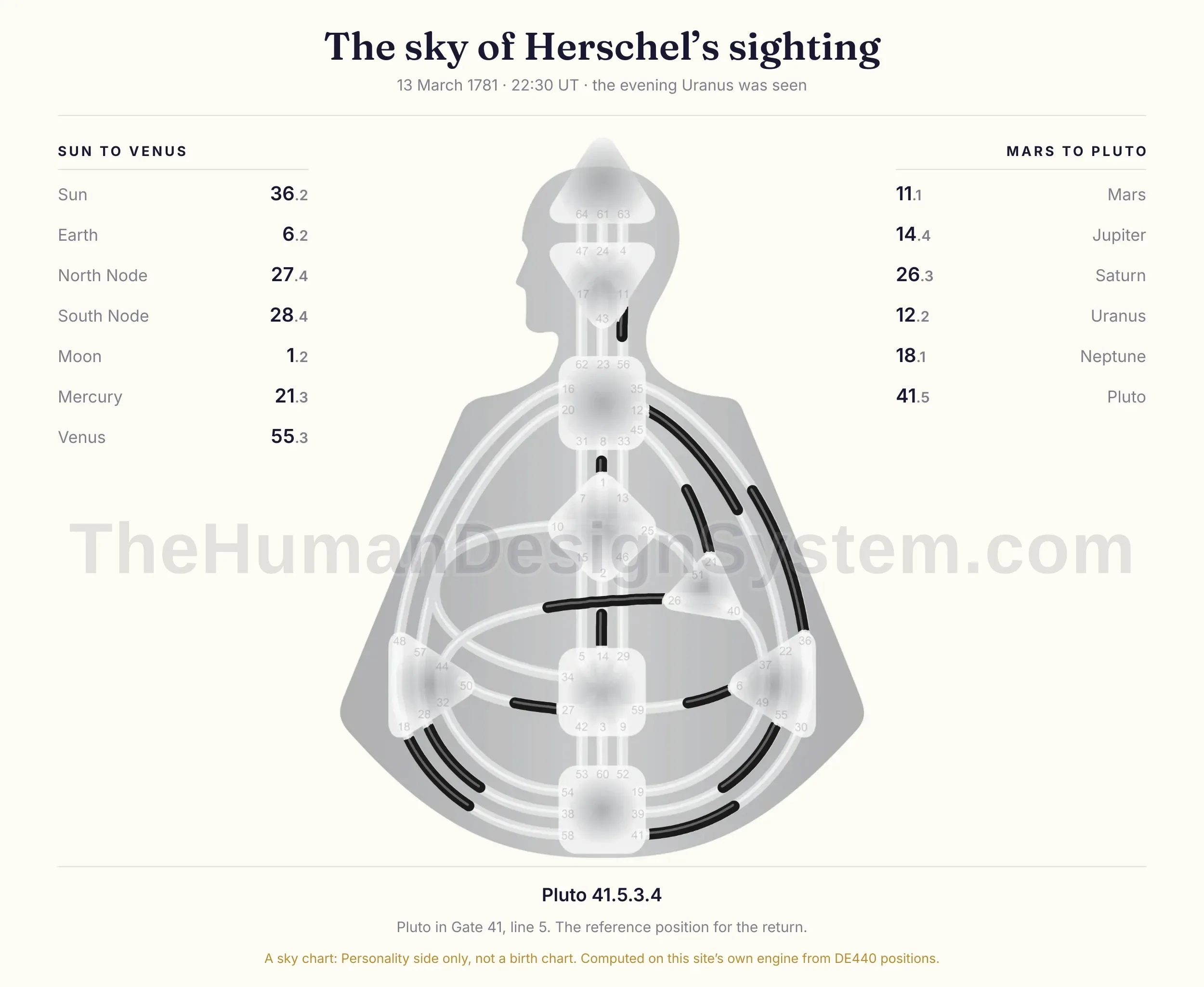
The sky at Herschel’s sighting. Personality side only: this is the sky at one moment, not a birth chart.
Uranus itself stood at 24°27’ Gemini, in Gate 12 Line 2. Pluto stood at 6°09’ Aquarius, in Gate 41 Line 5, color 3, tone 4. No channel is completed by the sky alone that evening. Cast as a birth chart the moment carries the Right Angle Cross of Eden, 36/6 | 11/12, an echo of the title of Ra’s The Dictate of the Dark Eden that I note and leave there.
1781 is also the year the system dates the mutation from seven centers to nine. If that is new to you, Transformation from 7 to 9 Centers and The Mechanics of Mutation set it out.
18 February 1930: Pluto is found
Percival Lowell searched for a ninth planet from 1905 until his death in 1916, reasoning from irregularities in the orbits of Uranus and Neptune. His observatory in Flagstaff, Arizona kept the search going. Observatory director Vesto Slipher hired a young observer named Clyde Tombaugh, who arrived in 1929 to run the systematic photographic survey (Planetary Society).
The method was to photograph the same patch of sky on different nights with a 13-inch astrograph and then flip between the two plates in a blink comparator, a device that makes anything that moved appear to jump. The plates that mattered were exposed on 23 and 29 January 1930, in the region near Delta Geminorum (a third plate, from 21 January, appears in the observatory’s own notes, and sources differ on its role). On 18 February 1930 Tombaugh recognized a moving image on that pair (Lowell Observatory collection, Linda Hall Library, Astronomy magazine). Slipher and his colleague Lampland confirmed it, and the observatory announced the discovery on 13 March 1930, the 149th anniversary of Herschel’s sighting and, by the sources’ account, Lowell’s birthday.
I checked the plate region against the engine. On 18 February 1930 Pluto stood about a quarter of a degree from Delta Geminorum, and about six tenths of a degree away on the two January plate dates, which fits a planet drifting slowly in that field. The astronomy and the record agree.
The clock time. Several accounts say Tombaugh made the identification at about four in the afternoon. I found no primary log that records the time, so I treat it as a widely repeated figure and not a measurement. The chart below uses about 16:00 Arizona time, 23:00 UT. Pluto’s gate and line hold across the whole day, so the choice only touches the Moon.
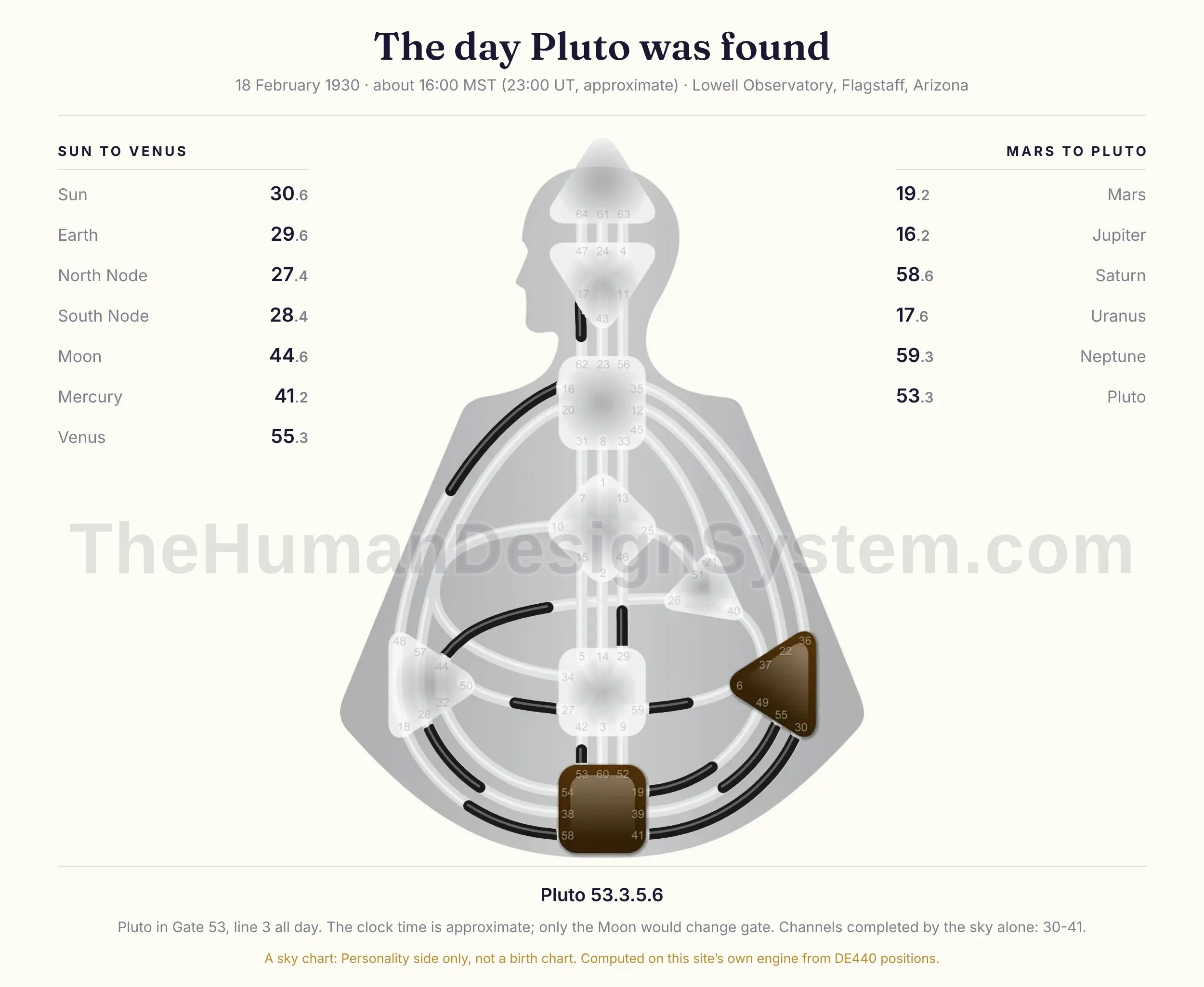
The day Pluto was found. Pluto sits in Gate 53, line 3, color 5, tone 6, at 17°45’ Cancer. The Sun in Gate 30 and Mercury in Gate 41 complete the Channel of Recognition that day.
The contrast with 1781 is the point. The planet was found while it stood in Gate 53, the Gate of Beginnings in the Root. In 1781 and again in 2027 it stands in Gate 41. For how the 1930 date sits inside Ra’s teaching, see the Pluto pattern from 1781 to 2026.
Naming and demotion. The name came from an 11-year-old in Oxford, Venetia Burney, who suggested Pluto at breakfast on 14 March 1930. Her grandfather Falconer Madan passed it to the astronomer H. H. Turner, who cabled it to Lowell Observatory, where the staff chose it from a short list that also held Minerva and Cronus (Smithsonian). Sources give 1 May and 24 May 1930 for the formal announcement of the name. On 24 August 2006, the International Astronomical Union meeting in Prague adopted a definition of a planet (Resolution 5A) and classified Pluto as a dwarf planet (Resolution 6A), because it has not cleared the neighborhood around its orbit (IAU resolutions). Pluto stood at 24°06’ Sagittarius that day, in Gate 11 Line 2. The Pluto pattern reads 2006 as the year of Ra’s Rave Cosmology recording on the Interregnum, which I cannot verify from public records and leave with that post.
The 246 years in between
Pluto’s orbital period is about 247.9 years (NASA fact sheet), and its orbit is stretched enough to change its speed a lot. From 13 March 1781 to 28 February 2027 is 245.96 years, a little short of the average, because Pluto moves fastest near its closest point to the Sun. By my calculation that point, perihelion, came on 4 September 1989 at 29.66 AU, and the far point, aphelion, comes in 2114 at about 49.3 AU. From 5 February 1979 to 11 February 1999 Pluto was closer to the Sun than Neptune is, a stretch NASA’s fact sheet also gives (it names the 1999 crossing at 11 February). The search results disagreed on the perihelion day, so treat my 4 September as a computed figure.
Between the two skies, Pluto went around the whole wheel once:
| Date | Event | Pluto (tropical longitude) | Gate.line |
|---|---|---|---|
| 13 Mar 1781 | Uranus found | 6°09’ Aquarius | 41.5 |
| 18 Feb 1930 | Pluto found | 17°45’ Cancer | 53.3 |
| 4 Sep 1989 | Perihelion | 12°54’ Scorpio | 44.6 |
| 24 Aug 2006 | Reclassified | 24°06’ Sagittarius | 11.2 |
| 14 Jul 2015 | New Horizons flyby | 14°04’ Capricorn | 38.5 |
| 15 Feb 2027, 22:10 | Ra’s chart time | 5°47’ Aquarius | 41.5 |
| 28 Feb 2027, 19:13 | First pass of the 1781 degree | 6°09’ Aquarius | 41.5 |
Pluto’s own page puts the usual tempo at around four years in a gate and eight months in a line. Gate 41 is a good case study for how loosely such averages hold, as the next section shows.
You can also hear that period. Pluto’s 247.9 years, doubled 41 times, is 281.05 hertz, close to the C sharp just above middle C. Pluto’s page rings it, and the Music of the Spheres gives every body in the chart its own bell. It is a way of turning a cycle into sound, and Pluto itself makes none. How a Planet’s Orbit Becomes a Bell shows the arithmetic.
Pluto’s passage through Gate 41
Pluto does not cross a gate boundary once and stay. Its retrograde loops carry it back and forth, so the passage is a set of touches that finally settle. For Gate 41 the sequence runs like this.
- 12 April 2024. Pluto first touches Gate 41 at 2°00’ Aquarius, then turns retrograde on 3 May and retreats on 24 May.
- 30 January 2025. It returns, passes into Line 2 on 3 March, turns retrograde on 5 May, and retreats on 20 August.
- 5 December 2025. It re-enters Gate 41 and stays.
- 8 January, 7 February and 12 March 2026. Pluto passes into Lines 2, 3 and 4. It turns retrograde on about 6 May at 5°30’, drops back through Lines 3 and 2, and turns direct on 16 October at 3°04’.
- 16 January 2027. Pluto re-enters Line 4.
- 14 February 2027, 21:05 UT. Pluto enters Line 5, at 5°45’00“ Aquarius.
- 22 March 2027, 23:36 UT. Pluto enters Line 6.
- 8 May 2027. Pluto turns retrograde at 7°10’41“ Aquarius, short of the Gate 19 boundary at 7°37.5’.
- 26 June to 18 October 2027. It slides back through Lines 5, 4 and 3, then turns direct at 4°44’.
- 24 December 2027 and 25 January 2028. It returns to Lines 5 and 6.
- 24 February 2028. Pluto touches Gate 19 for the first time, then turns retrograde on 9 May at 8°49’ and falls back into Gate 41 on 30 July.
- 2 January 2029. Pluto leaves for Gate 19 and does not come back.
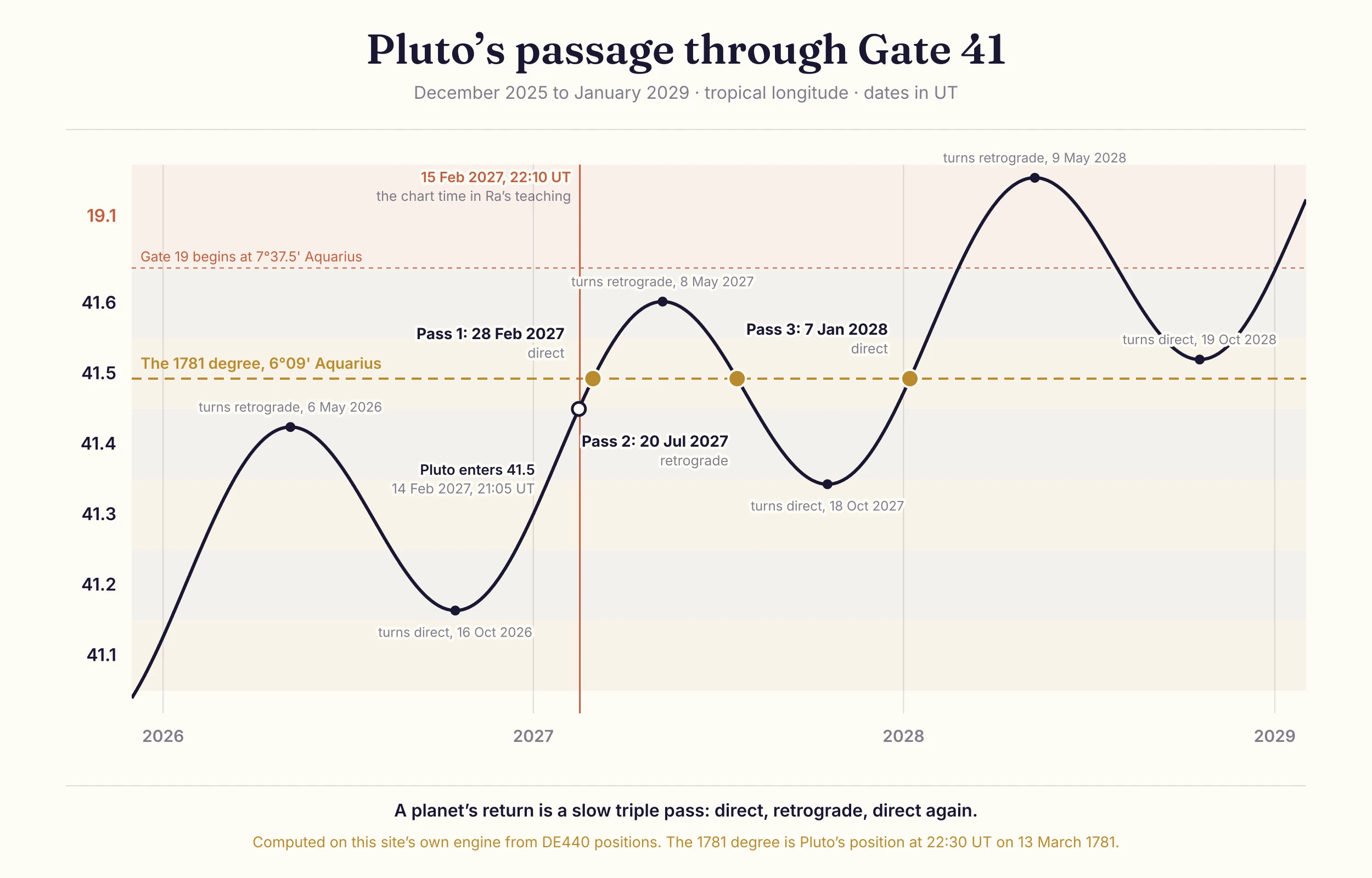
Pluto’s path through Gate 41, from this site’s engine. The gold line is the 1781 degree. The three gold dots are its three passes.
The figure explains why the Ides question and the Pluto-return question have different answers. Ra’s date, 15 February, sits one day after Pluto enters Line 5. The exact return, 28 February, sits two weeks later on the same upswing. Neither date is the last word, because the planet crosses that degree twice more before 2028 is out.
The return, measured
Ra defines the cycle as complete when Pluto’s Personality and Design lines repeat (41.5 and 41.2), and that holds from 14 February 2027. What follows is a different, stricter test that I added: the exact degree. The 1781 position needs a clock time, so I computed the three passes for two readings of Herschel’s evening.
| Reading of the 1781 clock | 1781 longitude | Pass 1 (direct) | Pass 2 (retrograde) | Pass 3 (direct) |
|---|---|---|---|---|
| 22:30 UT | 6°09’08.8“ Aquarius | 28 Feb 2027, 19:13 | 20 Jul 2027, 23:05 | 7 Jan 2028, 08:13 |
| 22:30 Bath local time (22:39 UT) | 6°09’09.3“ Aquarius | 28 Feb 2027, 19:21 | 20 Jul 2027, 22:55 | 7 Jan 2028, 08:20 |
Pluto moves about four arcseconds an hour, so Herschel’s hour-wide window of ten to eleven moves the 1781 position by about four arcseconds. That shifts each pass by roughly half an hour either side. The engine’s own error for Pluto is far smaller, about a hundredth of an arcsecond against the Swiss Ephemeris in its accuracy tests. The uncertainty is in the 1781 clock and not in the astronomy.
Three limits keep the claim honest:
- A degree is a degree. The match is exact in tropical longitude, which is what the bodygraph uses. It is not a claim about Pluto’s whole position.
- The positions are geocentric. A return measured from the Sun would fall on a different day, because Pluto’s orbit is not a clock and the Earth sits in a different place in its own orbit in late February than in mid March.
- Triple passes are normal. Every slow planet returns to a degree in a direct, retrograde and direct sequence. The date that gets quoted is the first pass.
What the teaching does with this
The Plutonic Interregnum is Ra’s name for the stretch of history between the 1781 mutation and the global cycle change in 2027. The Plutonic Interregnum covers what he says loosens along the way, and The Cross of Planning’s Dying Legacy covers the cycle that ends. Gate 41 is the initiating gate, the one where a new experience starts, and Pluto’s position there is the reason it is the instrument to watch. The cycle change itself, in the teaching, is the Cross of Planning giving way to the Cross of the Sleeping Phoenix, a boundary roughly four centuries wide (the 2027 hub has the structure and Locks and Keys the mechanics).
The sky data here adds timing to a teaching that was already specific about the date. It does not add proof. The mutation, the cycle and the meaning of any gate belong to the teaching, and the arithmetic belongs to the sky.
For your own chart
Nothing in this post changes the mechanics you were born with. Your Strategy and Authority are the equipment you experiment with in any cycle, and the cycle is the background they run against. If you want to see where Pluto sits in your own design, your free chart shows it, and Gate 41 and Gate 53 have their own pages.
If you keep a log during 2027, these are the dates worth writing down: 6 February (new moon and eclipse), 14 February (Pluto into Line 5), 15 February (Ra’s chart time), 20 February (full moon and eclipse), 28 February (first pass), 20 July (second pass) and 7 January 2028 (third pass). The dates are checkable and the interpretation is yours to test.
Sources and method
Ra’s lessons. Rave Cosmology IV: The Nature and Mechanics of the Rave (2027), Lesson Three, pages 35 to 48; Rave Cosmology V, Lesson Five; Rave Cosmology VII; and Emotionality in the Time of Mutation, all Jovian Archive. I paraphrase it and quote nothing at length.
Sky positions. Every position and date marked “computed” comes from this site’s engine, which reads tables fitted to NASA JPL’s DE440 ephemeris for 1700 to 2199 (see how charts are calculated). Moon phases and eclipses come from the same libraries and match the published times: NASA eclipse tables, US Naval Observatory moon phases.
Public records. Herschel and Uranus: Royal Museums Greenwich, NASA, the Royal Society, the Smithsonian, and the Herschel Museum via the University of St Andrews. Pluto’s discovery and naming: the Lowell Observatory collection, the Planetary Society, the Linda Hall Library, Astronomy magazine and the Smithsonian. The 2006 reclassification: the IAU resolutions text. Pluto’s orbit: NASA’s Pluto fact sheet. The Roman calendar: Encyclopaedia Romana and Britannica.
Where records disagree or are silent. Herschel’s clock time; why Ra chose 22:10 within the 98-minute window; the role of the 21 January 1930 plate; the clock time of Tombaugh’s identification; the date Bode first proposed Uranus; and the exact day the name Pluto was formally announced. Each is stated above as a range or marked as unresolved.
From my courses
 Black Friday through November 30 Human Design Cosmology Sampler Hear all seven volumes of Ra Uru Hu’s cosmology and find the one that pulls at you. $297 through November 30, then $497$497 See the course
 Black Friday through November 30 Fundamentals Sampler Three full classes on your Authority, your Type and your SubType. Yours to keep. $197 through November 30, then $297$297 See the course
 Black Friday through November 30 Analyst Training Sampler Sit in on a full class from every level of Professional Analyst Training. $297 through November 30, then $497$497 See the course
 Black Friday through November 30 Health & Wellness Sampler Ten health courses, one module each, read through your own design. $397 through November 30, then $597$597 See the course
 Black Friday through November 30 Best Rest by Design A whole course on sleeping by your design, built around your own chart. $297 through November 30, then $497$497 See the course
 Self-paced course Relationship Mastery How you love, connect and get along, by design. $697 See the course
 Self-paced course The Four Variable Transformations Determination, Environment, Perspective and Motivation, as four guided experiments. $850 See the course
 Where to begin Living Your Design Awakening The first class in the Human Design education, with the community around it. $350 See the course
 Foundations Human Design Cartography The second level of Human Design education, and the way into all advanced study. $850 See the course
 Professional training Human Design Analyst Training Level 1 (PTL1), Full Year A year on the 64 gates, the 384 lines and the art of a full chart reading. $3,450 See the course
See this in your own chart
Generate your free bodygraph and start your own experiment.
Get My Free HD Chart