
Deconditioning: the experiment at the center of Human Design
Deconditioning is the ongoing experiment of living with your Strategy and Authority while recognizing conditioned patterns you have taken to be yourself. Human Design teaches a seven-year cycle for this process. It gives the experiment a long horizon, without giving every person the same milestones or a guaranteed outcome.
Teaching by LaVeena B. Archers, PhD, Education Director of Jovian Archive and IHDS Independent Teacher. Updated October 20, 2026.
This overview helps you find a starting point and the next page to study. For a fuller discussion of individual pacing, conditioned pressure, and the seven-year teaching, read Human Design Deconditioning: The 7-Year Experiment.
Begin with your own chart. Find your Type, Strategy, and Authority, then use the guides to understand what those results mean. You can start with the free resources.
What conditioning is
Human Design describes conditioning through contact with other people and the changing planetary field. In my introductory teaching, I use the chart's definition and openness to distinguish what is consistent from areas of changing experience.
Conditioning is also learning. The differences you encounter can be nourishing and become material for wisdom. The question is whether the mind identifies with an influence and insists that you must become it, keep it, or prove it. You can learn from another person's qualities without needing their design to become yours.
Deconditioning gives you a way to explore that relationship through your own Strategy and Authority. It does not require eliminating everyone who differs from you or treating ordinary outside influence as a failure.
Definition, openness, and learning
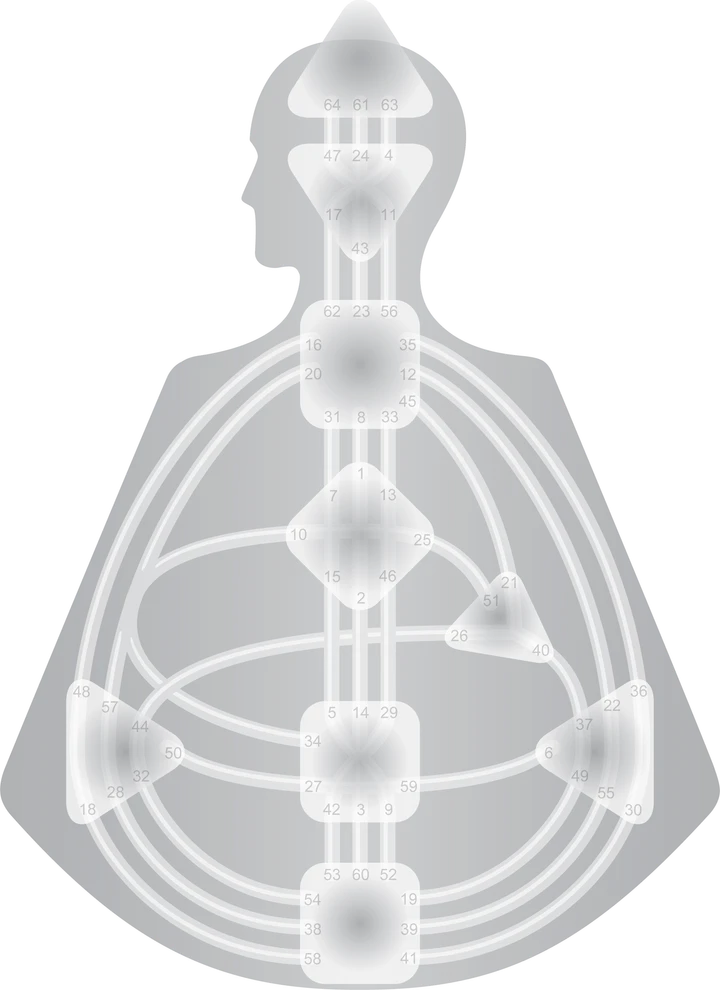



The BodyGraph has nine centers. Complete natal channels define their connected centers, shown filled in. An undefined center is unfilled and can still contain activated gates. A completely open center has no gate activations.
In my teaching, openness is an area of varied experience and potential wisdom. It is not a missing part of you. These familiar undefined-center themes can help you find the relevant center page and begin observing. They do not diagnose every reason you feel pressure, seek certainty, or want recognition. Completely open centers have distinctions that deserve study within the whole chart.
| Center | A theme to explore when undefined |
|---|---|
| Head | Feeling pressure to think about questions that do not matter to you. |
| Ajna | Pretending to certainty, holding fixed opinions to feel solid. |
| Throat | Speaking to be noticed, acting to attract attention. |
| G | Searching for love, direction, or a fixed sense of identity. |
| Heart | Proving worth, making promises to establish value. |
| Solar Plexus | Avoiding truth and confrontation to keep the peace. |
| Sacral | Not recognizing when enough is enough. |
| Spleen | Holding on to what is not good for you out of fear of letting go. |
| Root | Hurrying to be free of a pressure that only renews itself. |
A changing experience does not fill in a new permanent natal center. A transit or connection chart can show additional activations in a comparison layer. For corrected birth data and other apparent changes, read Can Your Human Design Chart Change?
What the seven years refers to
I teach the seven-year cycle as part of Human Design's framework for a sustained experiment. In professional-training discussions, I emphasize lived experience alongside knowledge. Repeating the terminology is different from having worked with it in your own life.
Here, seven years names the cycle taught in the system. It is not a measured biological deadline, a promise of a particular result, or a requirement to wait before paying attention to your experience. A chart does not measure how far along you are.
The article's seven-year discussion explores this long horizon in more detail, including why it should not become a countdown or a comparison with another student.
Strategy and Authority
Type and Strategy describe how you engage with life within the teaching. Authority describes the decision process read from your chart. Learn them together, rather than applying a Type description without its Authority context.
- Generators and Manifesting Generators: wait to respond.
- Projectors: wait for recognition and invitation in the areas where that Strategy applies.
- Manifestors: inform before acting.
- Reflectors: work with a full lunar cycle.
Authority differs within a Type. An emotional Generator and a sacral Generator share a Strategy, with different Authority processes. The Authority library explains emotional, sacral, splenic, ego, self-projected, mental, and lunar distinctions. A mental or sounding-board process does not mean that another person decides for you.
In my teaching on accelerating deconditioning, I begin with applying Strategy and Authority and releasing attachment to results. The mind can learn, observe, reflect, and share perspective. You do not need to stop thinking in order to begin the experiment.
Observing without a timetable
In student conversations, I take pressure off the demand for immediate transformation. Each person has a process that takes time. My descriptions of greater relaxation and less struggle offer something to explore, rather than a schedule everyone must meet.
You might notice a familiar pressure before you understand how you respond to it. You might revisit an interpretation after more experience. Neither an unsettled period nor a settled one establishes a specific stage. A difficult period is not proof that the experiment is working, and lack of a noticeable change is not proof that you have done something wrong.
If it helps, make a short note of a situation: what happened, what pressure you noticed, what you understood of your process, and what you learned afterward. This is an optional aid to observation, not a score or a required exercise.
Working with not-self themes
Human Design uses the not-self to describe conditioned patterns directing life. Type themes include frustration for Generators, frustration and anger for Manifesting Generators, anger for Manifestors, bitterness for Projectors, and disappointment for Reflectors. The Type pages explain them alongside each Type's Strategy and signature.
These themes can prompt reflection within the teaching. A feeling alone cannot establish the cause of an experience or prove that a particular decision was wrong. You do not need to turn every frustration into an accusation against yourself, and you do not need to produce constant satisfaction, peace, success, or surprise to demonstrate progress.
Knowledge and lived experience
Learning the language helps you read a chart. Experimenting gives you experiences to bring back to that learning. In my training discussions, I emphasize both practice and knowledge, with room for people to describe what they discover in their own words.
When considering a teacher, ask how they help you understand your own Strategy and Authority, make room for questions, and distinguish chart information from promises. The teacher-selection guide and source and education guide offer further context.
Questions to return to
- What birth evidence am I using? Keep an estimate or rectified time identified as such. The birth-time guide helps you investigate uncertainty.
- Do I understand both Strategy and Authority? Return to the relevant pages and ask specific questions about what you find unclear.
- What am I actually observing? Separate the chart output, an interpretation, and your experience. The calculation guide explains the tool's limits.
- Am I trying to match someone else's results? Return to your own experience rather than a promised timeline.
These are useful checks, not a diagnosis of why an experiment feels stalled. A reading may clarify the chart or the teaching; it cannot guarantee an explanation for every experience or a particular result.
How to begin
- Generate your chart. Use the best birth details available in the free chart calculator, retaining any uncertainty.
- Learn the diagram. Use How to Read Your Human Design Chart to find your results and distinguish activations from complete channels.
- Study your starting point. Read your Type, Strategy, and Authority pages and bring what you learn into observation of daily life.
- Continue with the article. The deconditioning article expands on conditioned pressure, pacing, and the role of the mind.
If you want help understanding your chart, a Foundational Analysis or foundational Living Your Design education provides a setting for questions. Professional training has separate requirements; your personal experiment alone does not establish a qualification to guide others.
Ra Uru Hu on this, in his own voice
7 recordings through SoundCloud and 6 videos through YouTube, from the Jovian Archive. Nothing loads from SoundCloud or YouTube until you press play.
Video
- Never Mind YouTube
- Deconditioning YouTube
- Mind YouTube
- No Fault YouTube
- Behind Your Back YouTube
- Self-Hatred YouTube
Audio
- Signposts SoundCloud
- Bypassing the Decision-Making Mind SoundCloud
- Aloneness SoundCloud
- Awareness Watches Intelligence SoundCloud
- Who Are You? SoundCloud
- We’re Not Here to Conform SoundCloud
- Liberation Through Form: The Mechanics of Being Yourself SoundCloud