The Royal Family Penta: A Human Design Family Analysis
Elizabeth II, Philip, Charles, and Anne shared one household for seventy years. Read as a family Penta rather than a firm, their four charts hold two seats and leave four empty, and the empty ones name the family's most public problems.

A Penta is the only form in this system that nobody carries alone. Every other design we study is a self-enclosed aura. The Penta is not. It is a trans-auric form, an aura made out of other auras, and it comes into existence the moment three to five people are physically in a room together. It has a design of its own, running from the Sacral through the G Center to the Throat, and while it exists, it dominates.
That is why the household you grew up in feels the way it does when you go back to visit as an adult. The full range of who you have become does not exist in that room. It cannot. The Penta is deeply restrictive by function, because its job is to create harmony in a small grouping and give that grouping one shared direction. As I tell students every time this lands badly: it is not the fault of your parents. It is what a Penta does.
Now take the most photographed household of the twentieth century and read it that way.
The same four charts, a different set of questions
I have already looked at Elizabeth II, Prince Philip, Charles, and Anne as a working team on my business site, in The Firm’s Own Penta. That piece asks what the four of them can and cannot do as a business: who plans, who sells, who keeps the books. This one asks the family question instead, which is a genuinely different question with genuinely different keynotes, even though the mechanics underneath are identical.
Human Design uses the Penta in exactly two ways. It is the foundation of family analysis, and it is the foundation of small business analysis. Same laws, same twelve seats. What changes is the keynoting. In business the twelve seats read as administration, planning, public relations, implementation, oversight, accounting, reliability, culture, vision, capacity, coordination, and commitment. In family analysis the same twelve read as discipline and the future, demonstration and the present, tradition and the past, inner flow and home, material and demands, discovery and the world.
Notice that the left, middle, and right columns keep their meaning across both sets. Left is the future, the logical, forward pressure of a group. The middle is the present, the energy of the moment. The right is the past, the abstract side, the keeping of the record. That is true of a company and it is true of a kitchen table.
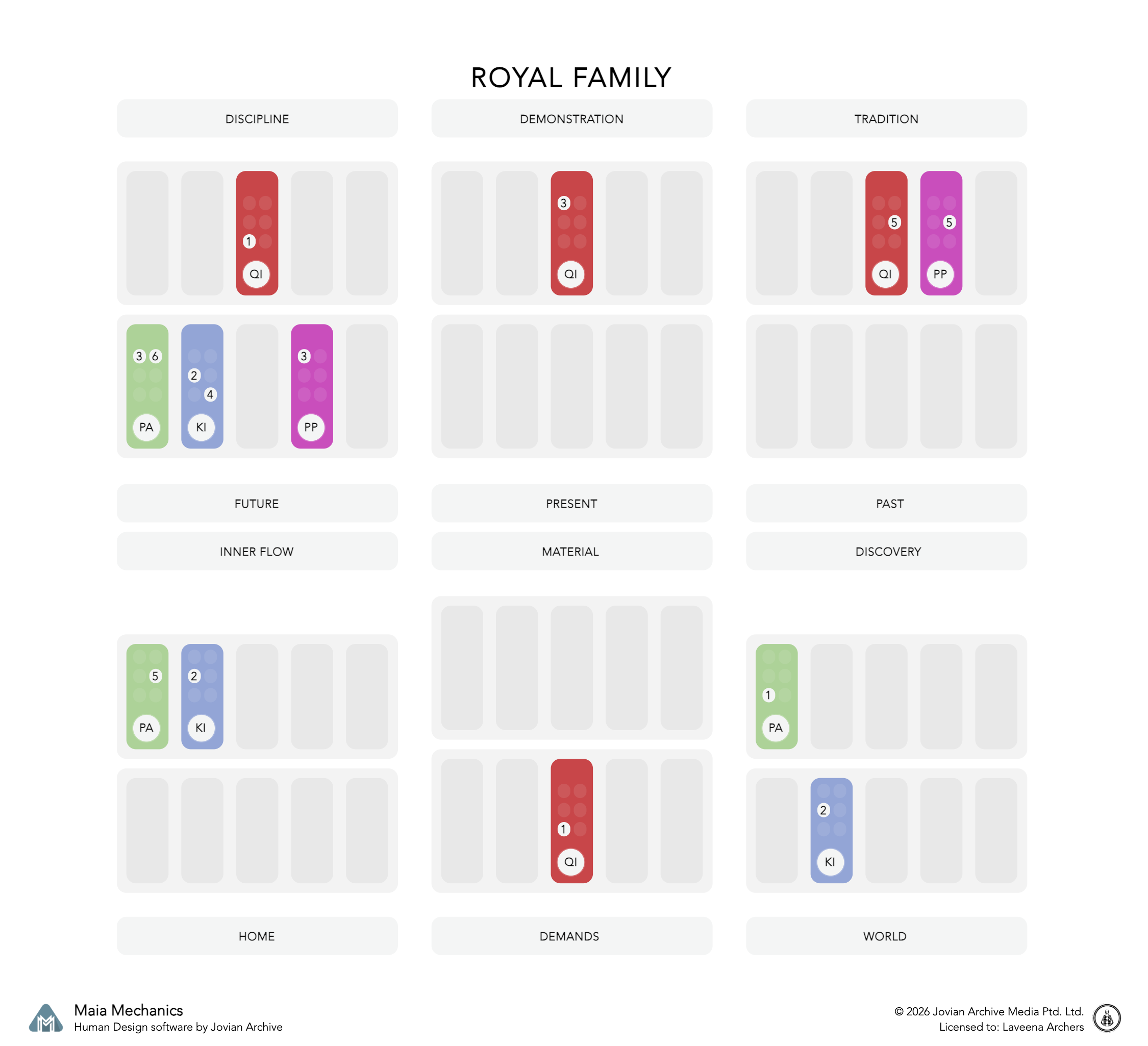
The four of them as a family Penta, calculated with Maia Mechanics. QI is
Queen Elizabeth II, PP is Prince Philip, KI is King Charles III, PA is Princess
Anne.
Two seats held, four seats empty
Read the graphic column by column and the household resolves fast.
Discipline is gate 31, and Elizabeth is the only person in the family who carries it. The future is gate 7, and Philip, Charles, and Anne all carry it, twice over in Anne’s case. So 31-7, the family’s leadership and direction channel, completes only when the Queen is in the room, and it completes with every single other member individually. One irreplaceable seat, three interchangeable counterparts.
Discovery and the world, 46-29, is the other completed channel. Anne carries gate 46, Charles carries gate 29. This is the aura stabilizer, the thing that homogenizes a group into one body and keeps it committed to itself. In the family keynoting it is the family’s capacity to go out and have experiences in the world and come back still being one family. It completes between the two children rather than between the parents.
Then the empty seats. Nobody carries gate 5, so home is vacant while Anne and Charles both hold gate 15, the inner flow. Nobody carries gate 1, so the present is vacant while Elizabeth holds gate 8, demonstration. Nobody carries gate 13, so the past is vacant while Elizabeth and Philip both hold gate 33, tradition. And nobody carries gate 2, so material is vacant while Elizabeth holds gate 14, the demands.
Four gaps. It takes exactly one gap to make a Penta dysfunctional, and the teaching on what a gap does is unambiguous: wherever the gap is, that is where all the attention goes, that is where the family overcompensates, and that is where they blame each other rather than the pattern. The mind wants a culprit. The mechanics only ever show a vacancy.
Tradition without the past
This is the one I would open a family reading with. Gate 33 is the family’s memory: the stories told and retold, the photographs, the films, the oral tradition, everything the family knows about itself and repeats. Elizabeth and Philip both carried it, which makes it the most heavily reinforced function in the household. Gate 13, sitting opposite, is the listener to secrets. It is the only seat in the entire Penta that looks back and tallies what actually happened rather than what the family says happened.
A household with a doubled 33 and no 13 will produce an enormous, immaculate, endlessly rehearsed official record and will have no internal mechanism at all for surfacing what is under it. The stories get told beautifully. The secrets stay secret until something outside the family opens them, at which point the family is genuinely surprised, because nobody in the room was ever built to have known. Set that against a century of royal biography and the pattern is not subtle.
A home with no rhythm of its own
Gate 5 is order and pattern, the fixed rhythm a household runs on. Without it there is no set pattern, and the family does not generate one from inside itself. Gate 15, which both children carry, is the magnetic field that draws people into a rhythm, but a magnet with nothing to be magnetized to is just pull with no shape.
The royal answer to this is the most literal prosthetic in the whole analysis. The rhythm this family could not generate was supplied from outside by an institution: Balmoral in late summer, Sandringham at Christmas, the same procession on the same date for centuries. That is not a family habit. It is a court calendar standing in for a missing gate.
And now the question I actually asked, out loud, in my very first analysis with my own BG5 analyst, long before there was a BG5 Institute: what if I have my dog? Does the dog count? Can the dog fill the gap? The answer was no. The reason: the dog will not do the work. A mammal in a household with a vacant 5 can soften the room and give it something to organize the day around. It cannot hold the seat. The most famous corgis in the world were not a solution to that gap. They were company inside it.
Demonstration with nothing to demonstrate
Gate 8 is readiness to demonstrate, and Elizabeth held it. Gate 1 is the model itself, the family’s own unique variation on the standard, and nobody in this household held it. That combination is a specific and uncomfortable mechanic: a family driven to display itself, with no internally generated original to display.
What fills that vacancy is imitation. A Penta without gate 1 tries to establish its uniqueness by copying, which is why the absence tends to show up as keeping-up-appearances behavior rather than as any obvious silence. It also tends to show up as continuity of dysfunction, the family repeating the exact pattern of the generation before it while sincerely believing it has chosen differently, because there is nothing in the room generating a new model to choose.
Demands without material vision
Gate 14 is the generative engine, the demand to work and the capacity to obtain resources. Elizabeth carried it. Gate 2 is the material seat, which at the individual level reads as direction but inside a Penta reads as vision, the long-term picture of what this could become. Nobody carried it.
The rule for that configuration is blunt and it does not care how much money is involved: a family with the 14 and no 2 is a family where everybody works extremely hard and cannot get ahead. Work energy with no vision to aim it at becomes work for its own sake. The wealth of the institution is not the point here. The Penta describes what four specific people generate between them, and what these four generated was a demand to work that ran through the sovereign herself, aimed at a vision seat that nobody in the room was holding.
Four is stable, and that is the trap
Group size is its own mechanic, separate from the gates. Three is compromise tension. Five is hierarchical tension, the configuration that always wants to split and reproduce itself. Four is office stability, and I use the dining chair image with students because it is exact: four legs, much harder to tip than three.
Four is what small groups fight to reach. It is also, and this is the part that gets skipped, a danger to be aware of. When a four has a gap, the stability itself becomes the problem. Everybody holds on and goes down with the ship, because the ship feels secure. Nobody wants to leave their little four.
Seventy years of the same four seats, in the same houses, on the same annual calendar, with four vacancies nobody in the room could fill, is that mechanic running at full scale and in public. The people who eventually left this structure did not leave a four that was failing. They left a four that was extremely comfortable and would not change shape.
What this actually means for your family
The last rule I would put on the table is the one that makes all of the above bearable: you cannot truly know who someone is until you are standing alone with them. Everything the Penta shows you is what these four people did to each other in the merged aura. It is not who any of them was. That distinction is the entire reason family analysis is worth doing, and it applies with unusual force to a family almost nobody ever saw standing alone.
So, practically. Work out which of the six family functions your own household actually leaves vacant before you assign any more blame, because the argument your family keeps having is almost certainly parked on top of a vacancy rather than on top of a person. Ask whether the rhythm your home runs on is genuinely yours or borrowed from an employer, a school calendar, or a church. Notice whether your family tells its stories well and still cannot say the true thing, which is a doubled 33 with a missing 13 and not a character flaw. And if your household is a stable four, enjoy it, and stay honest about whether the stability is holding something together or holding something in place.
Find your own type and authority with our free Human Design chart, and if you want your household read as one structure rather than four separate charts, that is the work we do in a personal reading.
See this in your own chart
Generate your free bodygraph and start your own experiment.
Get My Free HD Chart