
The Six Lines in Human Design: The Complete Guide to Line Values
The six lines from Investigator to Role Model: the keynotes, the trigrams, the harmonics, your two profile lines, the daily transit line, and the line eras behind 2027.

Ask most people what they know about their Human Design and they can name their Type and maybe their profile. The profile is two lines. But you carry 26 activations, and every one of them lands on a line. The transit field that conditions all of us runs on a line that changes about once a day. Even the 400-year global cycles are phased by line. The line is the smallest working unit of meaning in this system, and once you can read six of them, you can read them everywhere they appear.
Where a line comes from
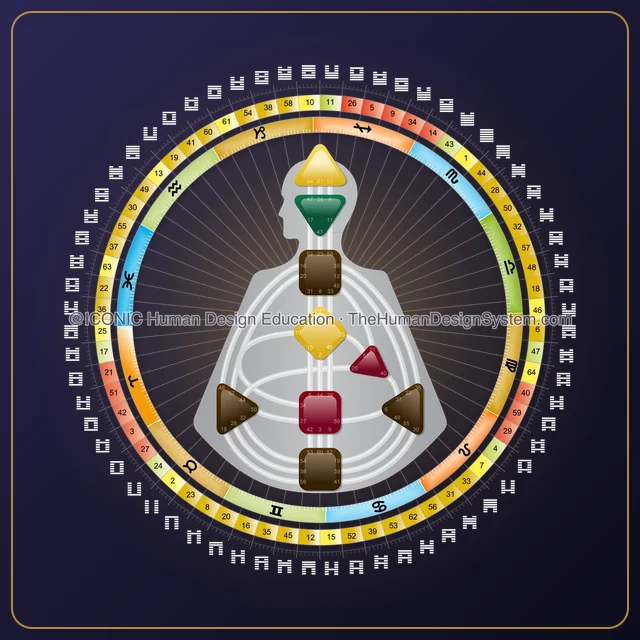
The bodygraph is calculated from the Rave Mandala, the wheel where the 64 gates sit against the zodiac. Each gate is a hexagram of the I Ching, and each hexagram is built from six lines, stacked from the bottom up: line 1 at the base, line 6 at the top. A gate spans about five and a half degrees of the wheel, so each line occupies a little under one degree. When a planet activates a gate in your chart, it activates it in one specific line, which is why chart notation reads like 26.4 or 55.6: gate first, line second.
The gate names the theme. The line says how that theme behaves. Two people can both carry Gate 51 and live it as two different lives, because one holds the first line and the other the fifth. That is the practical reason to learn the lines: they are what makes two charts with the same gates read as two different people. And beneath the line the mechanics keep going, into Color, Tone, and Base, which is the substructure.
Two trigrams, one house
The six lines divide into two trigrams, and the split does a lot of work. Lines 1, 2, and 3 are the lower trigram: personal, interior, looking inward and downward. This is the research and development department of the hexagram, the lines that work on the theme itself. Lines 4, 5, and 6 are the upper trigram: transpersonal, oriented to other people, here to get the word out. Ra called the upper trigram the propaganda of the hexagram, and he meant it mechanically: whatever the lower trigram develops, the upper trigram carries to the world.
Two lines sit on thresholds. The third line is the transition between the trigrams, which is part of why its life is so kinetic. The sixth line is the transition out of the hexagram altogether, already leaning toward the next story, which is why it spends so much of its life watching rather than participating. When I teach the lines I hang all six of them on a house, from the foundation to the roof, and the keynotes stop needing to be memorized because you can see where everyone lives.
The six lines, one by one
Line 1, the Investigator
The first line sits at the foundation, and it investigates because it is insecure. That is the engine, and there is nothing wrong with it: finding a secure foundation is the whole point of oneness. A first line that studies its subject until the ground stops moving becomes the authority the rest of the hexagram stands on, the expert everyone else leans on. Until the foundation is in, a first line under pressure feels the wobble through the whole structure above it, so it cancels, delays, and goes back to the books. Let it; preparation is what the line is for.
Line 2, the Hermit
The second line is the natural. It does what it does without being able to explain how, which is the exact opposite of the studied authority of the one. Second lines project their talent outward without knowing they are doing it, so other people can see a gift the hermit cannot see in itself. Left alone, the two stays absorbed in its own thing, and that is healthy, because this line runs on the call: it gets called out into the world for the talent it never advertised. The callers are usually the fives, the line built for calling people out. A second line does not need to force a process. It does what comes naturally until the right call names something it recognizes.
Line 3, the Martyr
The third line is the resilient one, and I will keep saying so, because pop Human Design keeps writing it up as the bruised line that life happens to. The third line learns by collision: trial, error, adaptation, discovery. It is here to find out what does not work and to say so, and that is where the martyr name comes from: it takes the hit, then teaches the truth about the lie. The world hands all of us promises of perfection and illusions of truth, and the third line is the one that tests those promises and breaks its bond with whatever fails the test. Its life looks untidy from the outside because the value is in the misses. Mistakes do not ruin third lines; mistakes build them, and what the trial and error is for deserves its own reading.
Line 4, the Opportunist
The fourth line moves upstairs into the transpersonal trigram, and it is fixed where the three is adaptive. Picture the three running around on a wobbly ladder while the four stands on solid ground. The four externalizes the foundation the one built, and it does that through people: friendliness is its method, and its opportunities arrive through the network that already knows, likes, and trusts it, never cold. Influence for a fourth line is a function of familiarity, so the quality of its network sets the quality of its life. And because the network is made of people, this is the line that can exhaust itself. Giving out through relationships all day is a real energetic spend, and a drained fourth line has to withdraw and refill before it can be a friend to anyone.
Line 5, the Heretic
The fifth line is here for strangers. Where the four works its own circle, the five universalizes: it carries practical solutions out to people who have no history with it at all. And because strangers have no history, they project. A fifth line walks into a room already cast as the general, the savior, the one who will fix it, and the five said none of that out loud. The projection is both the mechanism and the trap. Meet it with something practical and the five’s reputation carries its message further than any other line can reach. Fail the expectation, or stay too long, and the same crowd tears the heretic down. Familiarity breeds contempt for this line in a way it never does for the four, so a healthy fifth line steps in, delivers the rescue, and steps out.
Line 6, the Role Model
The sixth line is the strangest of the six, because in a sense it is barely in the hexagram at all. Ra taught it as a line of transition, already halfway out of the story the other five are living, and its life runs in three phases. For roughly the first thirty years it lives like a third line: hands-on, colliding, making and breaking bonds, gathering subjective experience it did not ask for. Around the Saturn return it climbs onto the roof, withdrawn, observant, objective, watching the street it used to live on. I have heard sixth lines, the four-sixes especially, describe that climb as a crawl, worn down by the people years and needing the distance. The roof years are for discovering what can be trusted. Then at the Chiron return around fifty, life calls the six off the roof to live as an example of what it has seen; people watch how it lives whether it wants the title or does not. Ra used to congratulate any 6/3 he met who had made it past thirty, which tells you what that first phase can be like. The six also carries a warning: a sixth line that avoids its design turns fragile, in body or in spirit, because objectivity was the assignment and it never got the distance to develop it. The sixth line profile process walks the three phases in detail.
The harmonics: 1 and 4, 2 and 5, 3 and 6
The six lines pair into three harmonies, and the pairs explain themselves once you have the characters. The one and the four share the foundation: the one builds it, the four hands it out through its people. The two and the five share projection: the two projects a talent outward without knowing it, the five has expectation projected onto it all day, and it is the five that puts out the call the two is waiting for. The three and the six share transition: the three bridges the lower trigram to the upper, the six bridges out of the hexagram altogether, and a six even spends its first thirty years living like a three. These pairs are why certain profile combinations create resonance between people, and the same arithmetic runs in the daily field: a transit line harmonic to one of your own activations lands easily, and a dissonant one grinds.
Two of your lines are your Profile
The two lines everyone meets first are the profile lines: the line of your Personality Sun and Earth over the line of your Design Sun and Earth. The Sun and Earth sit exactly opposite each other on the wheel, so each pair shares one line, and the two pairs give you two numbers, always the conscious line first. Profile is the costume of your purpose: the conscious line is the role you identify with, and the unconscious line is the behavior everyone else can see while you cannot. The keynotes compose cleanly. A 1/3 runs conscious introspection over unconscious adaptation; a 4/6 runs conscious externalization over an unconscious three-phase process. The twelve profiles then divide into three angles: seven right angle profiles living personal destiny, the single 4/1 juxtaposition walking its fixed fate, and four left angle profiles, the 5/1, 5/2, 6/2, and 6/3, working out transpersonal karma with the specific people they meet. I wrote the keynotes and the three angles up in The Six Line Keynotes, and every profile has its own guide.
The lines run the daily program
The lines also move. The Sun crosses a gate in just under six days and a line in a little under a day, so the transit field carries a line quality that changes daily, and the six line days arc like a week. The one, two, and three are the preparation days, the research half of the cycle, and they tend to favor Generators and Projectors because what these days bring is met by responding and by being called out. The third line day is the collision day, when something bumps into you and forces the matter; I still call it the most dangerous day of the cycle. The fourth opens the transpersonal days: interaction, networking, a day to be influential if that is correct for you. The fifth reaches the stranger world, the peak of the arc, when influence can land beyond your own circle, and the activity of these days gives Manifestors and Manifesting Generators the easier ride. The sixth is the rest day, the true Sunday: nothing to push, a day to look back over what the cycle did and evaluate it from a little height. The transit page runs live, and Neutrino News reads the field line by line each day. Each line of each gate also carries its planetary fixing, an exaltation and a detriment, which is why a transit note will say something like exalted fifth line.
The line eras, and why 2027 is a six
The largest wheel of all is phased by line too. Each global cycle runs about 411 years, and precession walks it backward through the six lines, entering at the sixth and leaving at the first, about 68 years to a phase. The Cross of Planning is ending in its first line phase, the age of details, where investigation runs on insecurity, which is why the background of this era feels like fear hunting for a foundation. In February 2027 the Cross of the Sleeping Phoenix enters at 55.6, a sixth line: the role model phase, the eternal optimist, an era that runs on trust, on being watched living it, and on nobody following anybody. If you have wondered why the 2027 countdown content rings hollow against the mechanics, this is the answer: the fear is the signature of the line that is ending, and what enters next is the objective optimist on the roof.
Start with your own lines
Run your free chart and read your two profile lines first; they are the costume. Then go down your activations and read the line on each one, starting with the Sun and Earth on both sides, which carry about seventy percent of the imprint. The gate gives you the theme, and the line tells you how you wear it. Then watch a week of transits with the six-day arc in mind. The lines stop being a table you memorized and become six characters you recognize on sight: in your chart, in the people around you, and in the day itself.
From my courses
 Black Friday through November 30 Fundamentals Sampler Three full classes on your Authority, your Type and your SubType. Yours to keep. $197 through November 30, then $297$297 See the course
 Black Friday through November 30 Analyst Training Sampler Sit in on a full class from every level of Professional Analyst Training. $297 through November 30, then $497$497 See the course
 Black Friday through November 30 Human Design Cosmology Sampler Hear all seven volumes of Ra Uru Hu’s cosmology and find the one that pulls at you. $297 through November 30, then $497$497 See the course
 Black Friday through November 30 Health & Wellness Sampler Ten health courses, one module each, read through your own design. $397 through November 30, then $597$597 See the course
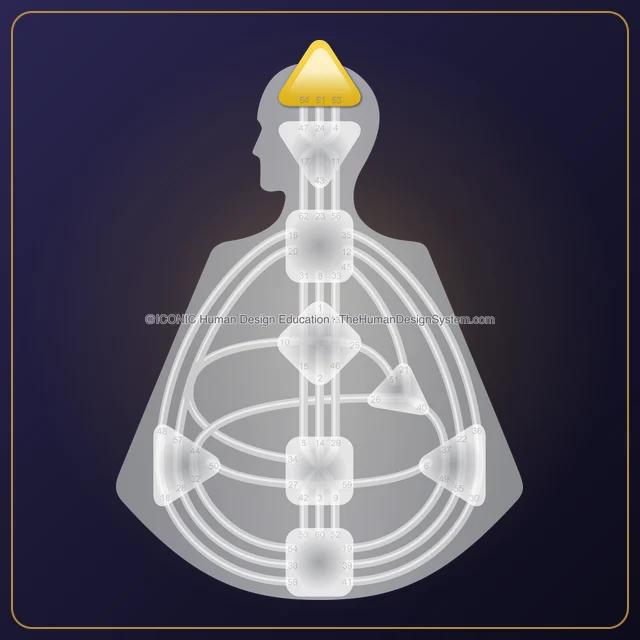 Black Friday through November 30 Best Rest by Design A whole course on sleeping by your design, built around your own chart. $297 through November 30, then $497$497 See the course
 Self-paced course Relationship Mastery How you love, connect and get along, by design. $697 See the course
 Self-paced course The Four Variable Transformations Determination, Environment, Perspective and Motivation, as four guided experiments. $850 See the course
 Where to begin Living Your Design Awakening The first class in the Human Design education, with the community around it. $350 See the course
 Foundations Human Design Cartography The second level of Human Design education, and the way into all advanced study. $850 See the course
 Professional training Human Design Analyst Training Level 1 (PTL1), Full Year A year on the 64 gates, the 384 lines and the art of a full chart reading. $3,450 See the course
See this in your own chart
Generate your free bodygraph and start your own experiment.
Get My Free HD Chart