
Undefined Splenic Center: What's Happening
An open Splenic Center means no consistent access to feeling safe, which is exactly why it's so easy to hold onto people and situations that aren't good for you.

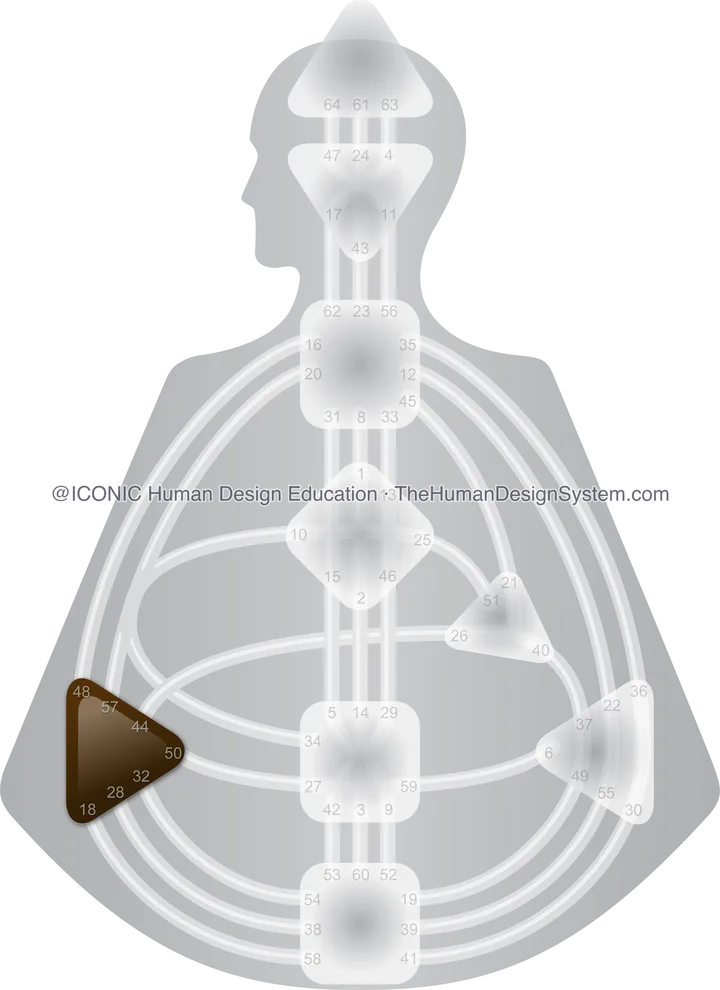
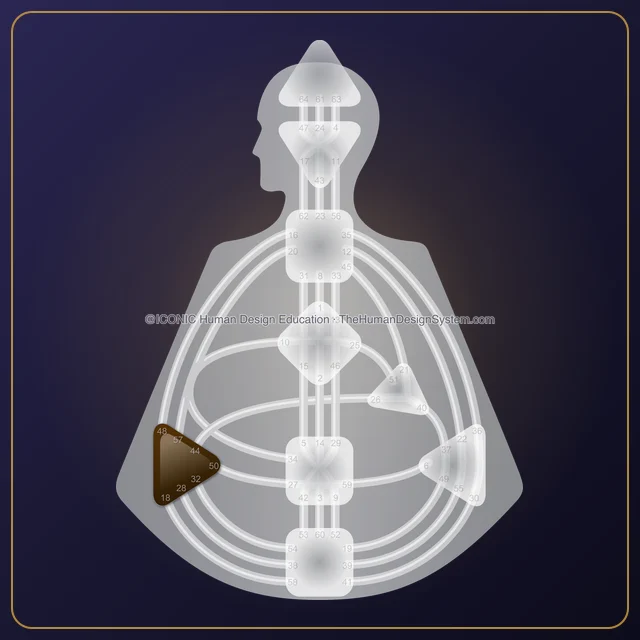
The Splenic Center is your body’s oldest, quietest awareness system: the one running underneath conscious thought, scanning constantly for danger, health, and what’s safe to take in. When it’s undefined, something specific and easy to miss happens: you lose consistent access to your own sense of feeling good in your body, and that gap gets filled with a very particular kind of not-self behavior.
What the Spleen governs
Biologically, this center correlates to far more than the spleen organ itself: it’s the whole lymphatic and immune system, plus a kind of full-body sensing instinct: smell, instinctive hearing, the hair-raising alertness that tells you not to walk into a room. It’s the part of you built to register danger and safety in real time, in the body, well before conscious analysis catches up.
The undefined pattern: holding on too tightly
Without consistent, built-in access to feeling safe, the open Spleen tends to develop a very specific coping strategy: once something or someone produces even a flicker of that feel-good, safe sensation, the mind grips onto it and doesn’t want to let go, even when the thing being held onto isn’t healthy. This shows up everywhere: staying in a job well past its expiration date out of fear nothing better exists, holding onto a living situation that’s stopped serving you, or remaining in a relationship that no longer feels good because the alternative, genuine uncertainty, feels more frightening than the discomfort you already know. The body’s felt sense of “safe” and the actual state of a situation are not always the same thing, and an open Spleen can struggle to tell them apart under pressure.
The tell to watch for is rigidity. If a change of plans throws you into real distress, or you find yourself defending a “no” that’s just fear wearing the costume of caution, that’s usually conditioning speaking, not your actual authority.
The seven fears worth knowing by name
Each gate connected to the Splenic Center carries its own flavor of survival fear, and knowing which ones are active in your own design turns a vague, background anxiety into something you can name and work with:
- Gate 48, fear of inadequacy, a nagging sense you don’t have enough depth or skill to solve the problem in front of you.
- Gate 57, fear of the future, an unease about what’s coming that can make you hesitate to trust what you’re intuitively hearing right now.
- Gate 44, fear of the past catching up with you, patterns and history you’re afraid will resurface and derail things.
- Gate 50, fear tied to responsibility: either avoiding it entirely, or taking on far more of it than is yours to carry.
- Gate 32: fear of failure, the voice that says a thing won’t work, so why even try.
- Gate 28, fear of dying without having lived for something that mattered, sometimes chased through risk-taking that provides a jolt of feeling alive.
- Gate 18, fear of authority and correction, judgment turned either outward at the world or inward at yourself.
None of these fears are flaws. They’re ancient survival information, built to keep you and the people you love alive. The question is only whether you’re consulting them consciously or being steered by them.
What healthy looks like here
The correct use of an undefined Spleen isn’t fearlessness, it’s discernment developed through your actual authority, not spontaneous in-the-moment reaction. People with a defined, healthy Spleen nearby can help; being close to someone whose sense of safety is consistent tends to feel good, sometimes good enough that it’s tempting to let their steadiness substitute for your own decision-making. That’s worth watching for. Borrowed safety is real, but it isn’t a replacement for checking in with whatever your own authority says.
Wisdom here, once it’s developed, is considerable: people with this openness often become unusually attuned to what’s safe and healthy for others (in food, in medicine, in relationships, in environments) precisely because they’ve had to learn the difference the hard way, over and over, until the pattern became visible.
If a decision is asking you to hold on tighter out of fear rather than clarity, slow down before you act on it. See whether your own Spleen is open in your free chart, and if this pattern feels familiar in your own life, a personal reading can help map exactly which fears are active in your design, and what listening to your actual authority, instead of your fear, tends to look like for you specifically.
From my courses
 Black Friday through November 30 Fundamentals Sampler Three full classes on your Authority, your Type and your SubType. Yours to keep. $197 through November 30, then $297$297 See the course
 Black Friday through November 30 Analyst Training Sampler Sit in on a full class from every level of Professional Analyst Training. $297 through November 30, then $497$497 See the course
 Black Friday through November 30 Human Design Cosmology Sampler Hear all seven volumes of Ra Uru Hu’s cosmology and find the one that pulls at you. $297 through November 30, then $497$497 See the course
 Black Friday through November 30 Health & Wellness Sampler Ten health courses, one module each, read through your own design. $397 through November 30, then $597$597 See the course
 Black Friday through November 30 Best Rest by Design A whole course on sleeping by your design, built around your own chart. $297 through November 30, then $497$497 See the course
 Self-paced course Relationship Mastery How you love, connect and get along, by design. $697 See the course
 Self-paced course The Four Variable Transformations Determination, Environment, Perspective and Motivation, as four guided experiments. $850 See the course
 Where to begin Living Your Design Awakening The first class in the Human Design education, with the community around it. $350 See the course
 Foundations Human Design Cartography The second level of Human Design education, and the way into all advanced study. $850 See the course
 Professional training Human Design Analyst Training Level 1 (PTL1), Full Year A year on the 64 gates, the 384 lines and the art of a full chart reading. $3,450 See the course
See this in your own chart
Generate your free bodygraph and start your own experiment.
Get My Free HD Chart