
Undefined G Center: The Mistake Almost Everyone Makes
An undefined G Center leaves identity and direction open, and the most common response is trying to borrow someone else's role instead of trusting your own authority.

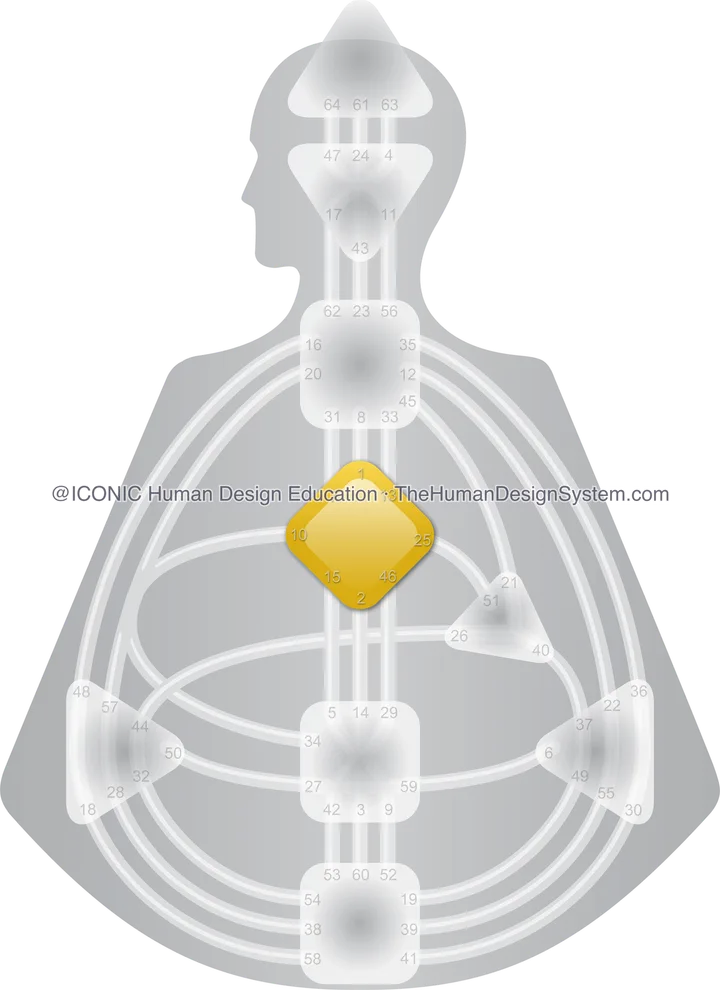
Roughly half the population carries an undefined G Center, and almost every one of them makes the same mistake at some point: they go looking for identity and direction in someone else’s life instead of trusting the one thing that was built to guide them, their own authority.
What the G Center is running
The G Center governs identity, direction, and love, three things that sound abstract until you look at what they correlate to physically: the liver and the bloodstream, the systems responsible for moving everything else through the body. When this center is undefined, there’s no fixed, consistent sense of “this is who I am” running in the background. That openness isn’t a deficiency. It’s an entirely different operating instruction, one built around flexibility rather than fixed identity.
The trap: borrowing someone else’s role
Here’s where it goes wrong. Without a consistent internal signal about identity, the mind starts scanning for one externally, and the fastest place to find an answer is by copying someone who already seems to have it figured out. Maybe that looks like pursuing a career because a parent modeled it convincingly, or adopting someone else’s personality in a relationship because their direction feels more solid than your own. Either way, the same pattern repeats: taking on somebody else’s role instead of trusting your own guidance system, and ending up, without quite noticing, in a life that was never yours.
This isn’t limited to people newer to their own design, either. Even years into living this system correctly, it’s entirely normal to keep catching the mind asking “who am I supposed to be when I grow up?”: as if identity were a fixed destination to arrive at, rather than something unconscious and always in motion, revealed through decisions made correctly over time rather than figured out in advance.
The not-self script, if you’re open here
If any of this is you, the internal monologue tends to sound familiar: Who am I? Where do I go to find out? Who’s going to show me? Where’s my soulmate, and how do I find them? What am I supposed to do with my life? That obsessive circling isn’t a character flaw. It’s what an open G Center’s mind does when it’s trying to manufacture certainty the body was never built to produce that way.
The wisdom potential on the other side
Here’s the reframe: an undefined G Center isn’t a hole to fill. It’s an instrument built to recognize identity and direction in other people with real clarity: to sense when someone is aligned with who they are, and to reflect that alignment back to them, without needing to borrow or perform it yourself. This is where a wide, generous, almost impersonal capacity for love tends to live too, not romantic attachment to one specific person, but something closer to a felt appreciation for people because they exist. Openness here makes you the room’s natural chameleon, capable of meeting different people from an adaptable place, as long as that adaptability is chosen consciously, not driven by anxious identity-searching underneath it.
What to do instead
When identity feels unclear, the correct move isn’t to chase an answer with the mind. It’s to return to whatever your actual authority is (sacral, emotional, splenic, ego, or otherwise) and let a real decision, made correctly, reveal the next piece of direction on its own timeline. And pay close attention to place: if an environment or a group of people doesn’t feel right, that discomfort is information, not something to override in the name of staying flexible. An open G Center doesn’t need a fixed role to hold onto. It needs the discipline to keep coming back to its own authority instead of someone else’s finished-looking life.
If you’re not sure whether your own G Center is open or defined, or what that specifically means for how you find direction, run your free chart to see your full definition, and a personal reading can walk through exactly what that openness is asking of you.
From my courses
 Black Friday through November 30 Fundamentals Sampler Three full classes on your Authority, your Type and your SubType. Yours to keep. $197 through November 30, then $297$297 See the course
 Black Friday through November 30 Analyst Training Sampler Sit in on a full class from every level of Professional Analyst Training. $297 through November 30, then $497$497 See the course
 Black Friday through November 30 Human Design Cosmology Sampler Hear all seven volumes of Ra Uru Hu’s cosmology and find the one that pulls at you. $297 through November 30, then $497$497 See the course
 Black Friday through November 30 Health & Wellness Sampler Ten health courses, one module each, read through your own design. $397 through November 30, then $597$597 See the course
 Black Friday through November 30 Best Rest by Design A whole course on sleeping by your design, built around your own chart. $297 through November 30, then $497$497 See the course
 Self-paced course Relationship Mastery How you love, connect and get along, by design. $697 See the course
 Self-paced course The Four Variable Transformations Determination, Environment, Perspective and Motivation, as four guided experiments. $850 See the course
 Where to begin Living Your Design Awakening The first class in the Human Design education, with the community around it. $350 See the course
 Foundations Human Design Cartography The second level of Human Design education, and the way into all advanced study. $850 See the course
 Professional training Human Design Analyst Training Level 1 (PTL1), Full Year A year on the 64 gates, the 384 lines and the art of a full chart reading. $3,450 See the course
See this in your own chart
Generate your free bodygraph and start your own experiment.
Get My Free HD Chart