The Head Center in Human Design
The Head is the pressure center at the top of the bodygraph, holding gates 61, 63 and 64, and its one function is to generate the pressure to think: the doubt, confusion or inspiration that starts thought, which the Ajna below then processes.
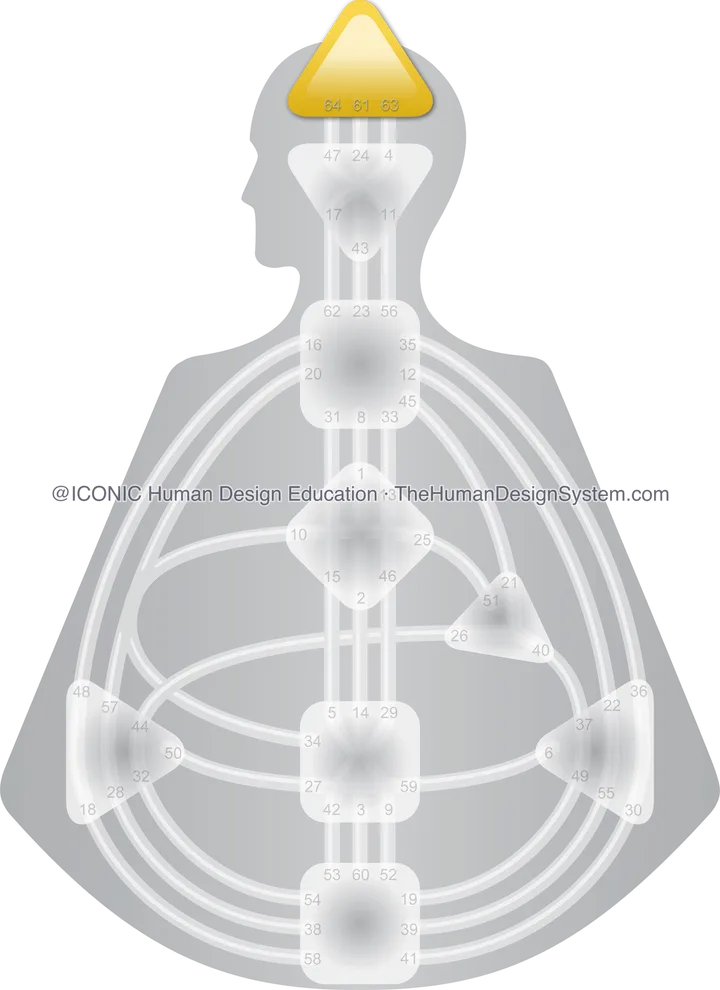
If your mind has ever kept you up at three in the morning chewing on a question you didn’t even care about at dinner, you’ve felt the Head center at work, and quite possibly, someone else’s Head center.
The Head sits at the very top of the bodygraph, and it does one thing: it generates pressure to think. Not thinking itself, which happens below in the Ajna, but the itch that starts thinking. Doubt that demands an answer. Confusion that demands to make sense. Inspiration that demands to be understood.
The mechanics: pressure, not awareness
The Head is one of two pressure centers in the design (the other is the Root, pressuring from below). It holds three gates, 61, 63, and 64, and it can only connect in one direction: downward into the Ajna, through the channels 61-24, 63-4, and 64-47.
That anatomy matters. Head pressure has nowhere to go except into conceptualization. It can never reach the Throat directly, which means the thoughts it fuels were never designed to run your life or force your decisions. The Head is fuel for contemplation, one of the great gifts of being human, not an inner authority. No one decides correctly from here.
Defined Head: a mind that runs on its own fuel
If your Head is defined (colored in), you have a consistent, personal source of mental pressure. You are inspired in a fixed and reliable way: a defined 63 doubts and tests, a defined 64 sifts the past for meaning, a defined 61 is pulled toward mystery and inner truth. Only a minority of people carry this definition, and they pressure everyone else’s minds simply by being in the room.
The challenge of a defined Head is that the pressure never clocks out. Your mind will always be asking. Living well with it means letting questions resolve in their own time, through your actual inner authority, rather than treating every open loop as an emergency.
Undefined and open Head: whose question is this?
Most people have an undefined Head, which means the center works as a receiver and amplifier. You take in the mental pressure around you and feel it more intensely than the person who generated it. Sit next to a chronic worrier and suddenly their deadline is your insomnia.
The classic not-self question for this center is: am I trying to answer everyone else’s questions? The conditioned undefined Head becomes a servant to borrowed pressure, endlessly researching, fixing, and figuring out things that were never its business. That’s a leading source of everyday anxiety and mental burnout.
A completely open Head, with no gates activated at all, goes further: there’s no fixed filter for what’s worth thinking about, so everything can seem equally urgent or equally confusing. The gift on the other side of that openness is real wisdom. With experience, the open Head becomes a connoisseur of questions, able to recognize which ideas are genuinely inspiring and which are just noise. You get to enjoy inspiration without being enslaved by it.
The three gates of the Head
- Gate 61, Inner Truth: the pressure to know, pulled toward mystery and the unprovable. Paired with Gate 24 in the Channel of Awareness.
- Gate 63, Doubt: the logical pressure to question whether a pattern will hold. Paired with Gate 4 in the Channel of Logic.
- Gate 64, Confusion: the abstract pressure to make sense of past experience. Paired with Gate 47 in the Channel of Abstraction.
Each gate is a question looking for its harmonic in the Ajna. Hanging alone, it presses without resolving, which is normal rather than broken.
Human Design anatomy
Human Design gives the Head center the pineal gland, and its three gates are three distinct pressures rather than three thoughts. Gate 64 is the pressure of raw mental activity, gate 61 the pressure of the unknown, gate 63 the pressure of patterns that look suspicious. Each one is the opening of a stream that runs down through the Ajna and, if the chart allows, out through the Throat. The Head does not think. It supplies the pressure that makes thinking happen, which is why the questions arrive whether or not you invited them, and why an open Head chasing other people’s inspiration is a pressure problem rather than a discipline problem.
Living it
Whether your Head is defined or open, the correction is the same in spirit: let the mind be an inspiration engine, not a decision-maker. Your reliable guidance lives in your inner authority, somewhere below the neck. The Head’s pressure is at its best when it’s fueling contemplation you actually enjoy.
To see whether your Head is defined, open, and which gates you carry, get your free chart. And if you want to understand how this pressure interacts with the rest of your design, including where your real decisions come from, a Foundational Analysis maps it precisely.
Whichever of the eleven bodies your own chart places in this center's gates adds its function here, for you specifically: see the Design Lunar & Planetary Square.
A framework for self-understanding, not a medical claim. See the full note on medical astrology and Human Design.
Frequently asked questions
What is the Head center in Human Design?
The Head is the pressure center at the top of the bodygraph. It generates the mental pressure to think: to make sense of the past, to question the future, and to know the unknowable. It holds three gates (61, 63, 64) and can only connect to the Ajna center below it. It is not an awareness center; it fuels thinking rather than doing it.
What does an undefined Head center mean?
An undefined Head means you take in and amplify the mental pressure of the people around you. Your questions, doubts, and inspirations shift depending on who you're with. The conditioning trap is treating borrowed pressure as urgent, trying to answer questions that were never yours. The wisdom side is knowing which questions are genuinely worth thinking about.
Is a defined Head center rare?
Yes, relatively. The Head can only be defined through one of three channels to the Ajna, whether 61-24, 63-4, or 64-47, and the majority of people have it undefined. A defined Head produces a consistent, reliable way of being inspired and pressured to think, but that pressure runs whether it's convenient or not.
What is the not-self question for the Head center?
The classic question is: am I trying to answer everyone else's questions? An undefined Head absorbs ambient mental pressure and turns it into anxiety, researching, ruminating, and problem-solving on topics that belong to other people. Noticing whose question you're actually carrying is the first step out of that loop.
Source and lineage
This entry is written in original words from Ra Uru Hu's source material as held by Jovian Archive, and taught by an IHDS Certified Independent Teacher. The mechanics (which center a gate sits in, which gates make a channel, how the authority hierarchy is ordered) come from the site's reference data, the same data the free chart runs on. To check either, see who writes here and the Human Design tools this site publishes.
Spotted an error on this page? Tell us and a human will look into it.