In Memory of Tim Curry: The Hour Nobody Wrote Down
Tim Curry was a 3/5 Sacral Generator on the Right Angle Cross of Laws, the same four gates as Dolly Parton's own cross. His birth time was a guess rounded to noon, and it barely mattered.

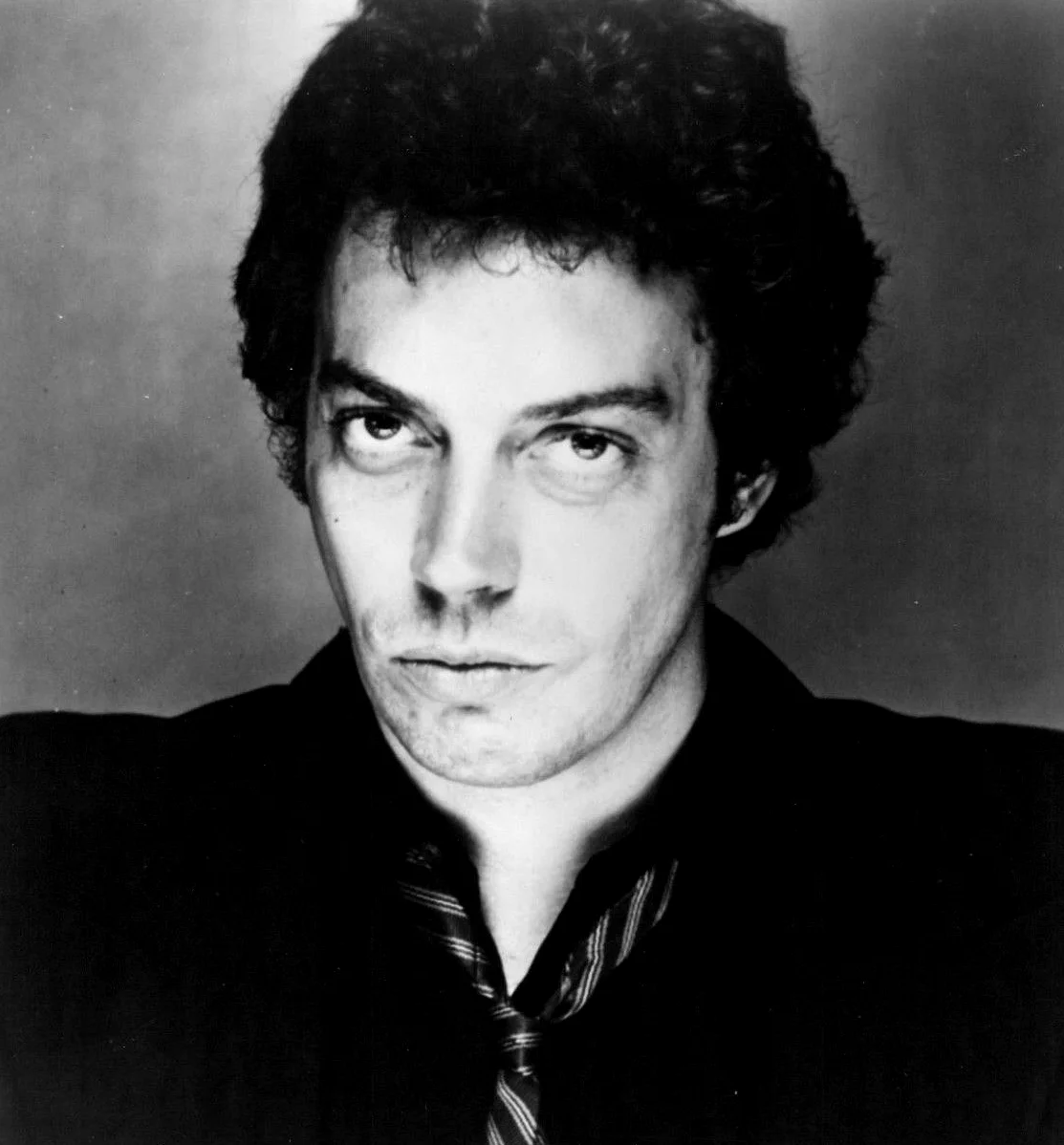
Tim Curry, 1978. Photo: A&M Records.
Tim Curry died August 25, 2026, in Toluca Lake, Los Angeles. He was 80, and he died the same day I lost Dolly Parton, which I still haven’t fully found the bottom of. I wrote her piece first because I couldn’t not, and I’ve spent the days since learning his chart, which turns out to share more with hers than the date on the death certificate.
His most-used chart carries a lower Rodden rating than hers: April 19, 1946, 12:00 PM, Cheshire, England, rated A rather than AA. The source is his own account, quoted by the astrologer Frederick Davies in the 1980 book Signs of the Stars, and the time itself is the tell: an exact noon, which is what a person says when nobody ever told them the real one and they’re rounding rather than reporting. I want to be straight about what that costs and what it doesn’t. I ran every candidate minute from midnight to nearly 7 the following morning against his chart. His type, authority, and definition do not move once across that entire span. His profile holds until almost 7 in the evening. A guess rounded to noon, and the mechanics that matter most survived a wider margin than some documented birth certificates I’ve worked with. Data quality tells you how much to trust a time. It doesn’t tell you how fragile the chart underneath it is. You have to check.
Run it and here’s what comes back:
| Type | Generator |
| Strategy | Wait to respond |
| Authority | Sacral |
| Profile | 3/5 |
| Definition | Single Definition |
| Cross | Right Angle Cross of Laws 1 (3/50 | 60/56) |
| Signature / Not-Self | Satisfaction / Frustration |
| Data | A record, self-reported to a biographer, noon, Cheshire, England |
Here’s the part I didn’t expect when I sat down to write this. His Cross of Laws runs through the exact same four gates as Dolly’s, 3, 50, 56, and 60, just with Personality and Design swapped: hers reads 60/56 on the conscious side and 50/3 on the design side, his reads 3/50 conscious and 60/56 design. Two Right Angle Crosses of Laws, mirror images of each other, in two people who left on the same afternoon. I don’t have a mechanism for what that means and I’m not going to invent one. I’m just going to name it, the way I’d want a student to name a pattern rather than talk themselves out of noticing it.
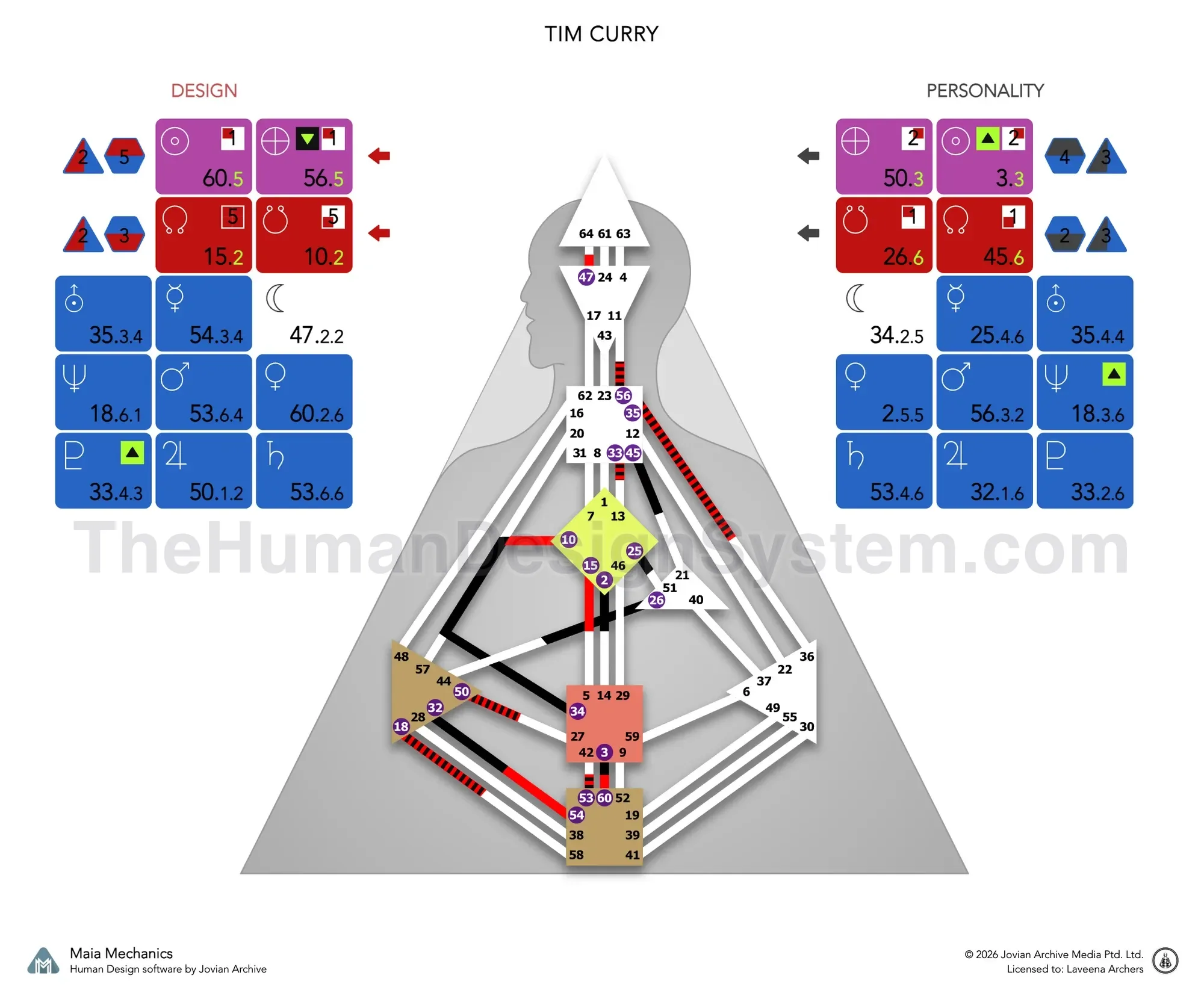
Tim Curry’s natal bodygraph, 3/5 Sacral Generator: Design and Personality, activated at birth.
A false start that became a legend
His conscious Sun sits in Gate 3, Ordering, line 3: the Sacral’s difficulty at the beginning, read on the line that survives false starts and finds workable order through sheer persistence, not through getting it right the first time. His conscious Earth sits in Gate 50, Values, line 3, the Spleen’s guardian instinct, on a line that learns through missteps which loyalties are nourishing and which corrode.
He originated Frank-N-Furter on a London stage in 1973 to real acclaim, then carried the same role into the 1975 film, which failed on release. His own words, fifty years later: “It died a death. It was a failure. And I was crushed… I thought that it might well be the end of my movie career. But I was tougher than that.” That’s Gate 3 line 3 as a career, not a metaphor: the new thing arrives without instructions, fails by every metric that mattered at the time, and only becomes what it was supposed to be through the sheer persistence of an audience that kept showing up at midnight screenings for years after the reviews had already rendered their verdict. Gate 50’s discernment shows up differently, in what he chose to protect rather than what he built. He spent decades declining Rocky Horror conventions and the autograph circuit that grew up around the role that made him famous, while never once turning down the stage, voice, or screen work that let him keep working as an actor rather than as a relic of one midnight movie. That’s a Spleen that had already sorted, correctly and early, which parts of that fame were nourishing his actual craft and which were just noise wearing his own face.
Structuring the freedom, telling the story
His unconscious Sun sits in Gate 60, Limitation, line 5: the Root’s pressure to accept a real constraint, on the line that sets wise limits for others so their freedom doesn’t collapse into chaos. His unconscious Earth sits in Gate 56, Stimulation, also line 5, the Throat’s storyteller, on the line that crafts narratives people actually act on. Both design placements land on the practical, exterior-facing fifth line: the design side of him was built to give other people’s freedom a structure and other people’s experience a story, whether that was Scrooge, Wadsworth, Pennywise, or the Criminologist explaining the rules of his own most famous film to a new generation of midnight audiences.
That same Gate 60 is the gate his life would eventually ask him to live rather than just play. On July 13, 2012, during a massage, two blood clots in his brain triggered a stroke severe enough to require an emergency craniectomy, a portion of his own skull removed to save his life. His words from Vagabond, the memoir he published a little over a year before he died: “My skull had been smashed in to save my life.” Left-side paralysis followed, weeks of relearned speech, a wheelchair for the rest of his life. Gate 60’s own lesson is exactly this and nothing gentler: transformation becomes possible only through accepting a limitation you did not choose and cannot negotiate down. He kept working from the chair, Chancellor Palpatine’s voice for The Clone Wars, Auntie Whispers for Over the Garden Wall, and at the Rocky Horror 50th anniversary event in September 2025, eleven months before he died, he named the limit without flinching from it: “I still can’t walk, which is why I’m in this silly chair, and that’s very limiting… I won’t be singing and I won’t be dancing very soon. I still have real problems with my left leg.” Design Earth’s storytelling instinct never left him either. That sentence is a story with a structure, offered to a room that came expecting nostalgia and got the truth instead.
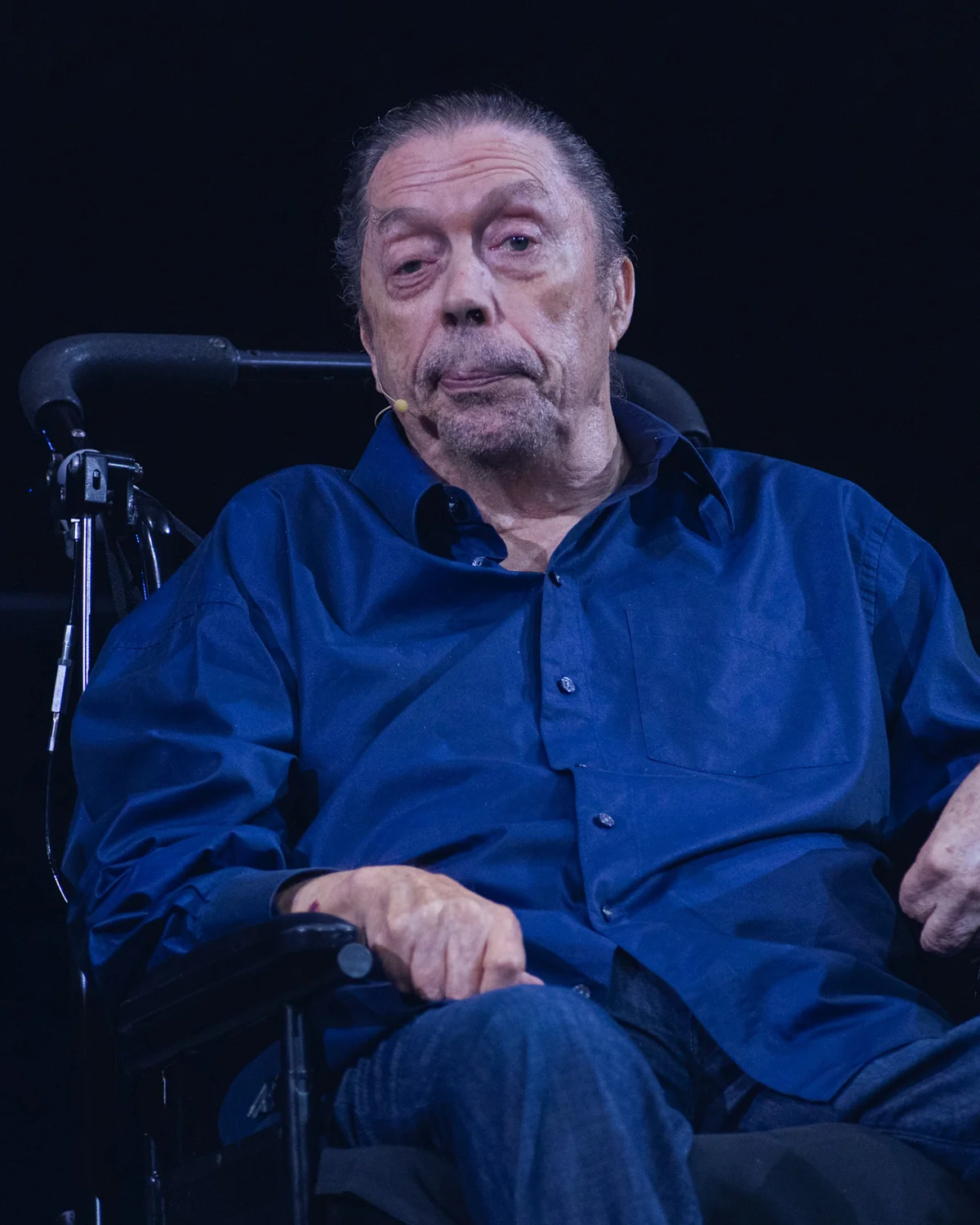
Tim Curry at the Rocky Horror Picture Show 50th anniversary Q&A, Los Angeles, September 26, 2025, eleven months before he died. Photo: Kevin Paul, CC BY 4.0.
One circuit, a pulse underneath it
Single Definition ties every defined center in his chart into one connected circuit: G Center, Sacral, Spleen, and Root, joined through three channels. Exploration links G to Sacral, self-empowered behavior running on its own convictions rather than a script, which is as good a description as any of an actor who spent fifty years refusing to be defined by his single most famous role. Transformation links Spleen to Root, ambition filtered through an instinct for what will actually last, the same wiring, as it happens, that Eric Dane’s chart carries too. And Mutation links Sacral to Root: the same channel that ran Dolly’s entire design, the pulse through which new things enter the world, on, then off, then on again, with real melancholy in the gaps between pulses.
His career reads like that pulse taken literally. A stage triumph in 1973. A film failure in 1975 that took years, not weeks, to become the opposite. A quiet stretch, then 1985 arriving whole: Clue and Legend the same year, an unusually full pulse in his transiting Uranus Opposition, more on that shortly. Another quiet stretch. It in 1990. Another. Muppet Treasure Island in 1996, a voice career gathering through the 2000s and 2010s. Silence after 2012, then voice work resuming from the chair. A last long quiet, and then, ten months before he died, a memoir: one more beginning, on schedule for a man whose natal Saturn never let him forget how to start.
Saturn Return, 1974–1975
Saturn returns to its own natal position roughly every twenty-nine years, auditing whatever in a life was never built to last. His natal Saturn sits in Gate 53, Beginnings, line 4: Root pressure to open a new cycle, on a line that begins through relationships and allies rather than alone. The return spans a window rather than a single date, three exact crossings between October 1974 and June 1975, the kind of extended pass that happens when Saturn stations retrograde mid-transit and re-crosses the same degree more than once.
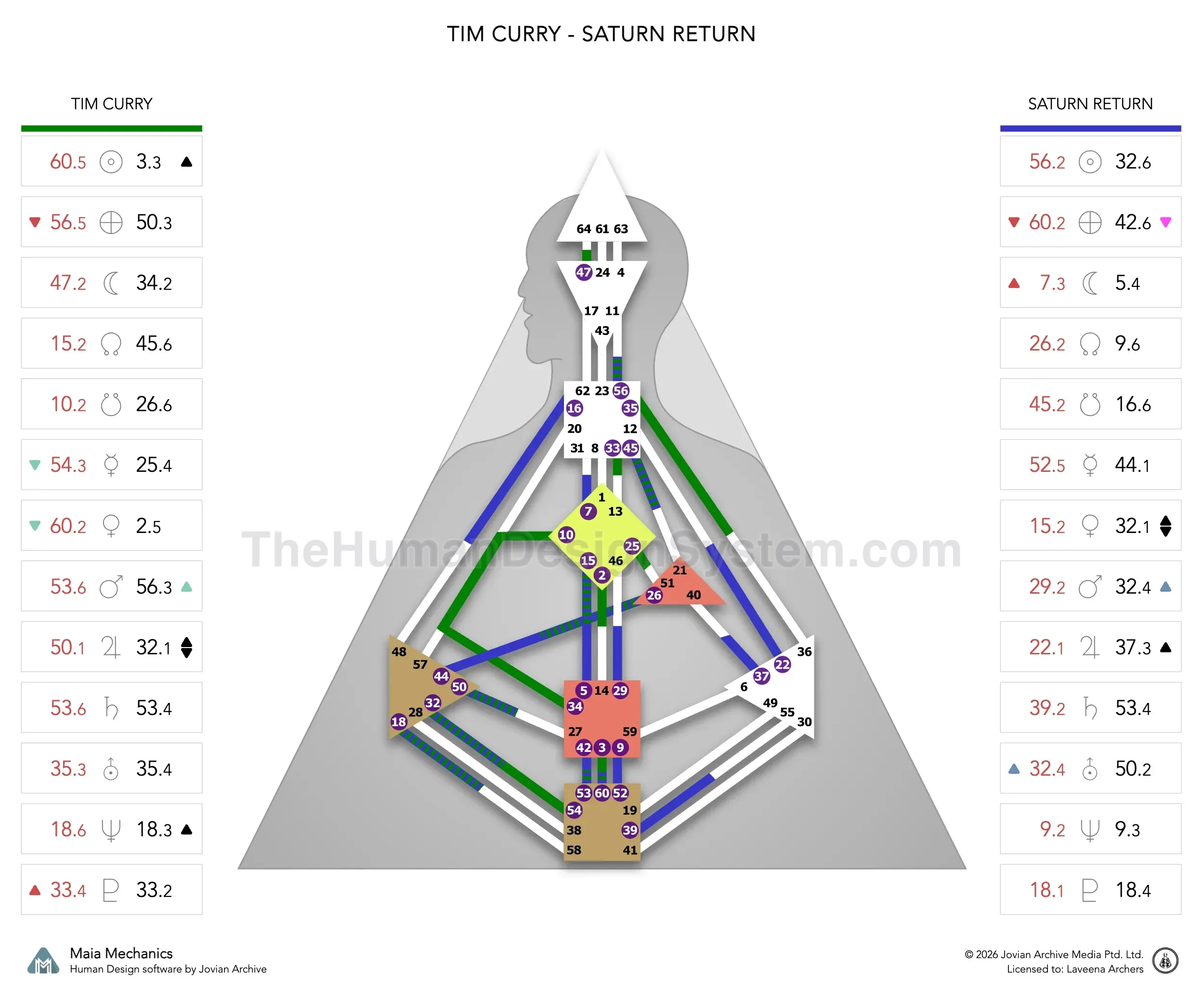
Natal chart against the October 1974 Saturn Return transit, age 28: Rocky Horror opens in theaters and fails.
That window covers almost exactly the run-up to the Rocky Horror film’s 1975 release and its immediate, brutal commercial failure. Gate 53 does not promise a successful beginning. It only promises a beginning, the pressure to open a new cycle of experience, full stop; finishing, let alone succeeding, belongs to a different gate entirely, one he doesn’t carry. Saturn auditing that exact placement in the months the film opened and died is not a chart explaining away a flop. It’s a chart naming, correctly, what the moment actually was for him: not an ending, just the hardest possible version of a beginning. This Saturn Return carried its own cross too: the Left Angle Cross of Limitation (32/42 | 56/60).
Uranus Opposition, 1984
Uranus takes eighty-four years to complete its circuit, so the opposition falls at the most disruptive point most people see before sixty. His fell December 22, 1984, transiting Gate 5, Fixed Rhythms, in the Sacral: the need for a fixed personal tempo, a rhythm that has to be discovered rather than imposed, or everything downstream of it runs wrong.
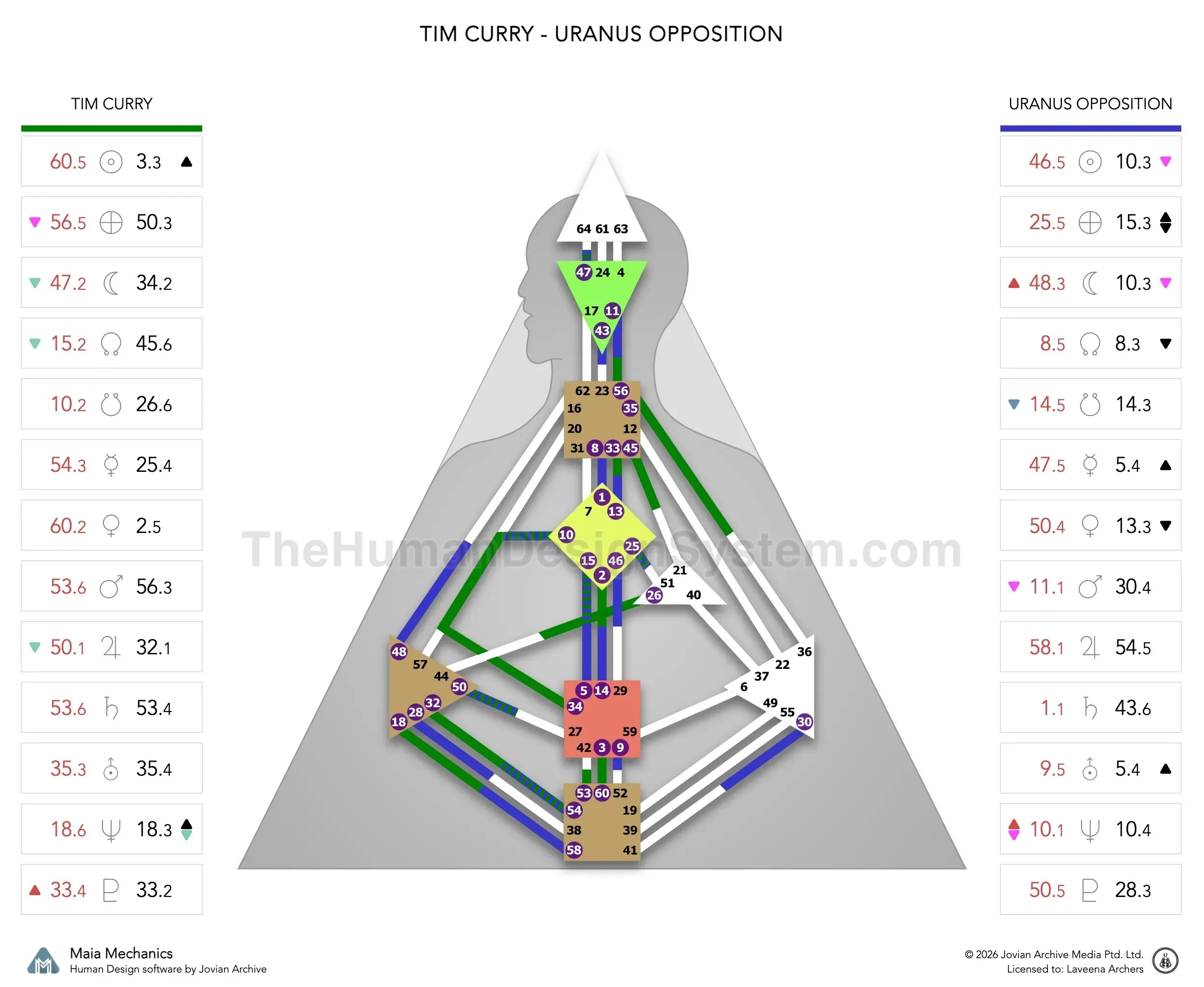
Natal chart against the December 1984 Uranus Opposition transit, age 38: mid-production on Clue and Legend, both releasing the following year.
Clue and Legend both reached theaters the following year, which means both were deep in production through the back half of 1984, an unusually dense, rhythmic stretch of delivered work for an actor whose career more often moved in the on-off pulse his Channel of Mutation runs on. A transit through the gate of fixed rhythm landing squarely inside the production window for two films at once reads less like coincidence than like a design briefly getting the tempo it always wanted, before the pulse went quiet again, the way Gate 3-60 always eventually does. This Uranus Opposition carried its own cross too: the Right Angle Cross of The Vessel of Love (10/15 | 46/25).
Chiron Return, 1996
Chiron’s return, close to fifty, is the one astrologers call the wounded healer coming home: whatever a person has spent a life managing or protecting tends to surface here and ask to be made useful instead of hidden. His fell September 22, 1996. Dolly Parton’s own Chiron Return landed that October, the same autumn, weeks apart, on the same continent, two people who would not otherwise cross paths for another thirty years, until the single afternoon they left it.
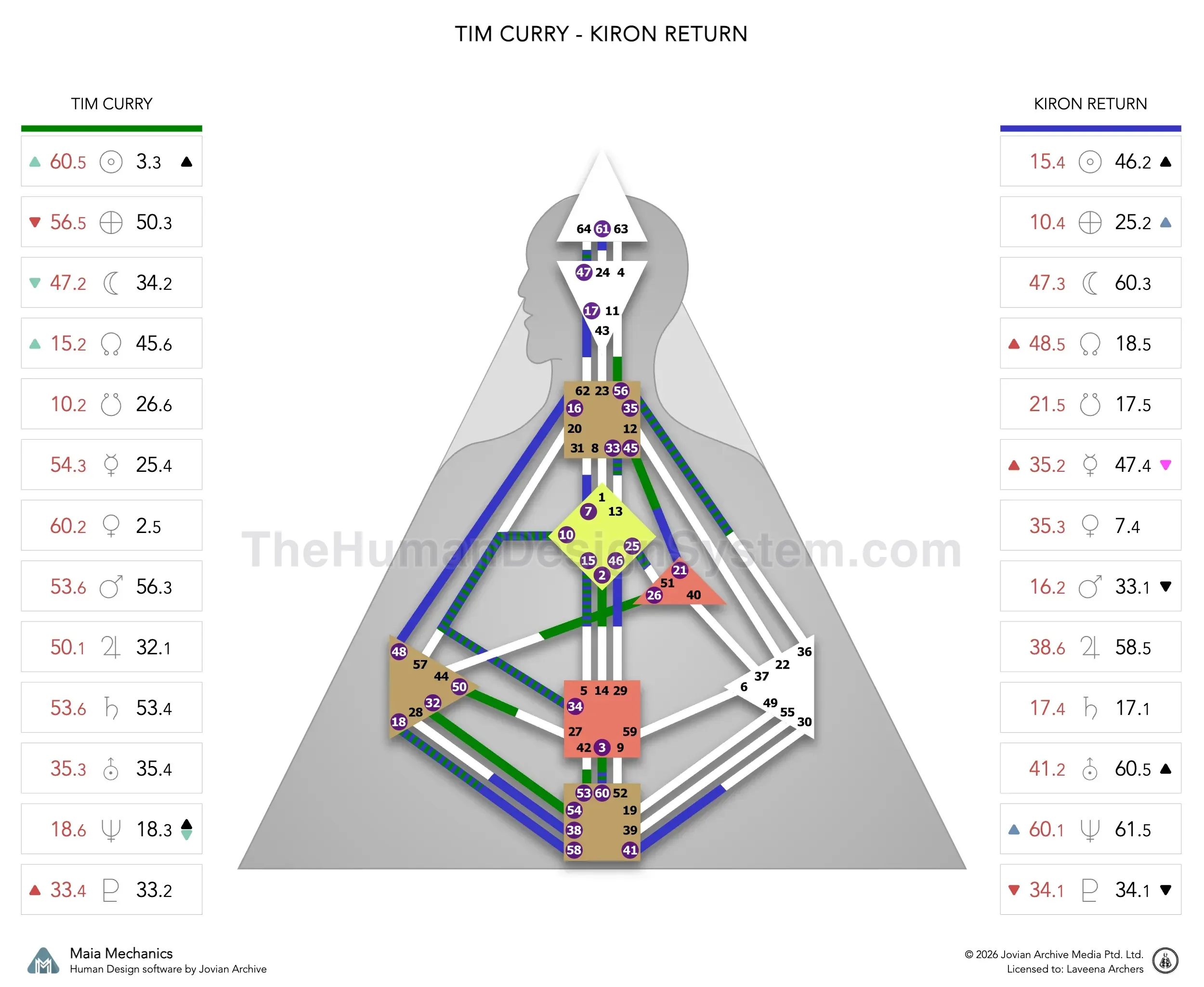
Natal chart against the September 1996 Chiron Return transit, age 50: the same autumn as Dolly Parton’s own Chiron Return, thirty years before they’d share a death date.
I don’t have a mechanism for what a shared Chiron season between two strangers means, any more than I did for the shared Cross of Laws, and I’d rather leave it standing unexplained than force it into a lesson. What I can say honestly is what came after: 1996 sits almost exactly at the midpoint between typecasting he’d spent two decades resisting and the stroke, sixteen years later, that would finally take the choice of how to keep working out of his own hands entirely. Whatever this return was asking him to stop hiding, he had, by the time it mattered most, already spent a lifetime practicing how to keep performing through a body that wasn’t cooperating. This Chiron Return carried its own cross too, the same family his own Uranus Opposition wore twelve years earlier with the gates rotated: the Right Angle Cross of The Vessel of Love (46/25 | 15/10).
Second Saturn Return, 2004
The second Saturn Return, close to fifty-nine, tends to arrive as ratification rather than crisis: an audit of ground already proven rather than ground still being tested. His fell in July 2004, a single clean pass back through the same natal Gate 53, Beginnings.
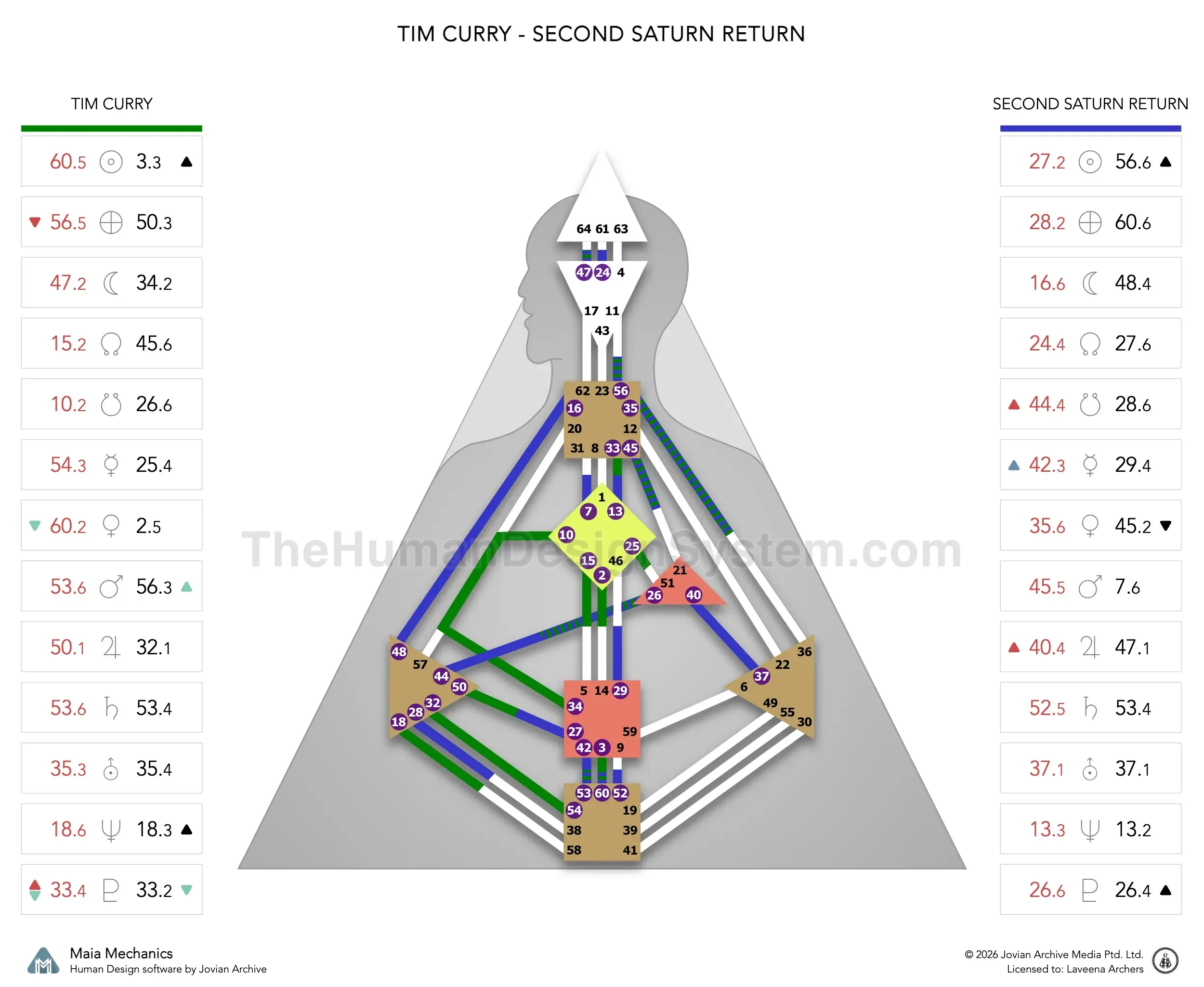
Natal chart against the July 2004 second Saturn Return transit, age 58: the fourth time this gate has proven itself since 1974.
By then the pattern the gate had been running his entire life, stage to film to voice to whatever came next, had already survived one commercial disaster, a decade of typecasting, and more reinvention than most careers attempt once. The second pass didn’t need to prove the gate worked. It already had, four separate times over, by 2004. This second Saturn Return carried its own cross too: the Left Angle Cross of Distraction (56/60 | 27/28).
What his design leaves behind
He was famously, consistently private about his romantic life, on the record for decades rather than by omission: “My romantic life is none of anybody’s business,” he told an interviewer in October 2025, and I’m taking him at his own word rather than the labels other people have reached for on his behalf. He never married and had no children. His mother, Patricia, died in 1999; his sister Judith, a concert pianist, died two years later, a loss he wrote left him, in his own word, untethered. He kept a running joke for decades that Miss Piggy, his Muppet Treasure Island co-star, was his one true love, and her own account posted a tribute when he died.
His longtime manager, Marcia Hurwitz, confirmed his death; the statement shared with press called him “an iconic actor and entertainer globally beloved for his dynamic contributions to stage and screen,” who “passed away peacefully at his home in Toluca Lake.” No cause has been disclosed, and I’m not going to guess at one. Tributes arrived from across five decades of collaborators: Susan Sarandon on his heart even in the wheelchair, Richard O’Brien calling him “a good egg and class act” who “never sought attention and never put himself before the roles he played,” Carol Burnett remembering him as a dear friend, Luke Evans, freshly finished playing Frank-N-Furter himself in the role’s most recent Broadway revival, thanking him in a letter written three weeks before he died “for inspiring generations of actors to be a little braver than they thought they could be.”
Read together, that’s a Right Angle destiny doing exactly what its own page says it does: a personal theme, learned by living through his own chaos rather than managing anyone else’s, that only became a set of laws other actors could stand on because he paid for them himself first, a flop absorbed at twenty-nine, a skull opened at sixty-six, a memoir finished at seventy-nine, none of it handed to him, all of it turned, eventually, into something the people who came after him got to use. He shared his cross with a woman who did the same thing with a theme park and a library. They left on the same afternoon. I don’t know what to do with that except notice it, the way I’d want any of you to notice the patterns in your own chart rather than explain them away.
His last Solar Return, and the day he died
He died on August 25, 2026, at his home in Toluca Lake, Los Angeles, at 80, as reported in NBC News’ obituary. No certified time of death has been published. A 911 dispatch time circulated in tabloid reporting, and a dispatch log records the minute somebody called for help; a death certificate records the minute a person died, and only the first of those is public. So his record closes the way it opens: with an hour nobody wrote down.
His last Solar Return, the chart for his final birthday on April 19, 2026, landed his transiting Sun and Earth on the identical Gate 3 and Gate 50 they occupy natally, computed in Maia Mechanics against the same rounded noon as everything else in this piece; a Sun that takes close to six days to cross one gate doesn’t care about a rounded hour. That last sky bridged nothing: no transit gate reached in to complete a channel with his own activations, the pulse of his design left to run on its own to the end. The one channel the transits completed, the 40-37 Channel of Community, they completed entirely among themselves, its two gates carried between the transiting Nodes, the Tribal bargain of work exchanged for belonging hanging whole in that final year’s sky.
In memory of an ICONIC Human Design,
LaVeena B. Archers, PhD
Chart via myBodyGraph, rendered through Maia Mechanics, Human Design Professional Software licensed from Jovian Archive, birth data via Astro-Databank, corroborated against Astrotheme. Biographical dates cross-checked against Wikipedia, timcurry.co.uk’s official biography, and Newsweek. Reporting on his death and the tributes that followed via CNN, TMZ, the Deseret News, and Broadway.com; his own account of the 2012 stroke and its aftermath via Fox News’ reporting on Vagabond and his September 2025 remarks at the Rocky Horror 50th anniversary event.
If you want to see what your own design would ask you to trust the way his asked him to keep beginning, your chart is free. It won’t make you the unique example his was. It will show you where your own pulse runs, and what it might be worth surviving a few false starts for.