The G Center in Human Design
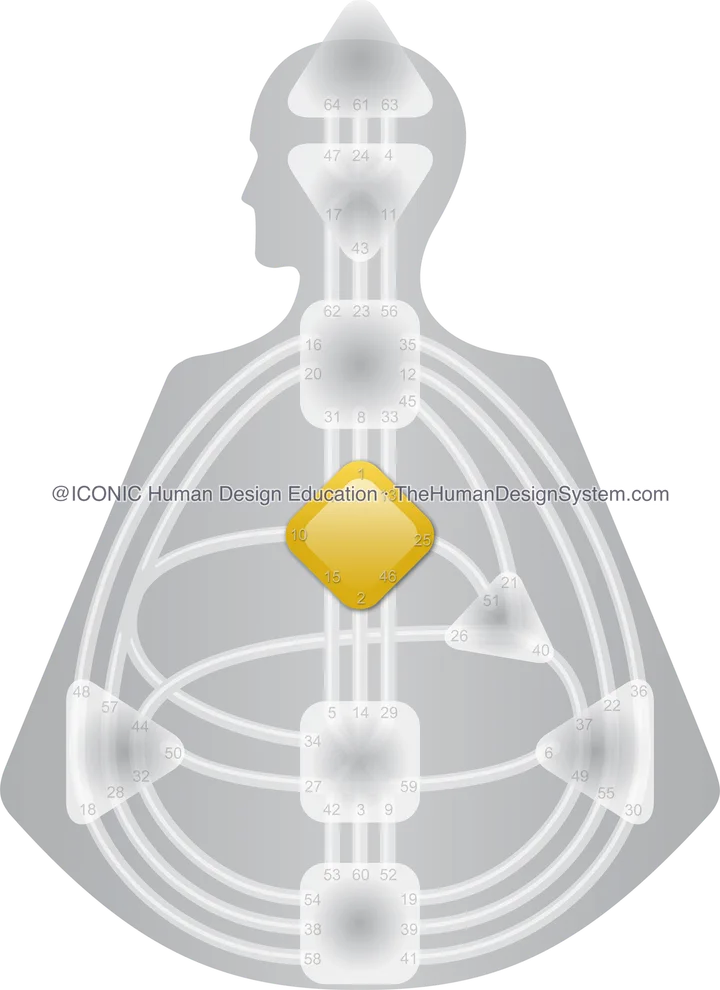
The G Center is the diamond at the middle of the bodygraph, holding gates 1, 2, 7, 10, 13, 15, 25 and 46, and governing identity, love and direction through the magnetic monopole it houses.
“Just be yourself” is the most common advice in the world, and for roughly half of humanity it misses how they’re built.
The G center, the diamond at the center of the bodygraph, governs identity, love, and direction. In the Human Design cosmology it houses the magnetic monopole: the mechanism that holds you together as a single identity and pulls you along your unique trajectory through life. Whether that identity is fixed or fluid depends entirely on whether the center is defined.
The mechanics: the still point of the chart
The G is neither a motor nor an awareness center. It doesn’t generate energy or process fear. It simply is: the seat of the self. Its eight gates are 1, 2, 7, 10, 13, 15, 25, and 46, and they connect the G to the Throat, Sacral, Heart, and, through Gate 10’s Integration channels 20-10, 10-34, and 10-57, to the Spleen as well.
The eight gates split evenly between themes of direction (2, 7, 13, 15, meaning where you’re headed and how you guide or witness others) and love (1, 10, 25, 46, meaning love of self, of the body, of spirit, of expression). Together they form what the tradition calls the sphinx and vessel-of-love wheels: direction and love as the two faces of identity.
Defined G: a fixed sense of self
With a defined G, who you are doesn’t change with the scenery. Your identity, your way of loving, and your life direction are consistent. You can be dropped into a new city or a new crowd and still feel like you. People experience you as self-possessed, sometimes enviably so.
The defined G’s challenge is inflexibility about direction: your trajectory is your trajectory, and when others (or you) try to force a detour, life resists. There’s also a subtle trap of assuming everyone experiences a stable “self” the way you do. They don’t. If your G connects to your Throat by definition, your identity can literally speak your truth; that’s the basis of Self-Projected authority.
Undefined and open G: identity as a mirror
An undefined G has no fixed identity or direction. You experience yourself through whoever you’re with: decisive with decisive people, adrift with drifting ones, a slightly different self in every room. Conditioning turns this into a lifelong ache, and the not-self question here is: am I looking for love and direction in the wrong places?
The wrong-places pattern is specific: clinging to relationships to feel loved, adopting other people’s goals to feel directed, staying in identities (jobs, roles, personas) because having some self beats having none. The undefined G can’t hold onto love or direction by gripping; it receives them through correct environment.
That’s the master key for this center: place. If the place is wrong, the people are wrong, and everything that flows from them, whether work, love or opportunity, is wrong too. Get the place right (the café that feels good, the city that feels like relief, the desk by the window) and the right people and direction find you. A completely open G amplifies all of this: the deepest uncertainty about who it is, and, when mature, the deepest wisdom about love and direction, able to recognize what’s authentic in others precisely because it isn’t fixed itself.
The eight gates of the G
- Gate 1, Self-Expression and Gate 46, Determination: creative identity and love of the body.
- Gate 2, Direction of the Self: the driver, receiving direction for the vehicle.
- Gate 7, The Role of the Self and Gate 13, The Listener: leadership and witnessing within the collective.
- Gate 10, Behavior of the Self: love of self, expressed as authentic behavior.
- Gate 15, Extremes: love of humanity in all its rhythms.
- Gate 25, The Spirit of the Self: universal, impersonal love.
Human Design anatomy
Human Design gives the G center the liver and the blood, which is the most radical of the nine assignments: identity here is not housed in the brain, it is housed in the tissue that reaches every other tissue. Blood goes everywhere, touches everything, and carries what it carries whether or not you have decided who you are that morning. Direction and love, in this anatomy, are circulatory rather than cognitive, which is one reason the G resists being thought about and responds so much better to being lived.
Living it
Fixed or fluid, the G center asks the same thing of you: stop steering with the mind. The defined G trusts its trajectory; the undefined G trusts its places and its strategy and authority to filter who comes along for the ride.
Not sure whether your G is defined? Generate your free chart and look at the diamond in the middle. Then, if you want to understand how identity, love, and direction actually operate in your specific design, a Foundational Analysis goes gate by gate.
For the glandular correspondences behind the G Center, the Throat, and the Heart, read The Biology Behind the Bodygraph: Throat, G Center, and Heart.
Whichever of the eleven bodies your own chart places in this center's gates adds its function here, for you specifically: see the Design Lunar & Planetary Square.
A framework for self-understanding, not a medical claim. See the full note on medical astrology and Human Design.
Ra Uru Hu on this, in his own voice
3 recordings from the Jovian Archive, played through SoundCloud. Nothing loads from SoundCloud until you press play.
- Personal and Transcendent Love SoundCloud
- The True “I Am” SoundCloud
- The G Center SoundCloud
Frequently asked questions
What is the G center in Human Design?
The G center is the diamond-shaped center in the middle of the bodygraph, governing identity, love, and direction in life. It holds the magnetic monopole, the mechanism that draws you along your trajectory, and its eight gates (1, 2, 7, 10, 13, 15, 25, 46) describe distinct expressions of self and love. It is neither a motor nor an awareness center.
What does an undefined G center mean?
An undefined G means identity and direction are not fixed in you, so you experience yourself differently depending on the people and places around you. That's not a flaw; it's a design built to sample identities and become wise about love and direction. The conditioning trap is searching for a fixed self, or holding onto relationships and roles to feel like somebody.
Why is place so important for an undefined G center?
Because an undefined G takes in identity and direction from its environment, the environment effectively steers your life. The practical rule: if you're in the wrong place, you're with the wrong people, and the opportunities that find you there won't be correct either. When the place feels right, the undefined G relaxes, and the right people and direction follow.
What is the difference between the G center and the Heart center?
They're neighbors but do different jobs. The G center is about who you are: identity, love, and the direction your life takes, and it has no energy of its own. The Heart (Will) center is a motor: willpower, ego strength, and material drive. Self-worth themes live in the Heart; self-identity themes live in the G.
Source and lineage
This entry is written in original words from Ra Uru Hu's source material as held by Jovian Archive, and taught by an IHDS Certified Independent Teacher. The mechanics (which center a gate sits in, which gates make a channel, how the authority hierarchy is ordered) come from the site's reference data, the same data the free chart runs on. To check either, see who writes here and the Human Design tools this site publishes.
Spotted an error on this page? Tell us and a human will look into it.