Channel 28-38: The Channel of Struggle
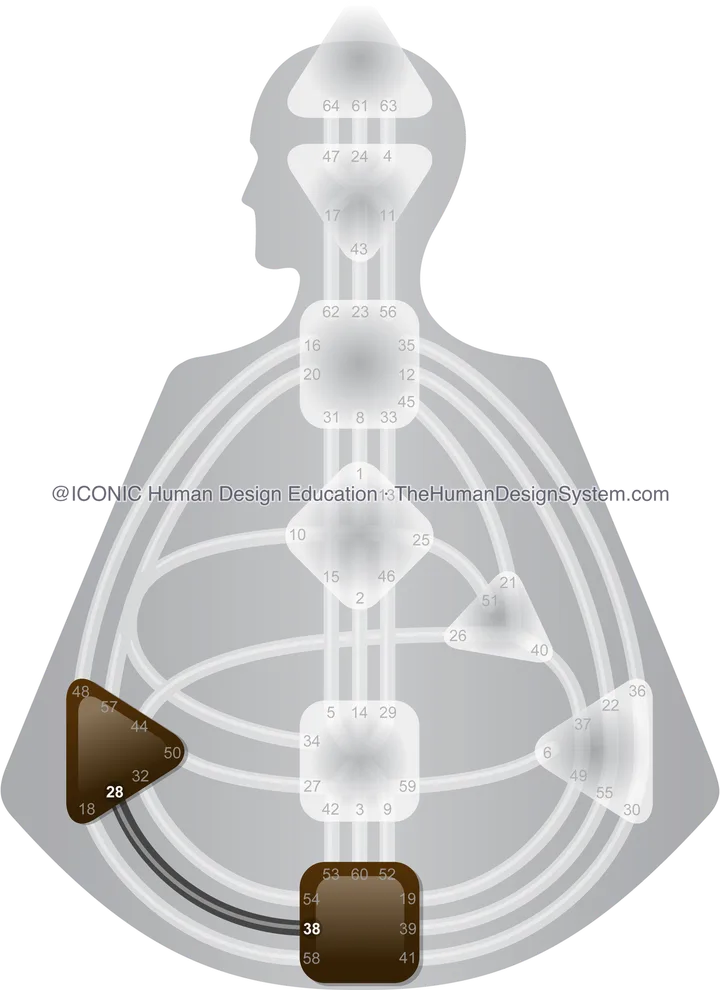
Part of the Individual Knowing circuit →
Some people are exhausted by resistance. Others are strangely organized by it: give them a worthy opponent, an uphill cause, a thing everyone says can’t be done, and they come alive. If the 28-38 Channel of Struggle is defined in your chart, you are the second kind, and the question of your life is never whether to fight. It is what is worth fighting for.
The mechanics
The Channel of Struggle runs from Gate 38, the Fighter, in the Root center to Gate 28, the Game Player, in the Spleen. Defined, it defines both centers: consistent Root pressure driving the fight, and consistent splenic awareness judging it. It belongs to the individual Knowing circuit, the mutative circuitry that empowers by example, which means this channel’s battles are personal, but their effect is transpersonal: watching someone struggle correctly for something meaningful gives everyone else permission to take their own life seriously.
What each gate brings
Gate 38 is pure oppositional fuel: the Root’s pressure to push against, to persist, to refuse the easy surrender. It is stubbornness as a survival trait. Alone, it fights indiscriminately (traffic, family, employers, itself) pressure looking for a wall.
Gate 28 is the Spleen’s gambler: the instinct that weighs risk against meaning in the moment, driven by the deepest splenic fear. That life might pass without purpose. It knows, in its body, which games are worth playing. Alone, it senses the worthy risk but cannot sustain the campaign.
The channel completes both. Gate 28 gives Gate 38’s fight a referee: struggle acquires selectivity, and the fighter stops bleeding energy on meaningless fronts. Gate 38 gives Gate 28’s knowing an army: the worthy game actually gets played, all the way through. What emerges is the channel’s real product, not victory, but meaning. Purpose, for this design, is not found in reflection; it is forged in correctly chosen struggle.
Struggle at work and in relationships
At work, the 28-38 is the one you want on the impossible project, the underdog case, the cause with real stakes. It is wasted, and corrosive, in frictionless roles; a 28-38 with nothing worth fighting for will manufacture conflict just to feel its own engine. The correction is not less fight but better targets: advocacy, turnarounds, competitive fields, missions. One warning sign to respect: if you cannot say what the current struggle is for, it is probably the wrong one.
In relationships, this channel needs a partner who understands that some sparring is intimacy: the 28-38 tests what it loves, and pushback is often engagement, not hostility. The genuine hazard is turning the relationship itself into the battlefield. The healthiest pattern points the fight outward: a shared cause, a mutual project, something the couple struggles for together rather than over.
One gate, not two
With only Gate 38, you carry the fighter’s pressure and a lifelong draw toward people whose instincts can aim it: Gate 28 carriers feel like clarity. With only Gate 28, you know which games matter and are drawn to the tireless push of Gate 38 people who can actually play them. That mutual pull is the electromagnetic attraction between harmonic gates: two charts completing the Channel of Struggle between them.
Human Design anatomy
The base of the Intuition stream, and the fight response written twice. Gate 38 is adrenal energy for struggle and gate 28 is the immune system’s awareness of whether a given struggle is worth having. Both are defensive systems, so the pushing is not optional in this design. The distinction that matters is a struggle with a purpose, where the Spleen has actually approved the target, versus adrenal output with nothing to push against.
Living it
Choose your battles with your body, not your mind: the Spleen knows which struggle carries your meaning, and the Root will fund it indefinitely once it is right. To see whether the 28-38 is defined in your design, or whether one of its gates is activated, get your free chart, and to understand how your struggle energy serves your type, authority, and purpose, book a professional reading.
A framework for self-understanding, not a medical claim. See the full note on medical astrology and Human Design.
Frequently asked questions
What is the 28-38 Channel of Struggle in Human Design?
The 28-38 Channel of Struggle connects Gate 38, the Fighter, in the Root center to Gate 28, the Game Player, in the Spleen. It belongs to the individual Knowing circuit and carries the energy of fighting for what is worth fighting for: a life that finds its meaning and purpose through chosen struggle rather than around it.
Is the Channel of Struggle a bad channel to have?
No, but it is demanding. This design is energized by resistance: the right battle makes it feel deeply alive and purposeful. The suffering associated with the 28-38 comes almost entirely from fighting the wrong battles, struggles adopted from pressure, habit, or other people's causes. Correctly aimed, the same energy produces some of the most purpose-driven lives in the bodygraph.
What fear drives the 28-38 channel?
Gate 28 carries the splenic fear of death: more precisely, the fear of a life that ends without ever having meant anything. That fear is the channel's compass. It pushes the design to risk, to play the big game, and to keep asking whether the current struggle is actually worth the life being spent on it. Honored, it points at purpose; ignored, it becomes background dread.
What if I only have Gate 28 or Gate 38 activated?
Each alone is a hanging gate. Gate 38 alone is the fighter's pressure without instinctive judgment about which fights hold meaning; Gate 28 alone senses which risks are worth taking but lacks the sustained fuel to fight for them. Each is reliably drawn to people carrying the harmonic gate, completing the Channel of Struggle between two charts.
Source and lineage
This entry is written in original words from Ra Uru Hu's source material as held by Jovian Archive, and taught by an IHDS Certified Independent Teacher. The mechanics (which center a gate sits in, which gates make a channel, how the authority hierarchy is ordered) come from the site's reference data, the same data the free chart runs on. To check either, see who writes here and the Human Design tools this site publishes.
Spotted an error on this page? Tell us and a human will look into it.