The Individual Centering Circuit in Human Design
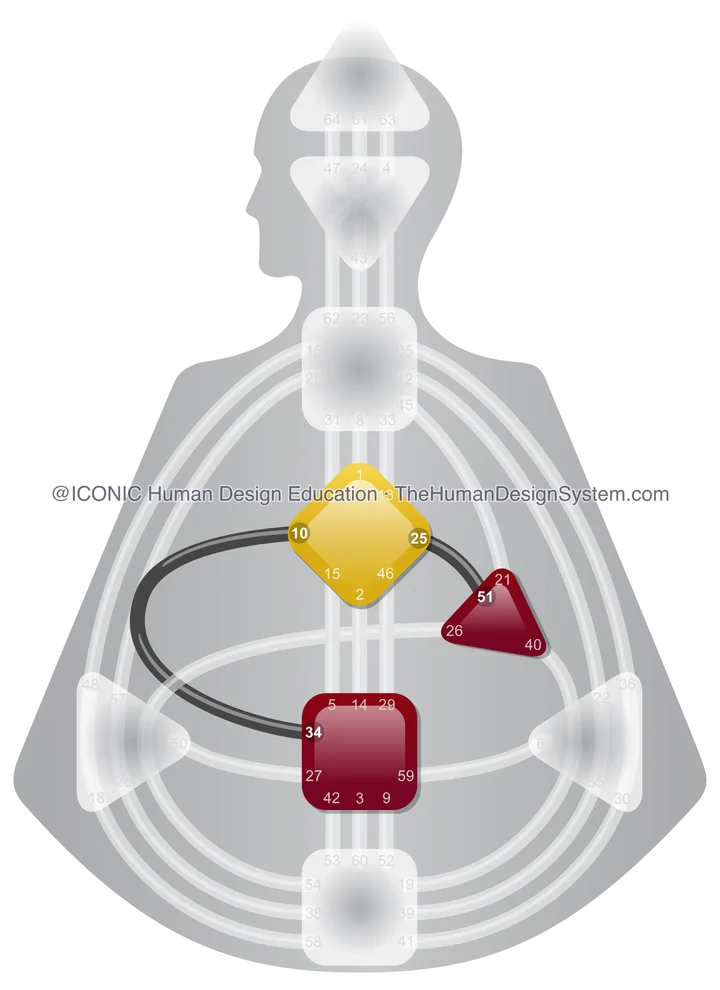
The Individual family has two circuits, and this is the smaller of them: two channels, both rooted in the G Center, against Individual Knowing’s nine. That is not a gap in the artwork or an oversight in the mechanics. It is simply how many channels this particular theme required.
What Individual circuitry is for
Individual circuits answer to no group. They are not about the tribe’s resources or the collective’s shared understanding; they are about the empowerment and mutation of one form, taken as far as it will go, with any benefit to other people arriving as a side effect of example rather than as the point. Individual Knowing carries that theme through sudden, unexplainable insight. Centering carries it differently: both of its channels root in the G Center, the seat of identity and direction, and both express self-love as a force rather than a feeling: one through the shock of beginning, the other through the conviction of continuing to live it out.
The two channels
25-51 Initiation joins the G Center to the Heart (Will) center. Gate 25 is the love of spirit itself, the kind that does not need a reason to keep going. Gate 51 is shock, the jolt that gets something moving when nothing else will. Put together, they produce a very particular kind of starter: not the strategist calculating the best opening move, but the person or moment that begins because beginning is, itself, an act of love.
10-34 Exploration joins the same G Center to the Sacral instead. Gate 10 is the love of being oneself, lived out as behavior and conviction. Gate 34 is raw, individual power, energy that answers to nobody’s agenda but its own. Together they keep that self-love going long after the initiating shock of 25-51 has passed, not the spark, but the fuel that sustains what the spark started. (Gates 10 and 34 also sit inside the four-gate cluster that separately forms the Integration Superchannel; the 10-34 channel itself, though, belongs here, not there.)
Living with this circuit
Carrying this circuit does not mean initiating constantly, or exploring constantly. It means that when either channel moves, it comes from a different place than ambition or obligation: something closer to devotion. The 25-51 side can look sudden to everyone standing nearby, because it usually is. The shock of Gate 51 rarely announces itself in advance, and the love of Gate 25 does not wait for consensus before it moves. The 10-34 side looks more like stubbornness from the outside, but it is the same self-love, sustained: living out your own convictions and behavior on your own terms, powered by Sacral response rather than anyone else’s plan.
The corresponding challenge is the same one every Individual circuit carries: this is not group-approved initiation, and it is not group-approved behavior either. Neither channel will always make tribal sense or collective sense, and trying to make either one make that kind of sense before acting on it tends to smother exactly the quality that made it worth having.
To see whether either of these two channels is part of your own definition, get your free chart. A professional reading will show you what carrying them actually looks like in your life.
For how the mystical potential in this circuitry actually shows up, and how it differs from what religion trained us to expect, read Why the Mystical Potential in Your Design Isn’t What Religion Taught You.
Every channel in the Individual Centering circuit
Frequently asked questions
What is the Individual Centering circuit in Human Design?
Individual Centering is the smaller of the two circuits in the Individual family: two channels, 25-51 (G Center to the Heart/Will center) and 10-34 (G Center to the Sacral). Both root in the G Center, the seat of identity and direction, and both express self-love as a force rather than a feeling, independent of tribal approval or collective usefulness.
Why is Individual Centering the smaller of the two Individual circuits?
The Individual family's two circuits aren't evenly sized; they're drawn from however many channels actually carry each theme, and Centering only needed two, against Knowing's nine. That doesn't make it minor. Two defined channels are a complete circuit the same way a single activated gate is a complete gate. The size of the set says nothing about the weight of what it carries.
What does the 25-51 channel actually do?
Gate 25 is universal love, the love of spirit and of the game of being alive, sitting in the G Center. Gate 51 is shock, the willingness to go first, sitting in the Heart (Will) center. Together they produce initiation that is not calculated: a person or moment that shocks its way into starting something, powered by love of the process rather than by a plan for the outcome.
What does the 10-34 channel actually do, and why is it Centering rather than Integration?
Gate 10 is the love of being oneself, expressed as behavior and conviction, also sitting in the G Center. Gate 34 is raw, individual power in the Sacral, energy that answers to nobody's agenda but its own. Together they sustain self-love as lived conduct, long after any initiating shock has passed. Both gates also belong to the four-gate cluster that separately forms the Integration Superchannel, which is why 10-34 gets miscounted as an Integration channel, but the channel itself is Centering's, rooted in the G Center exactly like 25-51 is.
How is Individual Centering different from Individual Knowing?
Both circuits belong to the Individual family and both empower the self first. Centering roots in the G Center and expresses through initiation and conviction: the spark that begins something, and the behavior that keeps living it. Knowing mutates: it is the insight that redirects something already moving. Two channels start the game and keep it going; the other nine channels change its rules mid-play. See the Individual Knowing circuit for the second half of the family.
Source and lineage
This entry is written in original words from Ra Uru Hu's source material as held by Jovian Archive, and taught by an IHDS Certified Independent Teacher. The mechanics (which center a gate sits in, which gates make a channel, how the authority hierarchy is ordered) come from the site's reference data, the same data the free chart runs on. To check either, see who writes here and the Human Design tools this site publishes.
Spotted an error on this page? Tell us and a human will look into it.