Diahann Carroll's Human Design Chart: The Left Angle Cross of Obscuration
Diahann Carroll was a 5/1 Emotional Generator with the entire top of her chart open: no fixed identity, no fixed voice, no fixed mind. A design built to be projected onto, in a career that made her the first at everything.

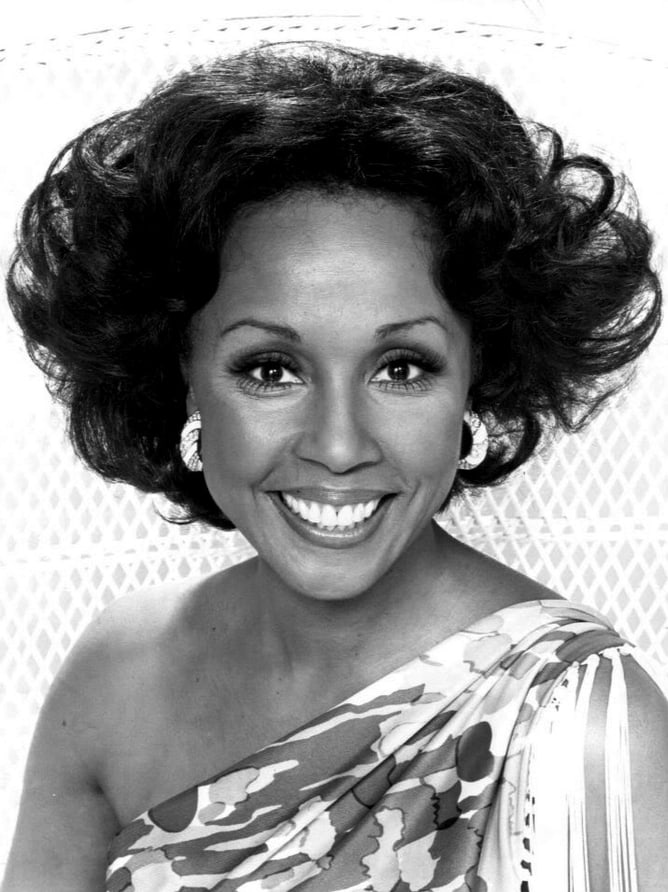
Diahann Carroll’s birth record carries a Rodden AA rating on Astro-Databank, birth certificate in hand, collected by the Wilsons: 17 July 1935, 9:35 PM, New York City. No disclosed ambiguity, no wartime clock, ordinary Eastern daylight time. The chart below is calculated from that record.
An Emotional Generator with the whole top of the chart open
Carroll is a Generator with Emotional authority, which means clarity arrives over time, across the wave, and never in the moment. Her five defined centers all sit in the lower two thirds of the bodygraph: Root, Sacral, Spleen, Solar Plexus and Heart. The Head, Ajna, Throat and G Center are all open.
That upper opening is the fact to sit with. She had no fixed way of thinking, no fixed voice, and no fixed sense of identity or direction. Everything above the diaphragm took its shape from whoever she was in the room with. Below it she was solid: consistent life force, consistent willpower, consistent instinct, a working emotional wave. So the design is a deeply powered body wearing a completely open mind and identity, and it is close to a diagram of the career she actually had. She was cast, repeatedly, as whatever a moment needed her to be: the ingénue in Carmen Jones at nineteen, the woman at the center of a Richard Rodgers musical written to make a point about interracial romance, a nurse in a sitcom carrying an entire national argument about representation, and later a jet-set diva on Dynasty whose function was to be impossible.
5/1: the one everybody projects onto
Carroll’s profile is 5/1, Heretic / Investigator, and if there is one line in Human Design built for what happened to her, this is it. The fifth line carries a projection field: people see in a 5 whatever solution they need, arrive with expectations the person never agreed to, and turn on them when the projection fails. The unconscious first line underneath needs a researched foundation before it feels safe to move at all.
Julia premiered in September 1968 and made Carroll the first Black woman to star in an American series in a role that was not a servant. She was thirty-three, and the show was received as a referendum. Critics called the character a white Negro; others called the series a milestone; hate mail and adoration arrived in the same sacks. Carroll said afterwards that she had been made to carry something no single performance could carry. That is the fifth line’s exact hazard, stated by someone living inside it, and the first line’s answer to it was the one she reached for repeatedly: preparation. She had trained at the High School of Music and Art, studied at NYU, and by her own account over-rehearsed everything.
Three channels, all of them about holding other people
Carroll’s definition is Split, two separate pieces of definition that never touch inside her own body, which means other people bridge her. Her split has a single closing gate: Gate 19, Approach, in the Root. She does not carry it. Anyone who does completes her chart into one connected piece for as long as they are in the room, and one gate is a narrow doorway for a whole design to depend on.
The three channels she carries are all about custody of other people. 40-37, the Channel of Community, joins Heart to Solar Plexus and is what the site’s page calls “the bargain”: willing work traded for belonging, loyalty, warmth. The page is direct about its failure state, and it reads like a summary of Carroll’s account of her own first marriage and the affair that followed it: “Resentment in this design is almost always a sign of an unspoken or broken bargain.”
27-50, the Channel of Preservation, joins Sacral to Spleen and makes its carrier the tribe’s custodian, with what the page names as its shadow: “Over-responsibility. This channel instinctively takes custody of whoever seems to need care.” 3-60, the Channel of Mutation, joins Root to Sacral and runs on a pulse, “nothing, nothing, nothing, then sudden change,” with a chemical melancholy in the gaps that the page insists is part of the process rather than a fault in it. Carroll’s career moved in precisely that rhythm: long fallow stretches of guest spots and nightclub dates, then a sudden discontinuity that changed what was possible for everyone behind her.
The Left Angle Cross of Obscuration
Carroll’s Incarnation Cross is the Left Angle Cross of Obscuration, personality Sun and Earth in Gate 62, Details, and Gate 61, Inner Truth; design Sun and Earth in Gate 3, Ordering, and Gate 50, Values. The cross’s own page describes a design for “walking into unlit rooms with a notebook,” and names the transpersonal karma attached: “the murk that calls you is almost always inhabited,” and the confusion you are built to clarify usually belongs to somebody else.
The page adds a detail that lands hard against Carroll’s biography. “From outside, you look like pure method: patient, exact, unhurried by ambiguity. From inside, something stranger is true.” The public Carroll was polished to a degree that became its own commentary, gowns and diction and control. The private account she eventually published was about crisis love affairs and dangerous dependencies. The cross names both halves and says the polish is how this design courts the thing it cannot pin down.
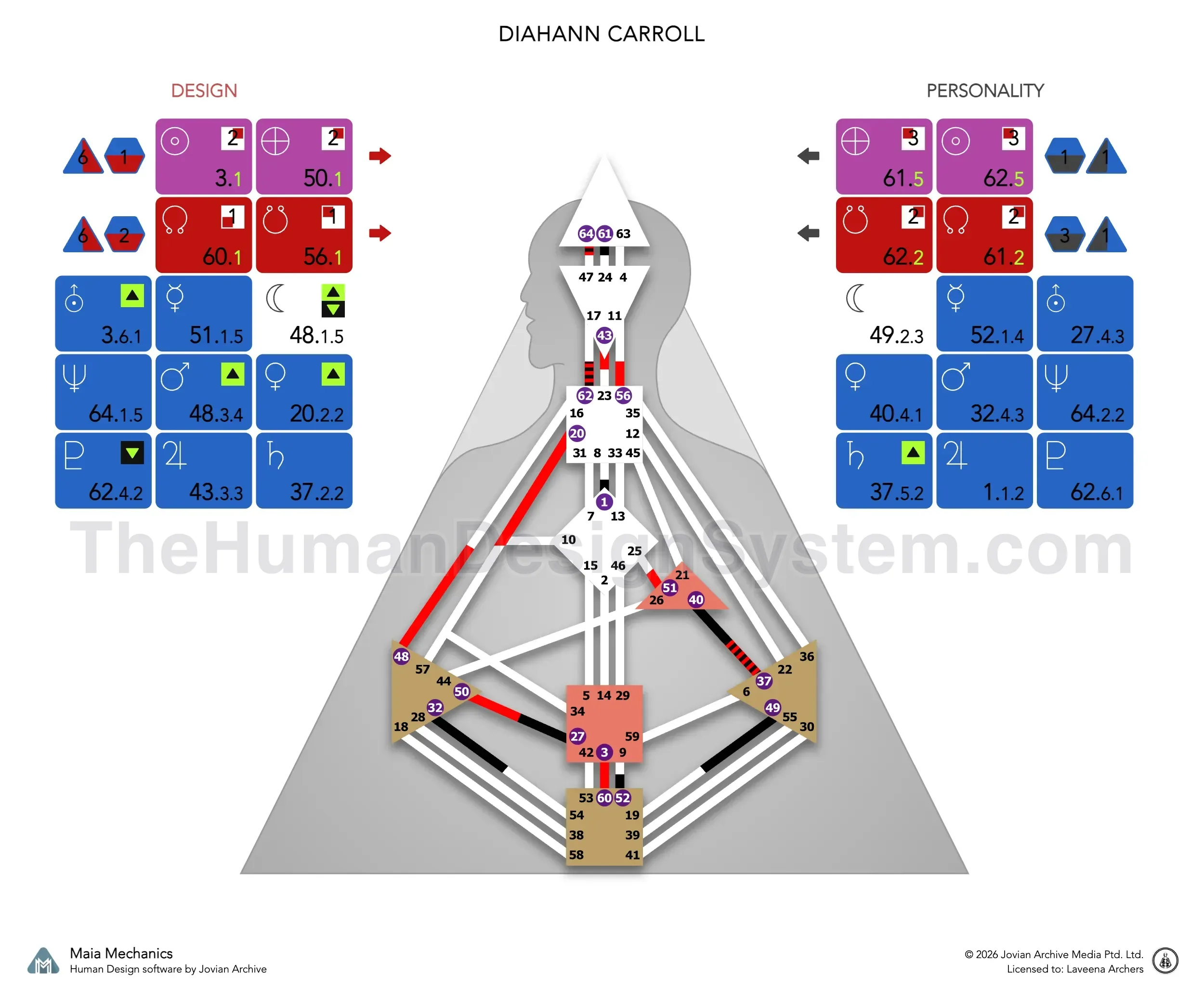
Diahann Carroll’s natal bodygraph, 5/1 Emotional Generator with Split Definition: Design and Personality, activated at birth.
Saturn Return, 1965
Carroll’s first Saturn Return fell 15 March 1965, age 29, under its own temporary cross, the Right Angle Cross of Eden (36/6 | 11/12).
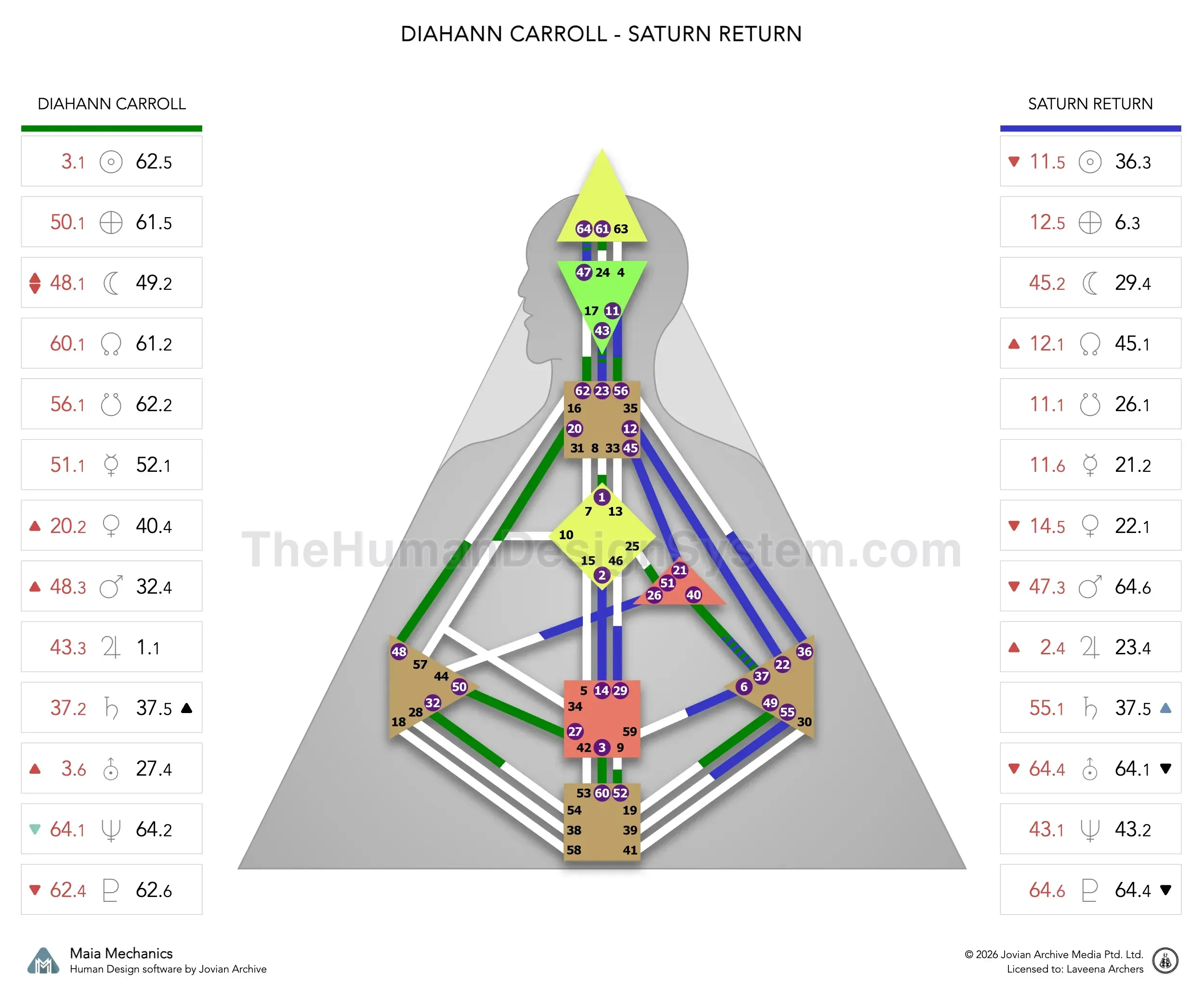
Natal chart against the March 1965 Saturn Return transit, age 29: this cycle’s own cross is the Right Angle Cross of Eden.
The structure being audited here was a bargain, which is what the 40-37 in her chart is built to make and built to feel the breaking of. Carroll had begun a relationship with Sidney Poitier in 1959, while both were married. By her own account in her autobiography, he persuaded her to divorce her husband on the understanding that he would leave his wife. She divorced Monte Kay in 1962. In 1965, the year of her Saturn Return, Poitier’s marriage did end. He did not marry her. The relationship ran three more years and finished in 1968.
A Saturn Return asks whether the terms a life was built on will actually be honored. Carroll’s were tested at the precise moment they became testable, and the answer arrived in the same year.
Uranus Opposition, 1975
Her Uranus Opposition landed 7 December 1975, age 40, under the Right Angle Cross of Consciousness (5/35 | 64/63).
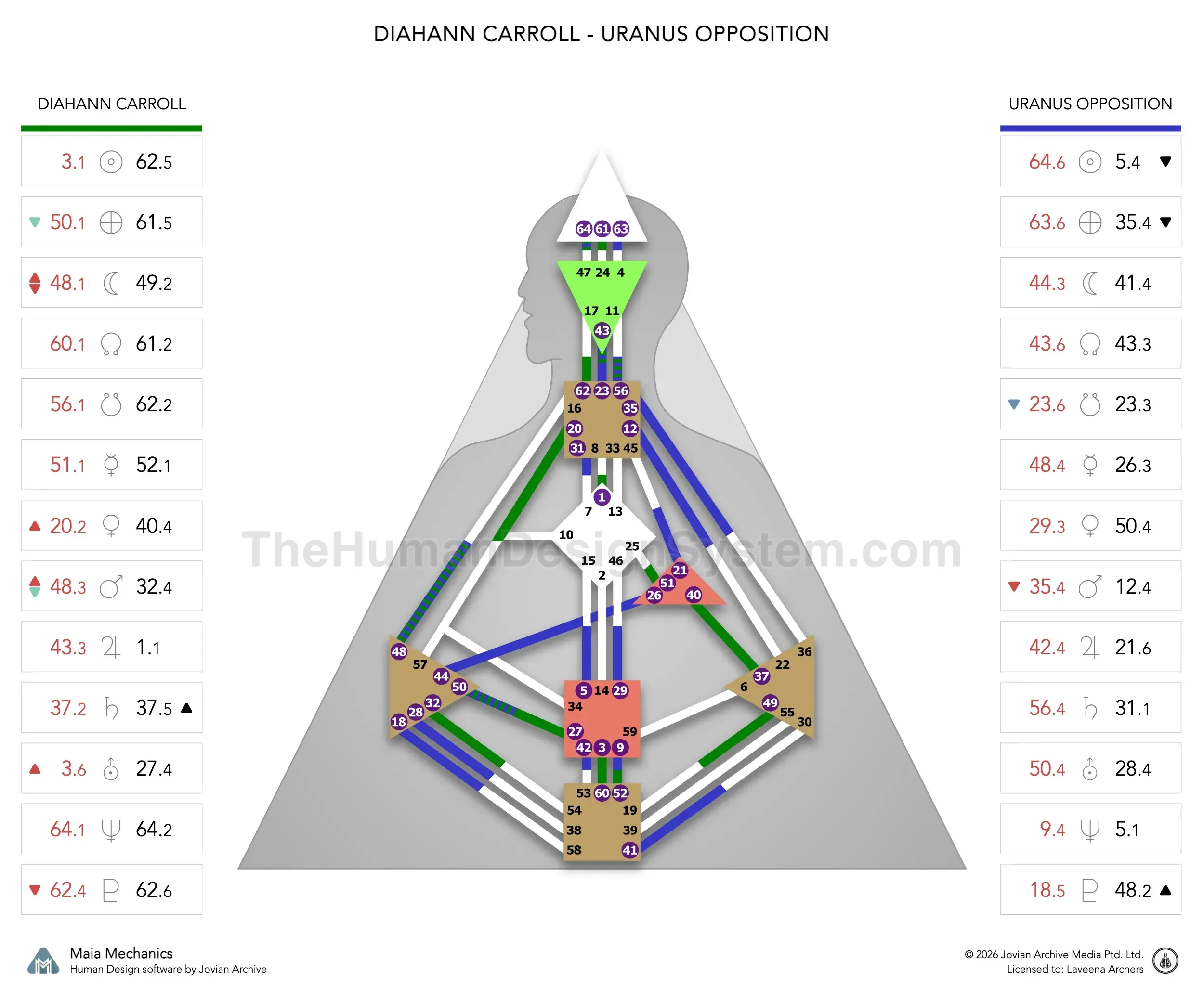
Natal chart against the December 1975 Uranus Opposition transit, age 40: this cycle’s own cross is the Right Angle Cross of Consciousness.
1975 rearranged everything at once. In February she was nominated for the Academy Award for Best Actress for Claudine, a part written for Diana Sands, who fell terminally ill before shooting and recommended Carroll to replace her. Robert DeLeon, the twenty-four-year-old managing editor of Jet, assigned himself the cover story about the nomination. On 25 May 1975 Carroll married him. She was thirty-nine. She left Los Angeles for Chicago because Jet was headquartered there, he resigned the job, and they moved again, to Oakland.
By the December of the opposition she had been nominated for the biggest prize of her career, married a man fifteen years younger whom she had met four months before the wedding, and relocated twice. A Uranus Opposition dismantles the arrangement of the first half of a life, and this one did the work in under twelve months. DeLeon was killed in a car crash in Beverly Hills on 31 March 1977, less than two years after the wedding.
Chiron Return, 1985
Carroll’s Chiron Return fell 13 August 1985, age 50, under the Right Angle Cross of Explanation (4/49 | 23/43).
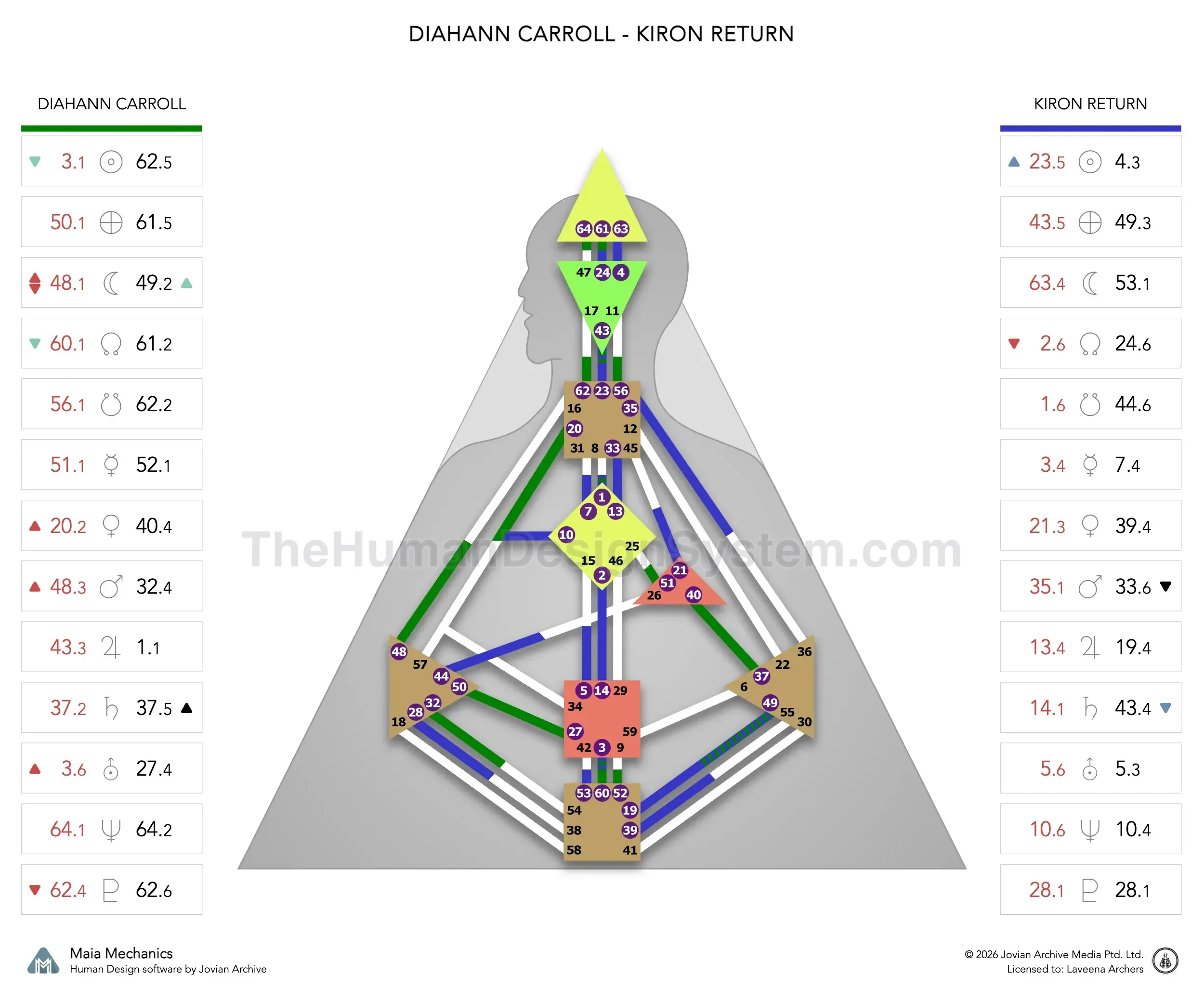
Natal chart against the August 1985 Chiron Return transit, age 50: this cycle’s own cross is the Right Angle Cross of Explanation.
She had joined Dynasty the year before as Dominique Deveraux, at fifty, in the most conspicuous role of her later career. What she was doing in private during the same stretch is the better match for the transit. By her own description she spent four years going back through her past to write Diahann: An Autobiography, which Little, Brown published in April 1986, eight months after the exact return. The book is an account of the crisis love affairs, the dependencies, the marriage that lasted three months and ended when her husband beat her.
A Chiron Return surfaces the wound and asks what can be done with it. A woman at the height of her visibility spending those same years writing down the parts nobody had seen, under a cycle cross named for explanation, is the transit doing its own job.
Second Saturn Return, 1994
Her second Saturn Return landed 24 April 1994, age 58, under the Right Angle Cross of The Unexpected (27/28 | 41/31).
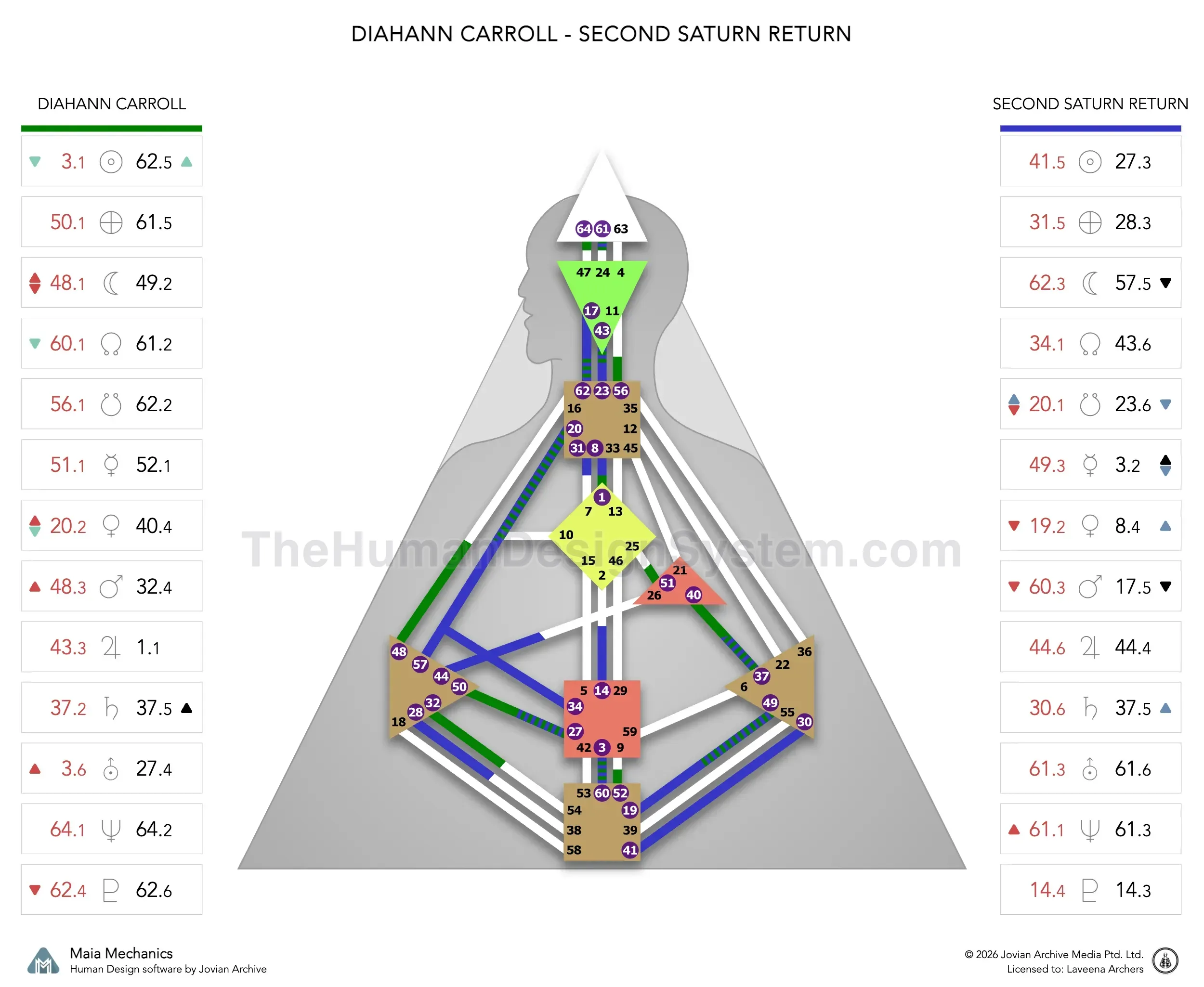
Natal chart against the April 1994 second Saturn Return transit, age 58: this cycle’s own cross is the Right Angle Cross of The Unexpected.
There is no single dated event on the return itself, and 1994 in Carroll’s working life is guest appearances: an episode of Burke’s Law, an episode of Evening Shade, a Perry Mason television film, and the start of a recurring role in the syndicated western Lonesome Dove: The Series. A Tony winner and an Oscar nominee, at fifty-eight, taking the week’s work.
The window either side of the date is a different picture, and it is the one a second Saturn Return is built to describe. It runs from October 1990 to October 1997. Her marriage to Vic Damone separated legally in 1991 and the divorce was finalized in 1996. In between she played Norma Desmond in the Canadian production of Sunset Boulevard, the largest stage role of her later career. In 1997 she filmed Eve’s Bayou and was diagnosed with breast cancer, which she treated with nine weeks of radiation and then spoke about publicly for the rest of her life. A marriage ending, a career-scale stage role, and a diagnosis, all inside seven years centered on the return.
What the audit produced showed up eighteen months later. On 15 October 1995 Carroll opened in Toronto as Norma Desmond in Andrew Lloyd Webber’s Sunset Boulevard, the first Black woman cast in the part, at sixty. The run lasted until August 1996 and then moved to Vancouver. The 3-60 pulse in her chart works on this rhythm: a long flat stretch where nothing appears to be happening, and then a change that had no obvious precedent.
What the four returns show
Read together, the pattern is a 5/1 being handed the same test in four different registers. A Saturn Return that called in a private bargain and found it wouldn’t hold. A Uranus Opposition that broke the shape of her life in a single year and cost her a husband within two. A Chiron Return she spent writing the wound down. A second Saturn Return that looked like nothing and was followed by a role no one had offered a Black actress before. The Cross of Obscuration keeps handing its carrier the undefined thing, the situation nobody has described accurately yet, and Carroll kept taking it and coming back with the description.
If your own chart is Split, and you’ve noticed you become a different person depending on who’s in the room, pull your free chart and see where the bridge actually falls. And if you’re a 5/1 carrying other people’s projections and want a trained read on which expectations are yours to meet, a professional reading is built for that distinction.
Her last Solar Return, and the day she died
Carroll died on October 4, 2019, at her home in Los Angeles, after years of living with breast cancer, a diagnosis she had made public in the late 1990s and turned into steady advocacy for early screening. She was eighty-four. No time of death was recorded in any public account; the published death notice gives the date and the place and nothing finer. Where the record stops, this series stops with it. A Solar Return is computed from birth data alone, so her last one is still fully readable.
Her last Solar Return, the chart for her final birthday on July 17, 2019, landed her transiting Sun and Earth on the identical Gate 62 and Gate 61 they occupy natally, computed in Maia Mechanics against the stated 9:35pm birth time. Two channels connected that year’s sky to her own design: the 32-54 Channel of Transformation, the sky’s Gate 54 reaching her Gate 32, and the 49-19 Channel of Synthesis, the sky’s Gate 19 meeting her Gate 49. Gate 19 is the doorway this post has already described, the single closing gate of her Split Definition, the one she does not carry, the one other people had to bring into the room for her chart to become one connected piece. In the chart of her final birthday, the sky itself brought it. Both bridges run on the tribal Ego circuit, the same circuit her own 40-37 belongs to, so her final year’s sky arrived speaking the language her chart already knew, the bargain and the belonging and the custody of other people.
In memory of an ICONIC Human Design,
LaVeena B. Archers, PhD
Chart via myBodyGraph, rendered through Maia Mechanics, Human Design Professional Software licensed from Jovian Archive, birth data via Astro-Databank.