Franklin D. Roosevelt's Human Design: Born a Year Before the Clock Standardized
FDR's birth certificate gives an exact time, but the year on it, 1882, is one year before the United States adopted standard time at all. What that does to the chart, and what it doesn't.

Franklin Roosevelt has the best-documented time in this series so far, a quoted birth certificate. He also has a wrinkle none of the certificate-holding presidents after him share: the certificate is dated to a year before the concept it’s implicitly using existed.
The record
Astro-Databank: astro.com/astro-databank/Roosevelt,_Franklin_D.
| Field | Value |
|---|---|
| Birthname | Franklin Delano Roosevelt |
| Date | January 30, 1882 |
| Time | 8:45 PM |
| Place | Hyde Park, Dutchess County, New York |
| Rodden rating | AA |
| Source | Quoted birth certificate |
The clock. The United States didn’t adopt standard time zones until November 18, 1883, almost two full years after Roosevelt’s birth. Before that date, clocks ran on local mean time, the actual solar time at each specific longitude, which varies continuously from place to place rather than snapping to a zone boundary. A chart run on the assumption that 1882 New York used the same Eastern Time offset it uses today would be computing against a standard that didn’t exist yet. I confirmed the in-house engine applies the correct local mean time for Hyde Park’s longitude for this date, then confirmed the resulting chart directly against Maia Mechanics, Human Design Professional Software licensed from Jovian Archive. The two agree in full, gate for gate, layer for layer.
What holds at every hour of the day
I ran the full twenty-four hours of January 30, 1882, Hyde Park, New York, at one-minute resolution. Maia Mechanics confirms the 8:45 PM chart directly, including the Incarnation Cross name, which matters given this site’s own cross-reference table has a known numbering bug affecting eleven of sixteen four-variant Right Angle families:
- Authority: Emotional, Solar Plexus, all day
- Incarnation Cross: Right Angle Cross of The Four Ways 4, Gates 19 and 33 personality, Gates 44 and 24 design
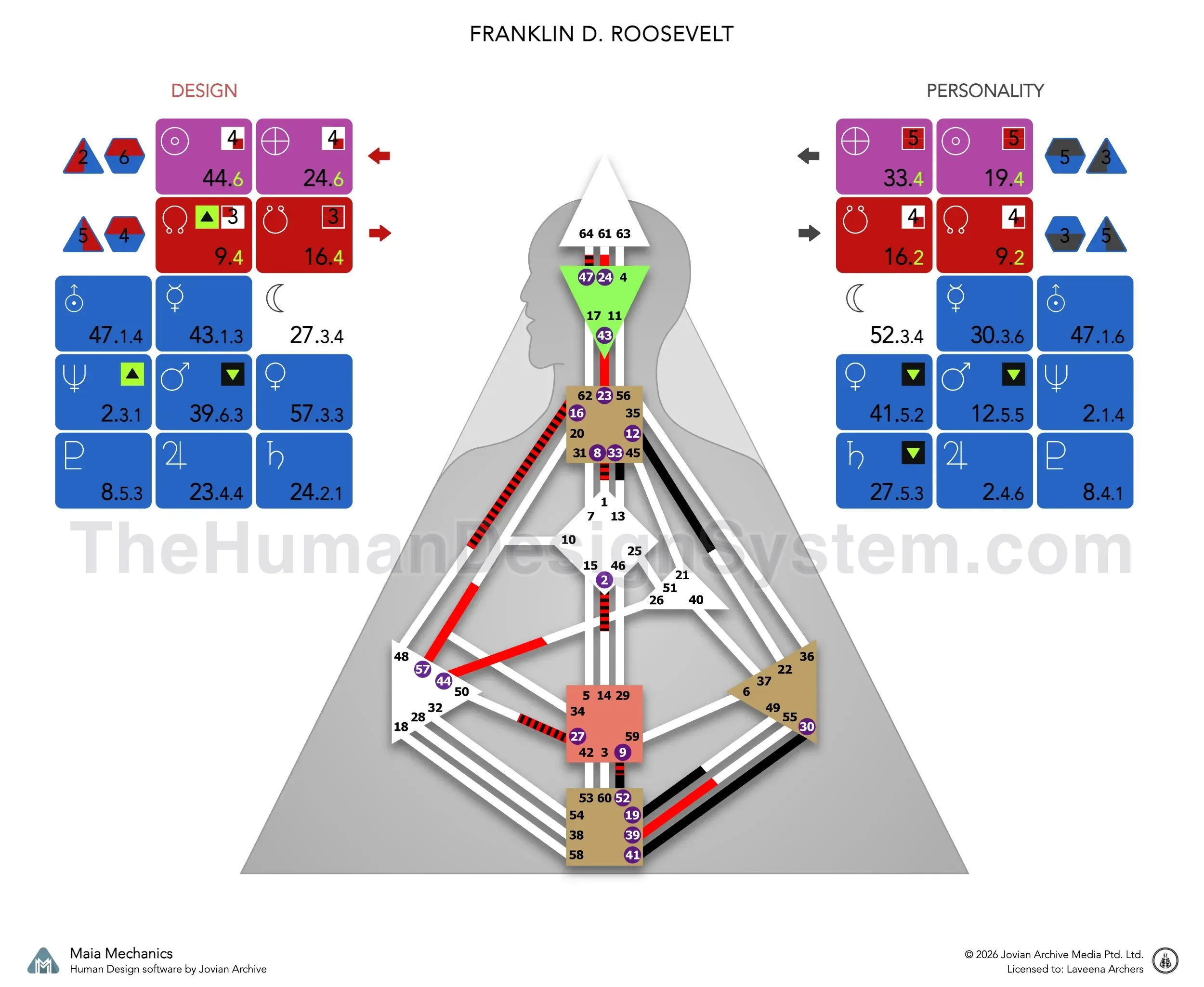 Roosevelt in Maia Mechanics at the stated 8:45pm, on the Generator side of the day’s type boundary. Right Angle Cross of The Four Ways 4, gates 19 and 33 personality, 44 and 24 design.
Authority never moves, which is the more decision-relevant of the two facts. What isn’t stable is Type itself.
Where it breaks: two boundaries, one of them a type flip
| Local time | What changes |
|---|---|
| 4:12am → 4:13am | Profile 3/6 → 4/6 |
| 4:03pm → 4:04pm | Type: Projector → Generator |
| 11:25pm → 11:26pm | Profile 4/6 → 4/1 |
The middle boundary is the one that matters. Before 4:04 PM, Roosevelt’s chart reads as a Projector, guided by invitation rather than initiation. After it, a channel completes that turns him into a Generator, built to respond rather than wait. His stated 8:45 PM sits more than four and a half hours past that boundary, and nearly seven hours clear of the following profile change at 11:25 PM, comfortably inside the Generator window with real margin on both sides.
What a year-early certificate does and doesn’t buy
The certificate’s precision, 8:45 PM to the minute, is the kind of record this series treats as gold-standard. The pre-standard-time clock doesn’t undercut that; a correctly applied local mean time is still a real, computable offset, and Maia Mechanics computing an identical chart from the same inputs confirms the math holds regardless of which clock convention the year officially ran on. What the wrinkle does buy is a caution for any chart from this specific stretch, the roughly two years between when a president’s records started getting certificate-precise and when the country’s clocks agreed on what “8:45 PM” universally meant. A birth an hour zone away, computed the lazy way with a modern time-zone assumption instead of the actual local mean time, would land in an entirely different part of the day, and given the type boundary sitting at 4:04 PM, that kind of shortcut could plausibly flip the very fact that decides Strategy.
His last Solar Return, and the day he died
Roosevelt died on April 12, 1945, at the Little White House in Warm Springs, Georgia, sitting for a portrait in the early afternoon when a massive cerebral hemorrhage took him. He was pronounced dead at 3:35 PM, sixty-three years old, not yet three months into his fourth term. The time is as well documented as a presidential death gets, carried in his physician’s account and in the White House announcement that same afternoon, both recounted by the National Constitution Center. Even here the clock demands a convention: 3:35 PM meant Eastern War Time, the year-round daylight schedule Congress kept from 1942 to 1945, so the chart is computed for a 7:35 PM Greenwich instant. Born before the country had standard time, he died on a clock the country had moved for a war.
His last Solar Return, the chart for his final birthday on January 30, 1945, landed his transiting Sun and Earth on the identical Gate 19 and Gate 33 they occupy natally, computed in Maia Mechanics against the same Hyde Park local mean time the birth chart runs on. Two channels connected that year’s sky to his own design, and both of them run between the Head and the Ajna: the 64-47 Channel of Abstraction and the 61-24 Channel of Awareness, the bodygraph’s cranial-pressure wiring, bridged across the final year of a life that ended with a bleed inside the skull.
What his own chart’s Bardo sequence shows in the hours after his death, read through the mechanics Ra Uru Hu taught from his own passing, is its own piece: Franklin D. Roosevelt’s Bardo: The Unfinished Portrait.
What his cycles show
Roosevelt’s natal cross, the Right Angle Cross of The Four Ways, carried on a 4/6 profile, runs on sensing what a moment or a room needs, then finding the right approach to meet it, tested privately before it’s ever offered in public.
- Saturn Return, 1910, age 28. Under the Right Angle Cross of The Unexpected (31/41 | 27/28), he accepted the Democratic nomination for the New York State Senate that October, a seat no Democrat had won from his district in more than thirty years, and won it that November.
- Uranus Opposition, 1924, age 42. Under the Right Angle Cross of Eden (36/6 | 11/12), he delivered the “Happy Warrior” speech nominating Al Smith at the Democratic National Convention on June 26, walking to the podium on crutches for one of his first major public appearances since polio had struck him three years earlier.
- Chiron Return, 1930, age 48. Under the Right Angle Cross of Tension (39/38 | 21/48), he won re-election as Governor of New York in a landslide that November, the win that put him on the national radar for 1932.
- Second Saturn Return, 1940, age 58. Under the Left Angle Cross of Defiance (2/1 | 49/4), he delivered the “Stab in the Back” speech at the University of Virginia on June 10, a month after the exact date, condemning Italy’s invasion of France and arguing against American isolationism.
In memory of an ICONIC Human Design,
LaVeena B. Archers, PhD
Chart computed against the in-house engine (src/lib/hd/chart.js, src/lib/hd/timezone.js) at one-minute resolution across all twenty-four hours of January 30, 1882, Hyde Park, New York, applying local mean time for the pre-standard-time date. Cross-checked directly against Maia Mechanics, the licensed Jovian Archive software, at the stated 8:45pm time; the two agree in full, including the Incarnation Cross name. Astro-Databank record: astro.com/astro-databank/Roosevelt,_Franklin_D., Rodden rating AA. This is a chart and a data-quality case, with no partisan framing or commentary on any administration intended or offered.