Jean-Paul Sartre's Human Design Chart: The Right Angle Cross of the Vessel of Love
Sartre was a 2/4 Emotional Manifesting Generator carrying 43-23, the channel the site calls genius to freak. The philosopher of radical freedom was born on a fixed cross made entirely of G Center gates, and every one of them is about love.

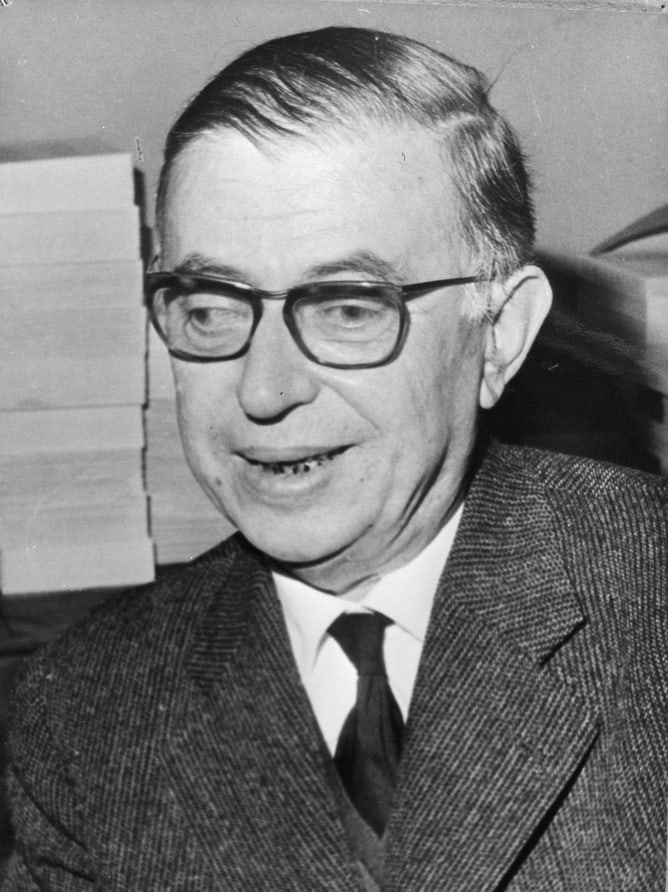
Jean-Paul Sartre’s birth record carries a Rodden AA rating on Astro-Databank, birth certificate in hand, collected by Geslain: 21 June 1905, 6:45 PM, Paris. The clock is the one detail worth checking before anything else. France did not run on Greenwich time in 1905. It ran on Paris Mean Time, nine minutes and twenty-one seconds ahead of Greenwich, and did not switch until March 1911. A chart calculated as though 6:45 PM in Paris meant 6:45 PM in London would be nine minutes wrong. The chart below is calculated with the Paris Mean Time offset applied, which puts his birth at 18:35 UTC.
A Manifesting Generator with a defined Throat and an open G
Sartre is a Manifesting Generator with Emotional authority: a Sacral engine wired through to a voice, and clarity that only arrives across time rather than in the moment. His strategy is to wait to respond, and the not-self theme is frustration with anger underneath it.
Six centers are defined: Ajna, Throat, Heart, Solar Plexus, Sacral and Spleen. Three are open: the Head, the Root, and the G Center. That last one is the interesting absence. The G Center carries identity, love and direction, and Sartre’s is open, taking its sense of who he was and where he was headed from whatever surrounded him.
A man with no fixed identity in his own bodygraph built a philosophy on the claim that there is no fixed human nature, that existence precedes essence, and that a person is nothing but the sum of what they do. Human Design does not need that correspondence to be true to be worth noticing, and the correspondence is there in the mechanics.
43-23, and the difference between genius and freak
Two of Sartre’s channels connect thought to speech. 43-23, the Channel of Structuring, links Ajna to Throat in the Individual Knowing circuit, and the site’s own page names the knife-edge it lives on: “the same insight, spoken at different moments, produces opposite results. Delivered when people are open and asking, it sounds like genius; blurted into a closed room, it sounds bizarre. The mechanics don’t change; the reception does.”
Sartre’s reception followed that rule with unusual literalness. La Nausée in 1938 was read by a small circle. L’Être et le Néant in 1943 was a dense phenomenological treatise published under occupation. Then in the autumn of 1945 he gave a public lecture on existentialism to a crowd that overflowed the room, and within two years the same body of thought was a mass European phenomenon and he was the most famous living philosopher in the world. The insight had not changed. The room had opened.
The page also describes what this channel’s carrier has to do to be understood: “context first, one concept at a time, invited questions,” because the insight arrives whole, without the steps that produced it. Sartre wrote novels and plays alongside the philosophy for most of his career, which is one way of describing the same problem being solved.
45-21, the Channel of Money, joins Throat to Heart and carries what the site calls the voice of ownership, along with a real need for autonomy: “Gate 21 can only work on its own terms.” Sartre co-founded and co-edited Les Temps Modernes in 1945 and kept it running for the rest of his life, refused the Légion d’honneur, refused a chair at the Collège de France, and refused the Nobel Prize. That is Gate 21 declining to be managed.
His other two channels, 40-37 Community and 27-50 Preservation, are both tribal, both about the bargain and the custody of other people. For a philosopher of individual freedom, half the defined circuitry in his body is about obligation to a group.
2/4: the hermit who lives inside a network
Sartre’s profile is 2/4, Hermit / Opportunist. The conscious second line needs to be left alone and then called out by name; the unconscious fourth line lives and works entirely through a fixed network of known people, and does not do well outside it.
Both halves are documented to the point of caricature. He wrote in cafés for hours a day, in isolation inside a crowd, and told an interviewer that he had never been unhappy while writing. And his life was one network, small and permanent: Simone de Beauvoir from 1929 until his death, Paul Nizan from the École Normale, Camus until the break, Merleau-Ponty, Michel Leiris, the Temps Modernes circle. He and Beauvoir are buried in the same grave at Montparnasse. A 2/4 gets found, and then it stays.
The Right Angle Cross of the Vessel of Love
Sartre’s Incarnation Cross is the Right Angle Cross of the Vessel of Love, personality Sun and Earth in Gate 15, Extremes, and Gate 10, Behavior of the Self; design Sun and Earth in Gate 25, the Spirit of the Self, and Gate 46, Determination. All four gates sit in the G Center, the one center in his chart with nothing fixed in it, and every one of them is a gate of love.
Maia numbers this configuration differently from the way our own cross index does, so the ordinal after the name varies by source; the four gates and the Right Angle are the same in both.
The cross’s page describes Gate 15 as “the widest embrace in the G Center: love of humanity expressed as acceptance of the full spectrum of human rhythms,” and Gate 10 as love of self “lived as how you actually behave when no one’s watching.” The design pair adds Gate 25’s impersonal, unconditional warmth, “the same warmth for stranger and intimate alike,” and Gate 46’s commitment to physical existence.
Read against the life, this is the most uncomfortable cross in the set, and the discomfort is the point. Sartre wrote the line about hell being other people and then spent fifty years in a lifelong open partnership, an editorial collective, and a series of political commitments made on behalf of people he would never meet. The page warns about the specific failure mode of a 15/10 lead: “your acceptance of others is rarely the problem, self-abandonment is.” A man who drank heavily, chain-smoked two packs a day, took amphetamines to write, and worked himself to physical ruin by his sixties is not a stranger to that warning.
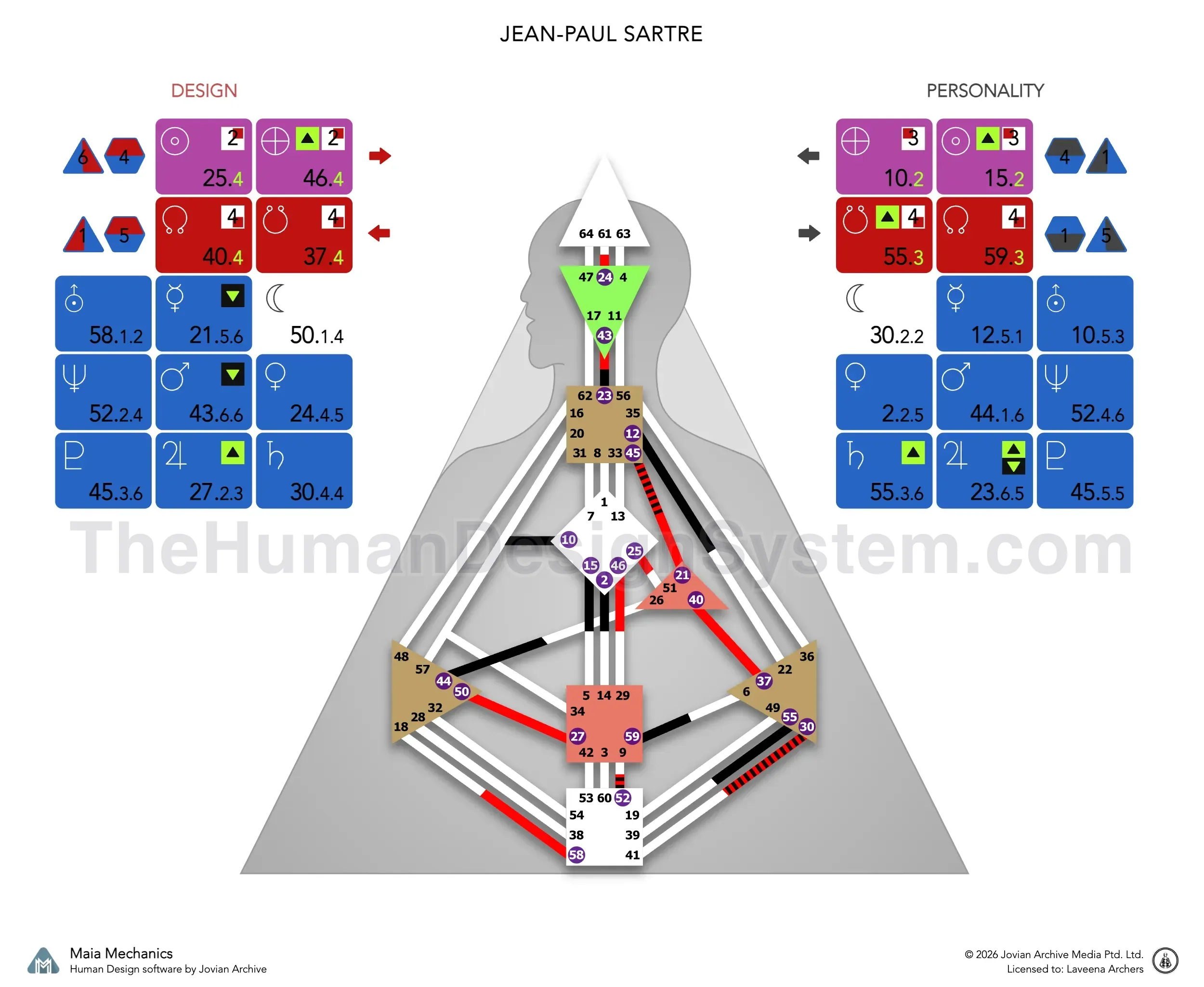
Jean-Paul Sartre’s natal bodygraph, 2/4 Emotional Manifesting Generator: Design and Personality, activated at birth.
Saturn Return, 1935
Sartre’s first Saturn Return fell 10 March 1935, age 29, under its own temporary cross, the Right Angle Cross of Rulership (22/47 | 26/45).
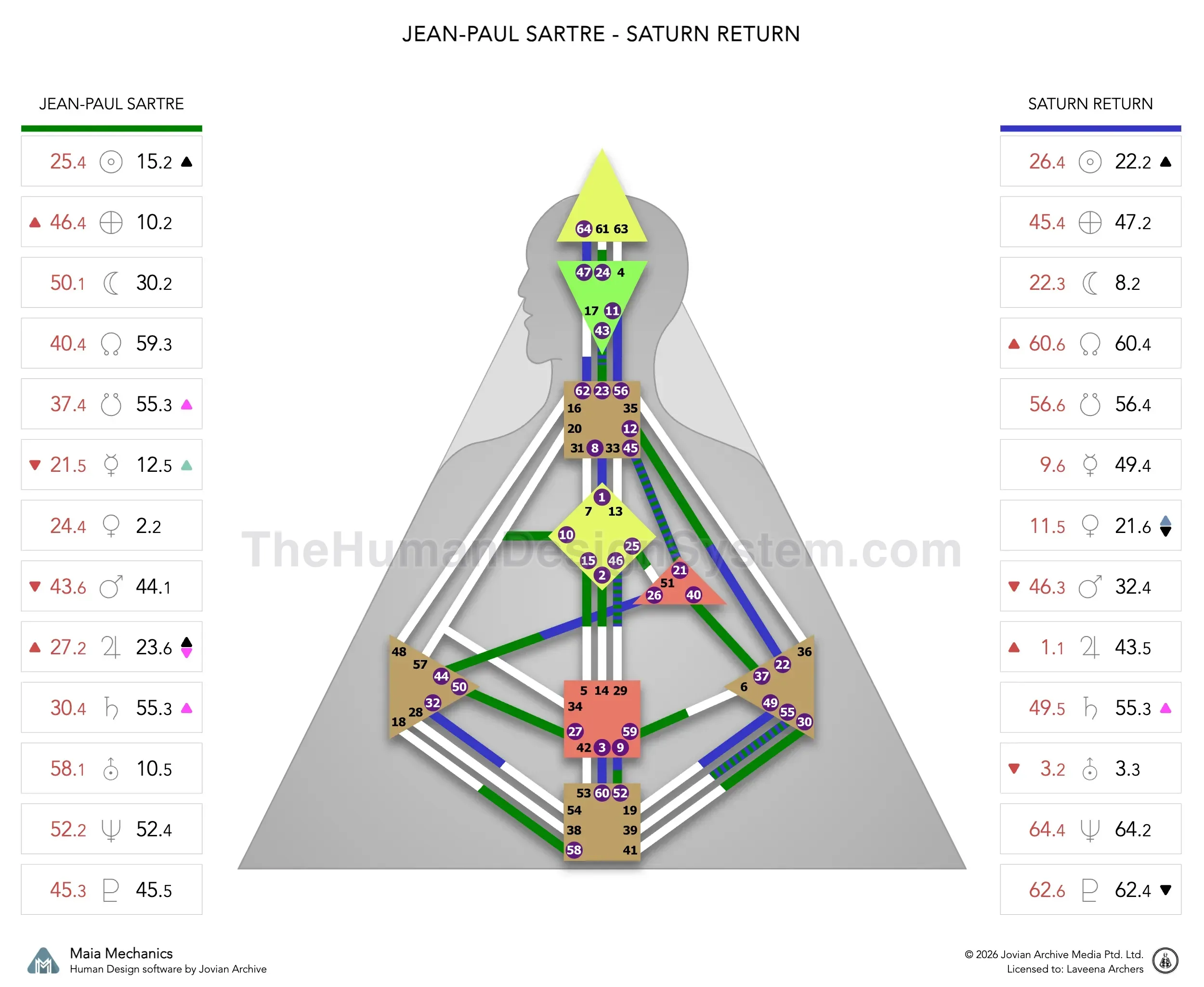
Natal chart against the March 1935 Saturn Return transit, age 29: this cycle’s own cross is the Right Angle Cross of Rulership.
In February 1935, weeks before the return, Sartre had himself injected with mescaline at the Sainte-Anne psychiatric hospital in Paris under the supervision of the psychiatrist Daniel Lagache, who was working on phenomenology. He wanted material on the structure of the imagination and volunteered his own mind for it.
Beauvoir’s account of what happened is specific: umbrella-vultures, skeleton-shoes, monstrous faces, crawling crabs and octopi at the edge of his vision, which vanished when he looked at them directly. The effects did not stop with the drug. He was pursued by flashbacks for months, and told an interviewer in 1971 that for a long stretch afterwards a giant lobster followed him around, always about to arrive.
A Saturn Return audits the structure a life is being built on, and the structure Sartre was building was a theory of consciousness. He audited it by breaking his own. The work went into L’Imagination in 1936 and L’Imaginaire in 1940, and the crabs turn up again decades later in his play Les Séquestrés d’Altona.
Uranus Opposition, 1949
His Uranus Opposition landed 20 July 1949, age 44, under the Right Angle Cross of Laws (56/60 | 3/50).
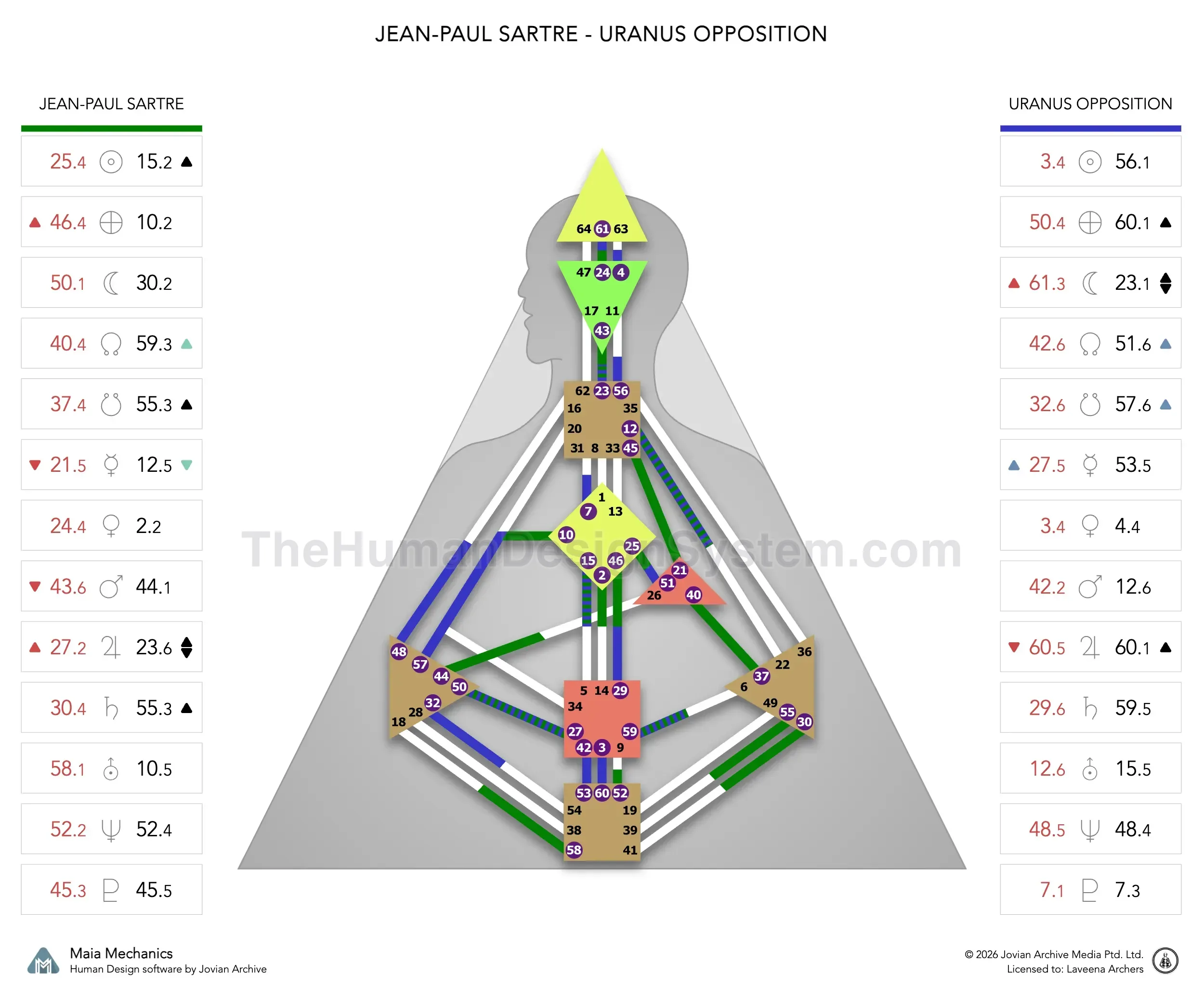
Natal chart against the July 1949 Uranus Opposition transit, age 44: this cycle’s own cross is the Right Angle Cross of Laws.
Sartre spent 1948 and 1949 attempting the one thing his chart is least built for: founding an institution. With David Rousset and Georges Altman he set up the Rassemblement Démocratique Révolutionnaire, a left grouping independent of both the Communist Party and the pro-American Socialists. Its paper, La Gauche, ran from May 1948 to March 1949. The organization came apart across the year of his opposition over the one question it existed to avoid, which side of the Cold War it was actually on. Sartre resigned in October 1949 and the RDR was finished by December.
A Uranus Opposition breaks the structure a person spent their first half building toward, and it broke this one under a cycle cross named for laws. Sartre never founded another party. He went back to the thing his 43-23 was built for and wrote, and the political influence he had for the next thirty years came through a magazine and a signature rather than an organization.
Chiron Return, 1956
Sartre’s Chiron Return fell 25 January 1956, age 50, under the Right Angle Cross of The Unexpected (41/31 | 28/27).
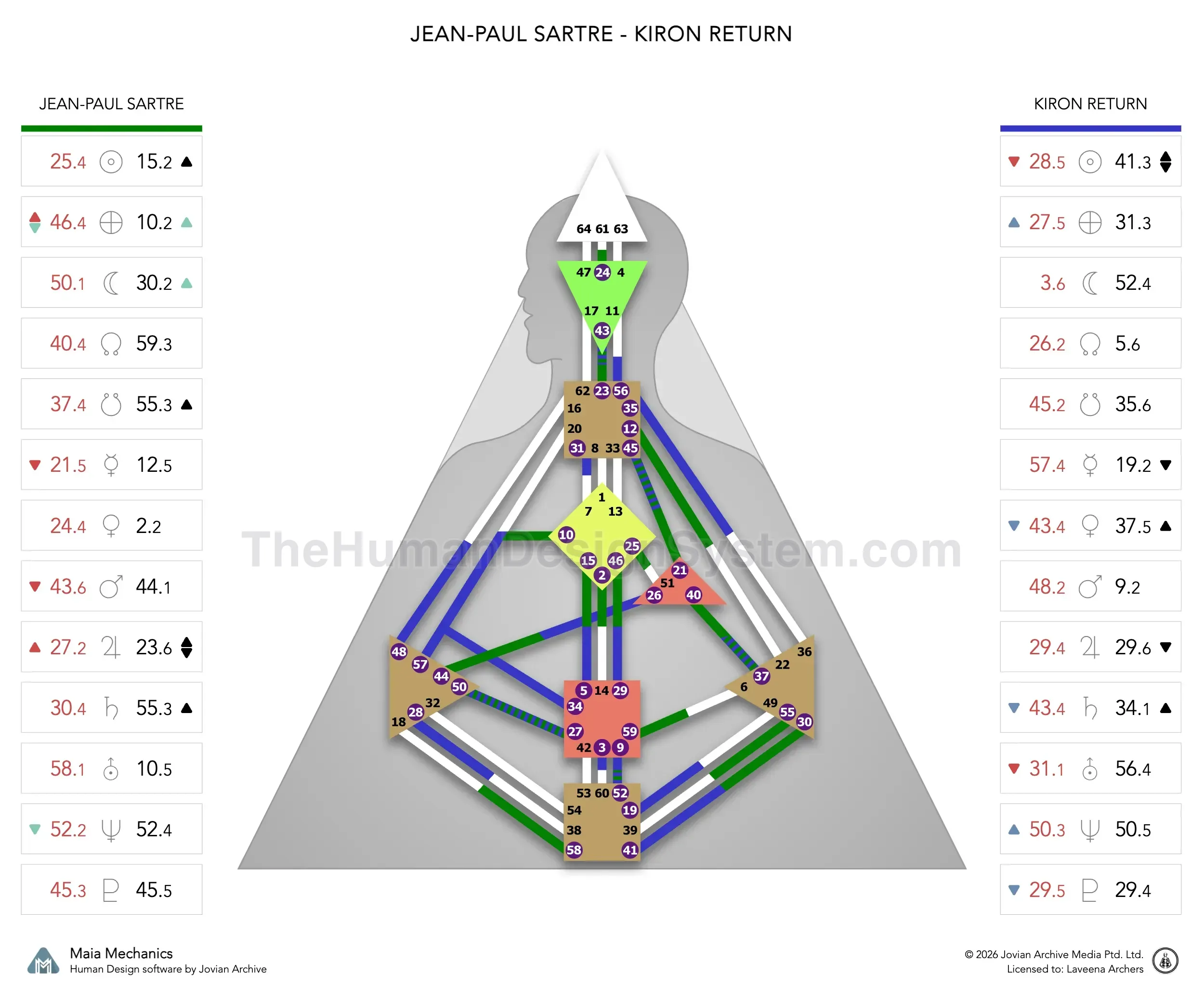
Natal chart against the January 1956 Chiron Return transit, age 50: this cycle’s own cross is the Right Angle Cross of The Unexpected.
Two days after the return, on 27 January 1956, Sartre spoke at the Salle Wagram in Paris at a meeting of the committee of intellectuals against the continuation of the war in North Africa, on a platform that also held Aimé Césaire, Michel Leiris, Alioune Diop and Daniel Guérin. The address was published in Les Temps Modernes that spring under the title “Le colonialisme est un système”: colonialism as a machine with a structure, rather than a set of individual excesses that better administration could correct. It committed him publicly against his own country’s war, at real cost, for the next six years.
That is a Chiron Return doing what it does. The wound this transit surfaces belongs to the carrier, and for a Frenchman at fifty the wound was French. Later the same year, after Soviet tanks entered Budapest on 4 November, he broke publicly with the French Communist Party in “Le Fantôme de Staline.” Both of 1956’s ruptures were with something he had belonged to.
Second Saturn Return, 1964
His second Saturn Return landed 23 April 1964, age 58, under the Right Angle Cross of The Unexpected (27/28 | 41/31), the same cross as his Chiron Return with the gates rotated into the opposite position.
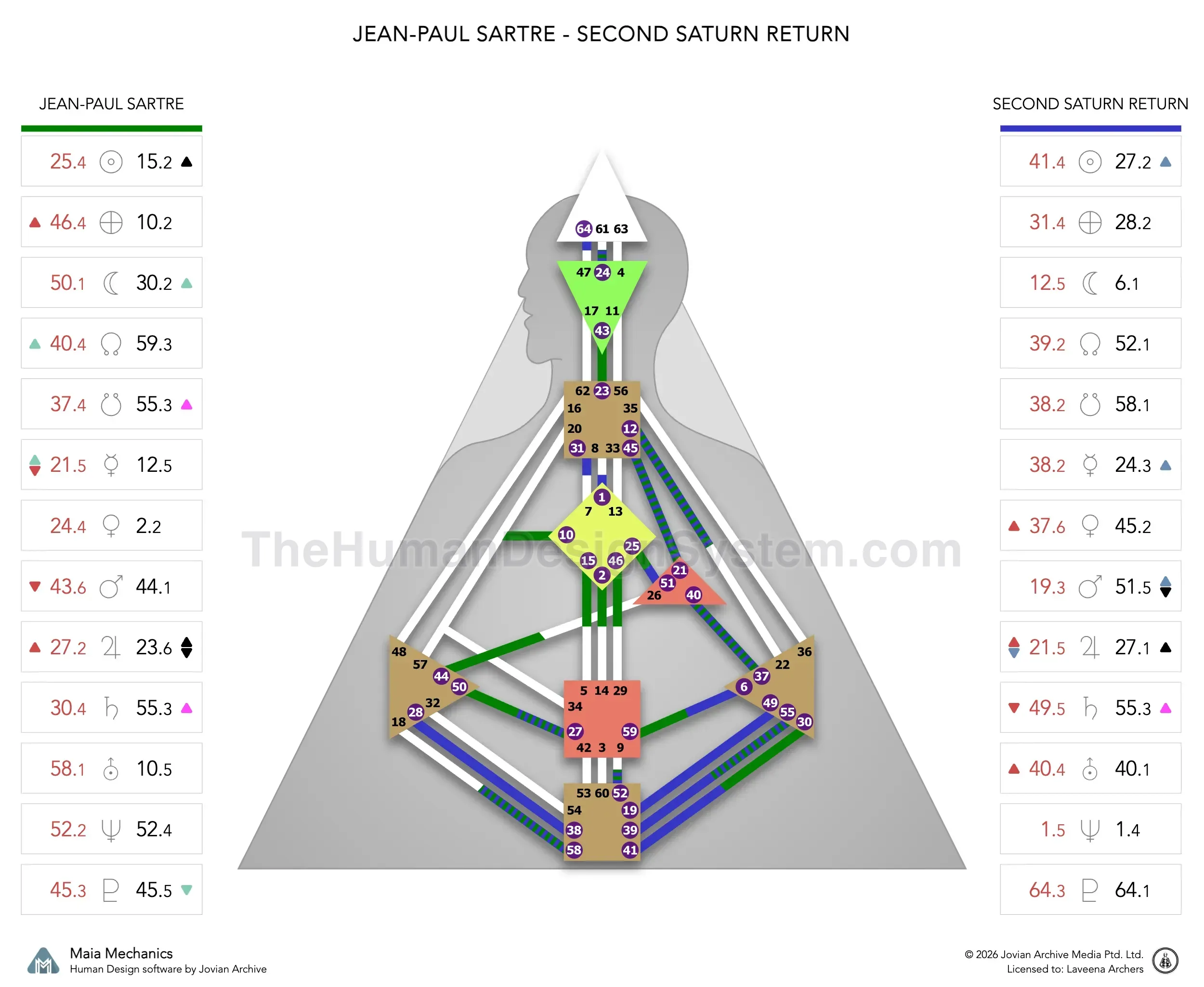
Natal chart against the April 1964 second Saturn Return transit, age 58: this cycle’s own cross is the Right Angle Cross of The Unexpected.
Five days before the return, on 18 April 1964, Le Monde published Jacqueline Piatier’s interview with Sartre about Les Mots, the account of his own childhood he had just published. Asked what literature could do, he said that faced with a dying child, La Nausée does not measure up.
A second Saturn Return audits what a life has actually built, and Sartre performed the audit himself, in print, on his own best book, at fifty-eight. Six months later, on 22 October 1964, the Swedish Academy awarded him the Nobel Prize in Literature and he refused it, on the grounds that a writer should not allow himself to be turned into an institution. Boris Pasternak had been forced to decline it in 1958 under Soviet pressure; Sartre remains the only writer to have turned the literature prize down of his own accord.
What the four returns show
Read together, the four cycles show a design that kept auditing itself out loud. A Saturn Return spent testing a theory of consciousness by dismantling his own. A Uranus Opposition that ended the one attempt to build an institution. A Chiron Return that opened two days later with a speech against his own country. A second Saturn Return in which he told a newspaper his masterpiece did not weigh enough, and then turned down the highest honor his field could give him.
The Vessel of Love is a Right Angle cross, which means it is filled through personal lived experience rather than through a mission. Sartre spent his experience arguing that no one is owed a fixed self and that everyone is responsible for the one they build. It is a strange life to find on a cross made entirely of gates about love, until you notice that all four of them sit in the one center he was born with open.
If your own G Center is open and you’ve spent years wondering why your sense of who you are keeps changing with the company, pull your free chart and see what’s actually fixed in your design. And if you carry 43-23 and are tired of watching faces glaze over, a professional reading is built for the timing question underneath that.
His last Solar Return, and the day he died
Sartre died on April 15, 1980, at the Hôpital Broussais in Paris, of pulmonary edema, sixty-seven days short of his seventy-fifth birthday (Wikipedia). No time of death is on the public record, and this series leaves the hour blank rather than estimate one; the Solar Return needs only his birth data, so nothing below depends on it. The funeral, four days later, drew a crowd estimated at fifty thousand through the streets to Montparnasse Cemetery, to the grave he now shares with Beauvoir.
His last Solar Return, the chart for his final birthday on June 21, 1979, landed his transiting Sun and Earth on the identical Gate 15 and Gate 10 they occupy natally, line for line, computed in Maia Mechanics with the same Paris Mean Time offset this post opened by defending. Two channels connected that year’s sky to his own design. Transiting Pluto, carrying Gate 57, reached his personality Earth in Gate 10 to complete the 10-57 Channel of Perfected Form, splenic intuition wired into the one center he was born with open, and the return’s own Earth held that channel whole in the sky besides, standing in Gate 10 alongside Pluto’s Gate 57. Transiting Neptune, carrying Gate 26, joined his Mars in Gate 44 to complete the 26-44 Channel of Surrender, a pointed name to hand a man who spent his public life refusing things. And the 8-1 Channel of Inspiration hung complete among the transits alone, Moon and Mars in Gate 8 with Uranus in Gate 1, Throat to G Center. A man born with nothing fixed in the G Center spent his last year under a sky that kept reaching into it.
In memory of an ICONIC Human Design,
LaVeena B. Archers, PhD
Chart via myBodyGraph, rendered through Maia Mechanics, Human Design Professional Software licensed from Jovian Archive, birth data via Astro-Databank.