Lena Horne's Human Design Chart: The Left Angle Cross of Demands
Lena Horne ran on the rarest configuration in the bodygraph: a Projector with two centers defined, one channel, and no inner authority at all. A 6/2 built to wait for recognition, in an industry that spent thirty years withholding it.

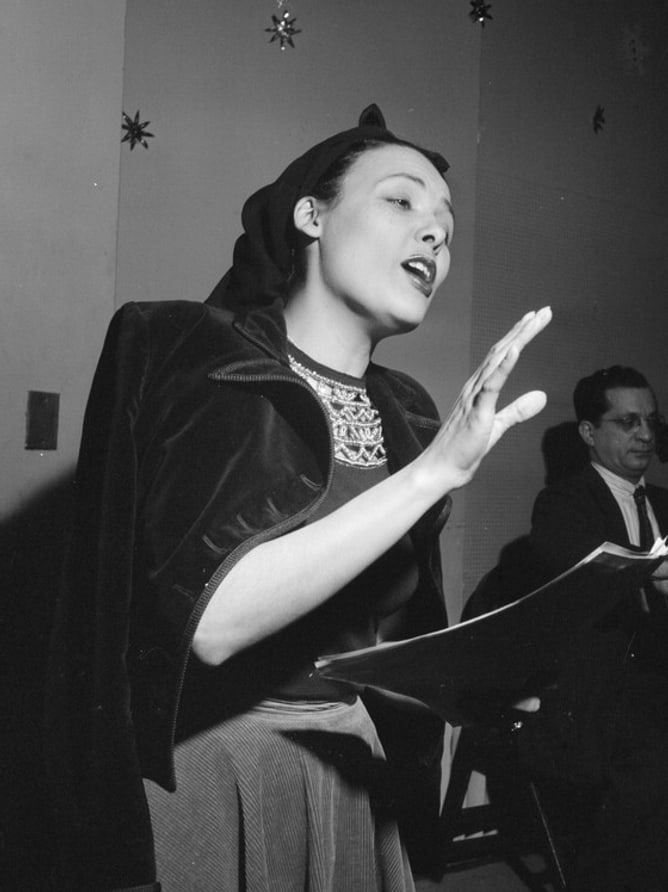
Lena Horne’s birth record carries a Rodden AA rating on Astro-Databank, a quoted birth record collected by Rodden herself: 30 June 1917, 11:45 PM, Brooklyn, New York. The record’s provenance is a family one, information her mother wrote down, quoted later by Bertucelli, which is what an AA rating covers. The clock is straightforward standard Eastern time, a year before the United States adopted daylight saving at all. The chart below is calculated from that record.
A Projector with almost nothing switched on
Horne is a Projector, and her chart is close to the sparsest version of one you will ever see. Two centers are defined, the Ajna and the Throat, joined by a single channel. The other seven centers are open: Head, G, Heart, Spleen, Sacral, Solar Plexus, Root. There is no motor anywhere in the design, no fixed life force, no consistent emotional wave, no reliable gut.
The Projector strategy is to wait for recognition and the invitation, and the not-self theme when that doesn’t come is bitterness. It is difficult to imagine a life more precisely built to test that mechanic. Horne was hired into the Cotton Club chorus at sixteen to perform for audiences her own family would not have been admitted to. She signed a seven-year MGM contract in 1942 and appeared in thirteen features across the fourteen years that followed, with a speaking part in two of them; in the rest she sang a song, standing alone against a pillar so the sequence could be lifted out whole before the print shipped South. That is the Projector’s structural problem stated in studio-system terms: enormous, visible capability, and an industry that would look at her without inviting her in.
No inner authority, only the right room and the right people
Her authority is Sounding Board, sometimes called mental or environmental authority, and it belongs only to charts like this one, where nothing internal is defined enough to serve as an inner authority. There is no gut response to check, no emotional wave to ride out, no splenic hit. Clarity arrives for this design by talking, out loud, with people it trusts, in an environment that suits it. The environment is half the mechanism here, and the design does not work without it.
Horne’s own account of her life reads as a long search for the room where she could hear herself. Café Society, the integrated Greenwich Village club she joined in March 1941, was the first place she has described as somewhere she could work as herself. Her closest working relationship, by her own repeated statement, was with Billy Strayhorn, whom she called the love of her life and her only real friend, and what she describes is a sounding board: the person she thought out loud to. When she wrote about her decision to speak publicly on civil rights, it came out first as an article, “I Just Want to Be Myself,” in Show magazine. This design does not arrive at a position and then announce it. It finds the position in the act of saying it to someone who is listening.
One channel: opinions with the receipts attached
Everything defined in Horne’s chart runs through 17-62, the Channel of Acceptance, Ajna to Throat, in the Collective Understanding circuit. The site’s own page describes what it produces: “visual concepts about how things should work, expressed through named, detailed, testable language,” and it is direct about the condition attached. “An opinion only gains acceptance when it’s backed by detail.” An opinion without the specifics is noise; with them, the collective can check it and take it up.
The page is equally direct about the failure mode: “correcting people who didn’t ask.” For a Projector, whose whole strategy is the invitation, a channel that only lands when the room has asked is the same instruction arriving twice. Horne’s public statements about race were never vague and never general. She named the base, the hotel, the contract clause, the specific thing that had happened to her. That is Gate 62 doing its work: an opinion carried by detail that other people can verify.
6/2: the hermit who becomes the example
Horne’s profile is 6/2, Role Model / Hermit. The sixth line lives three lives: an experimental first third, a withdrawn and observing second third beginning around thirty, and a return around fifty as the person others look to. The unconscious second line is the hermit, which needs to be left alone and then called out by name.
Horne’s life follows that shape almost too neatly to be worth pointing out, except that the dates are checkable. The trial-and-error years ran through the Cotton Club, two early marriages, the MGM contract, and the blacklist. The withdrawn middle stretched from her thirties into her fifties: nightclub work, Europe, long absences from American screens, and after 1971 a retreat from public life altogether. Then in 1981, at sixty-three, she opened Lena Horne: The Lady and Her Music on Broadway and ran 333 performances, the longest run for a one-person show in Broadway history, won a special Tony and two Grammys for it, and became the thing the sixth line finally becomes. She had announced her retirement the year before.
The Left Angle Cross of Demands
Horne’s Incarnation Cross is the Left Angle Cross of Demands, personality Sun and Earth in Gate 52, Stillness, and Gate 58, Vitality; design Sun and Earth in Gate 21, The Hunter, and Gate 48, Depth. The cross’s own page opens with a line that could have been written about her: “You have never once been accused of having low standards.”
What that page describes is a conscious demand for focus and for improvement, with an unconscious pairing that supplies the leverage: Gate 21’s grip on the material domain, Gate 48’s well of real solutions. “The demand is conscious; the leverage is not.” As a Left Angle cross it is transpersonal, worked out through other people rather than alone. And the page names the specific corrosion this design is prone to: “Nothing embitters this design faster than being the only one who cares.” Bitterness is also the Projector not-self theme. In Horne’s chart the two arrive from opposite directions and meet in the same place.
She brought an NAACP representative to the negotiation of her own MGM contract, in 1942, to write in that she would not play maids. She was thirty-four years into a career before she performed a dramatic role with no reference to her color. The demands were made, in writing, from the start.
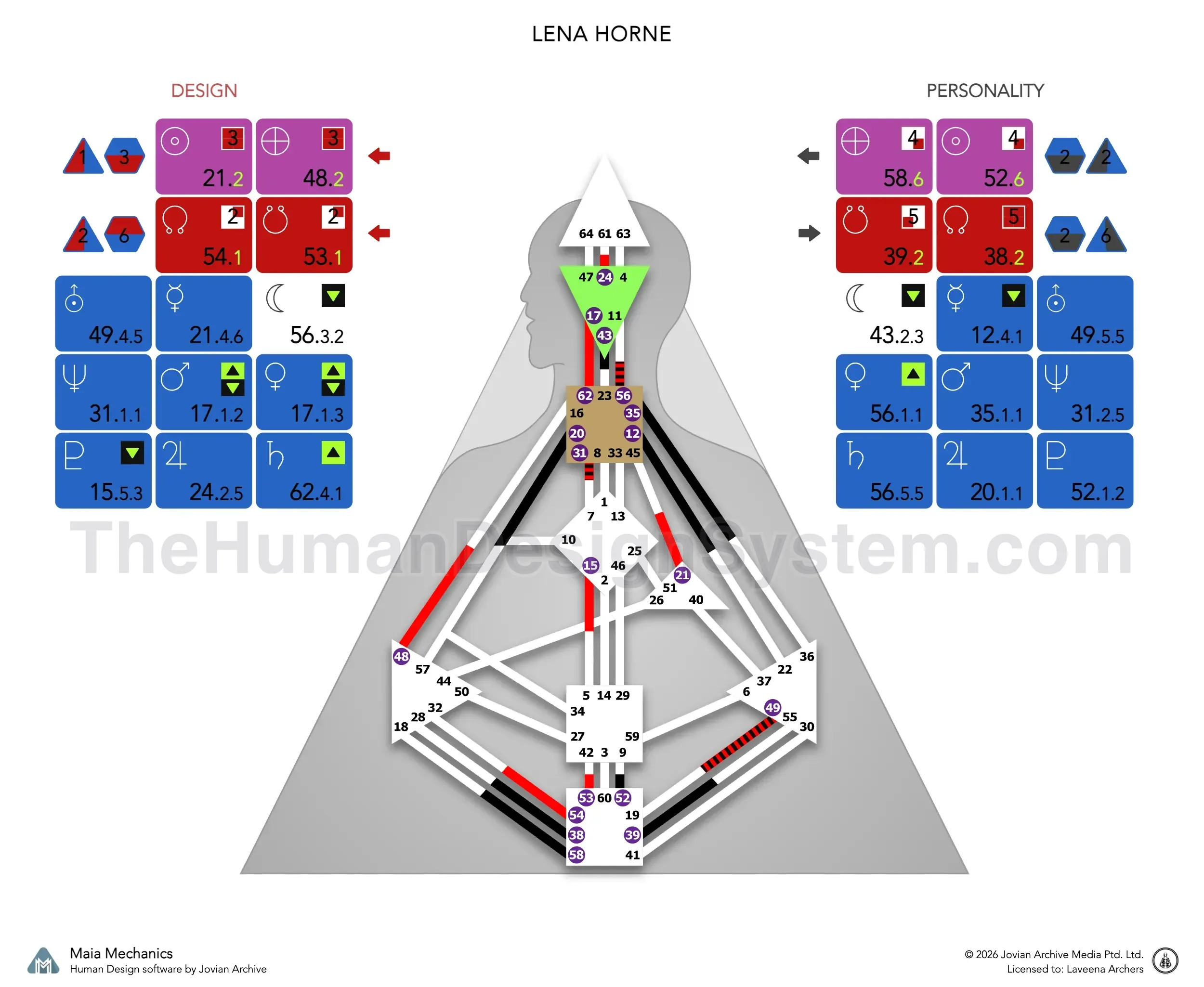
Lena Horne’s natal bodygraph, 6/2 Projector with Sounding Board authority: Design and Personality, activated at birth.
Saturn Return, 1946
Horne’s first Saturn Return fell 8 August 1946, age 29, under its own temporary cross, the Right Angle Cross of The Sphinx (7/13 | 2/1).
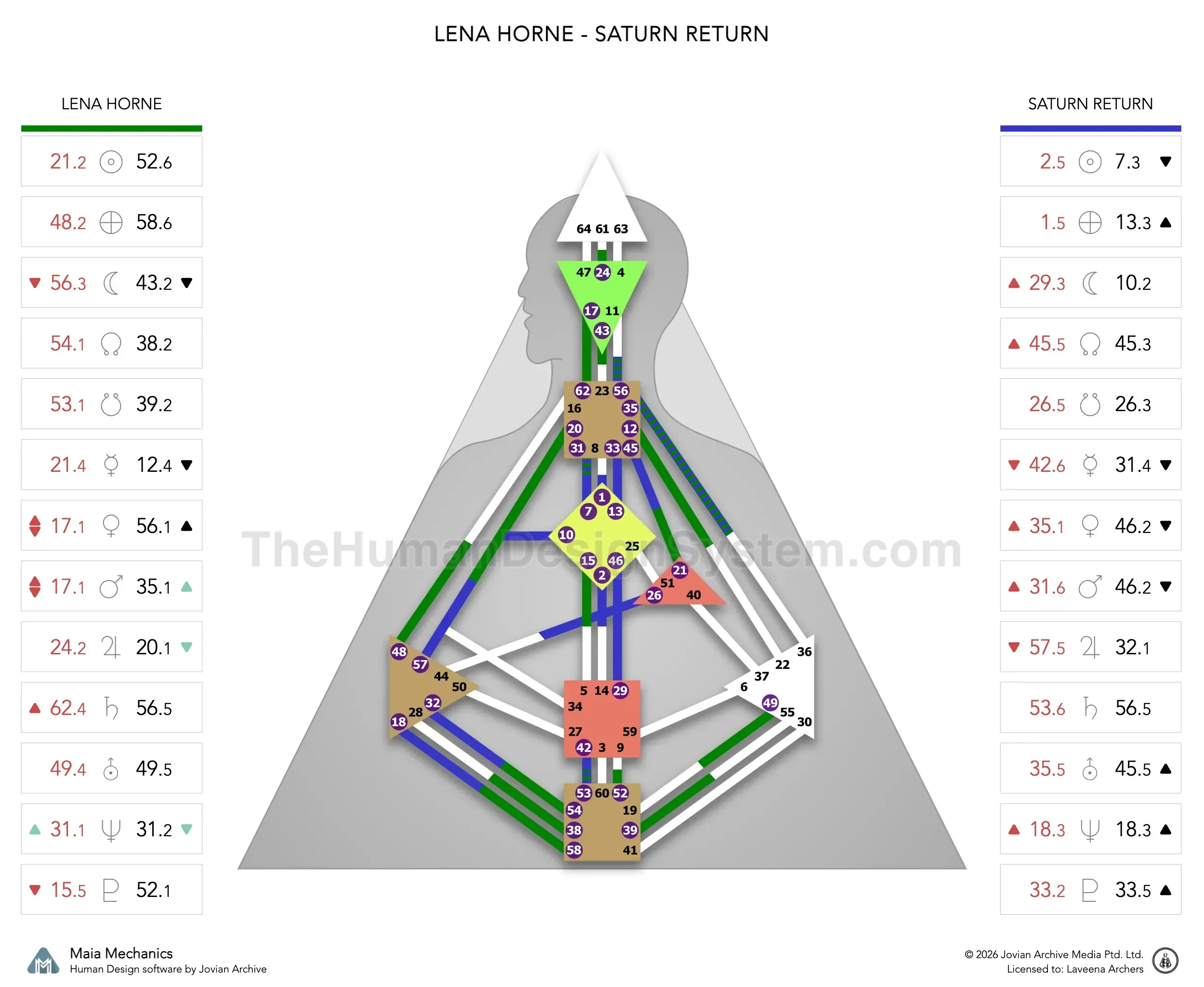
Natal chart against the August 1946 Saturn Return transit, age 29: this cycle’s own cross is the Right Angle Cross of The Sphinx.
A Saturn Return audits whether a structure holds, and 1946 is the year Horne’s did not. She spent it filming the Show Boat sequence in Till the Clouds Roll By, singing Julie LaVerne, the light-skinned Black woman passing for white, which was the role she wanted more than any other. She got fifteen minutes of it inside a film about somebody else, and her performance of “Bill” was cut. Jerome Kern and Oscar Hammerstein had invited her to play Julie in the Broadway revival that year; MGM would not release her from her contract to do it. Five years later the studio gave the part to Ava Gardner, in makeup that had been mixed for Horne’s skin.
The commercial structure came apart in the same twelve months. She left RCA in 1946 and recorded that autumn, immediately after the return, for Black & White Records, a label with almost nothing behind it. When Till the Clouds Roll By opened that November, MGM launched its own record label off the soundtrack and absorbed her onto it. Label, studio, and the one role she had asked for, all audited inside a single year.
Uranus Opposition, 1960
Her Uranus Opposition landed 14 September 1960, age 43, under the Left Angle Cross of Informing (47/22 | 12/11).
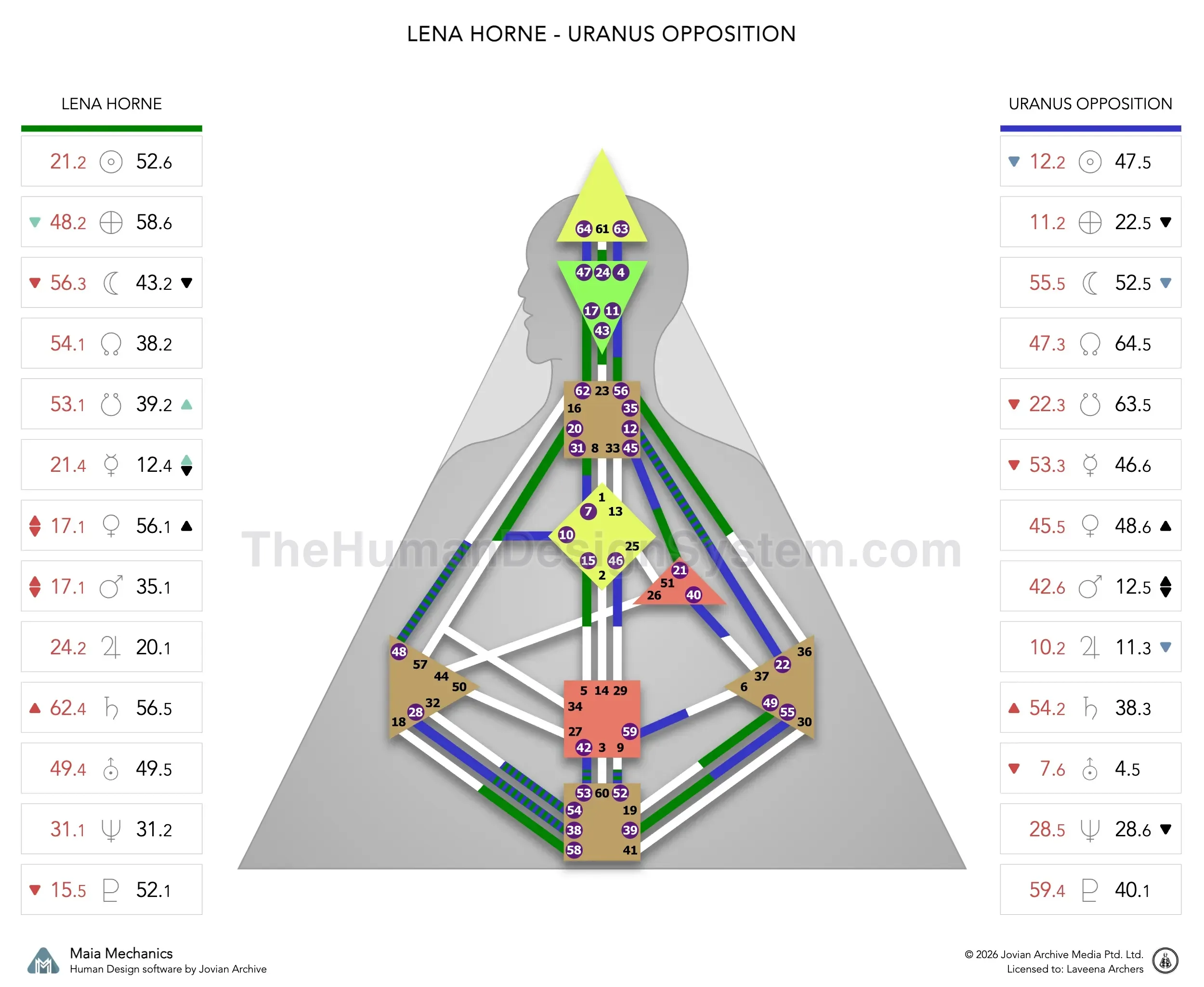
Natal chart against the September 1960 Uranus Opposition transit, age 43: this cycle’s own cross is the Left Angle Cross of Informing.
1960 is the year Horne stopped being decorous in public. At the Luau in Beverly Hills, after a show, a patron named Harvey St. Vincent demanded to be served before her and used a racial slur. She threw an ashtray at his head, then a hurricane lamp, then a second one. He was left bleeding and declined to press charges. Her statement to the press afterwards was not an apology: “My anger is directed at something that was wrong, not at something I have to apologize for.” Telegrams arrived from all over the country.
Seven weeks after the exact opposition, over three nights from 3 to 5 November 1960, RCA recorded her live at the Sands in Las Vegas for the album Lena at the Sands, which brought her another Grammy nomination. A Uranus Opposition breaks the arrangement a life has settled into, and this one arrived under a cross named for informing, in the year a woman who had spent two decades being impeccable started saying the thing out loud instead.
Chiron Return, 1968
Horne’s Chiron Return fell 31 March 1968, age 50, under the Right Angle Cross of Tension (21/48 | 38/39). Gates 21 and 48 are her own design Sun and Earth, the unconscious half of her natal cross handed back to her in the conscious position.
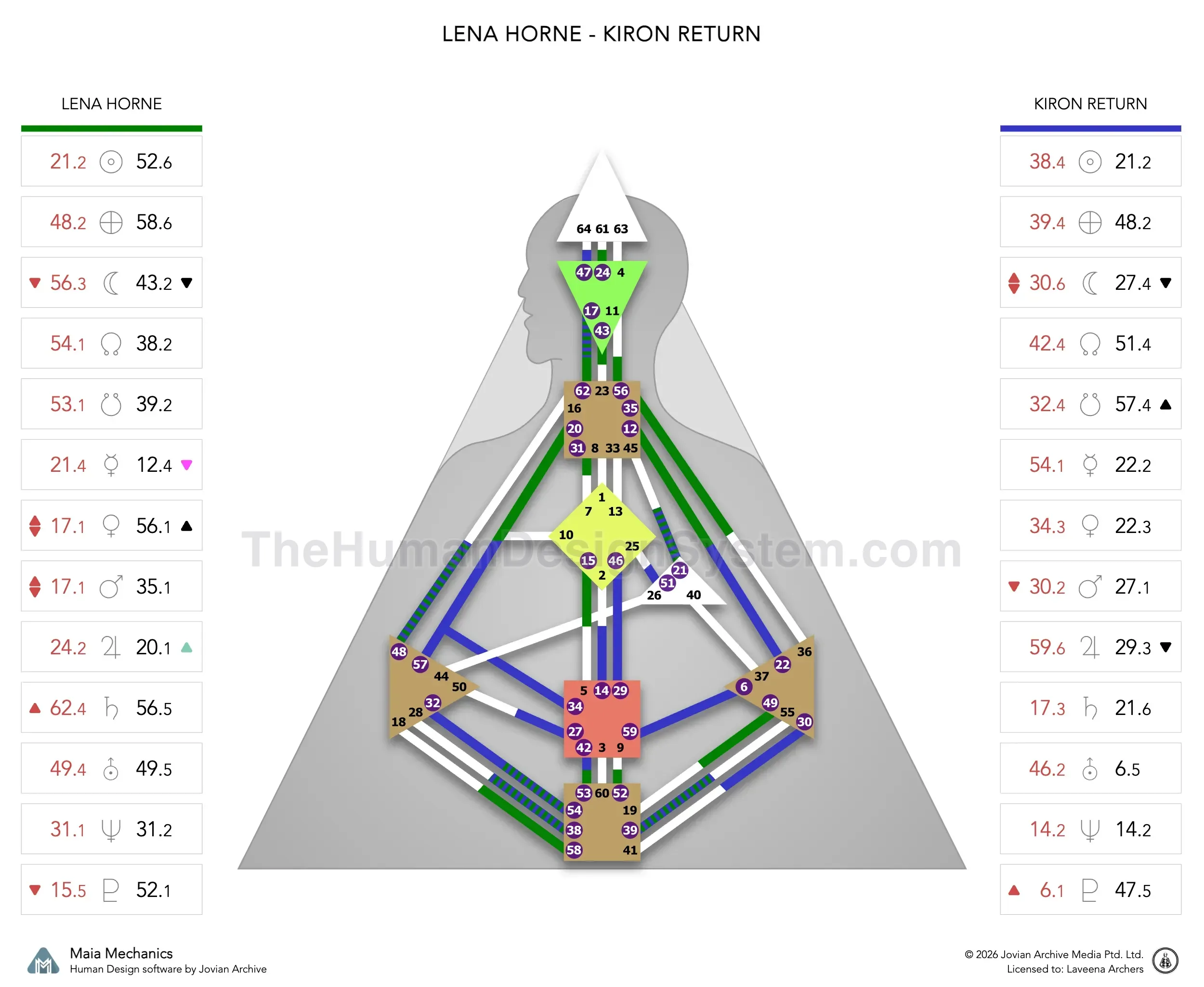
Natal chart against the March 1968 Chiron Return transit, age 50: this cycle’s own cross is the Right Angle Cross of Tension.
Billy Strayhorn had died of esophageal cancer on 31 May 1967, ten months earlier. Horne’s account of it is one line: “I was so angry when he died.” The Sounding Board authority had lost the person it sounded off against.
Professionally, this is the emptiest stretch of her adult life. She had no recording contract after 1966 and had given up the Nevada showrooms. Politically it was the opposite of empty and no kinder for it. She had appeared with Medgar Evers at a Jackson, Mississippi rally days before he was murdered in June 1963, and stood at the March on Washington that August. Martin Luther King Jr. was assassinated on 4 April 1968, four days after her Chiron Return. A Chiron Return surfaces the wound rather than resolving it, and at fifty Horne was carrying a private one and a public one at once. The repair took decades and arrived in the right form: in June 1993, at seventy-five, she built an entire show around Strayhorn’s music and recorded it as We’ll Be Together Again, which topped the jazz charts.
Second Saturn Return, 1975
Her second Saturn Return landed 26 September 1975, age 58, under the Left Angle Cross of Healing (46/25 | 52/58). Gates 52 and 58 are her natal personality Sun and Earth, so between this cycle and the last one both halves of her birth cross came back to her, each in the opposite position from where she was born with it.
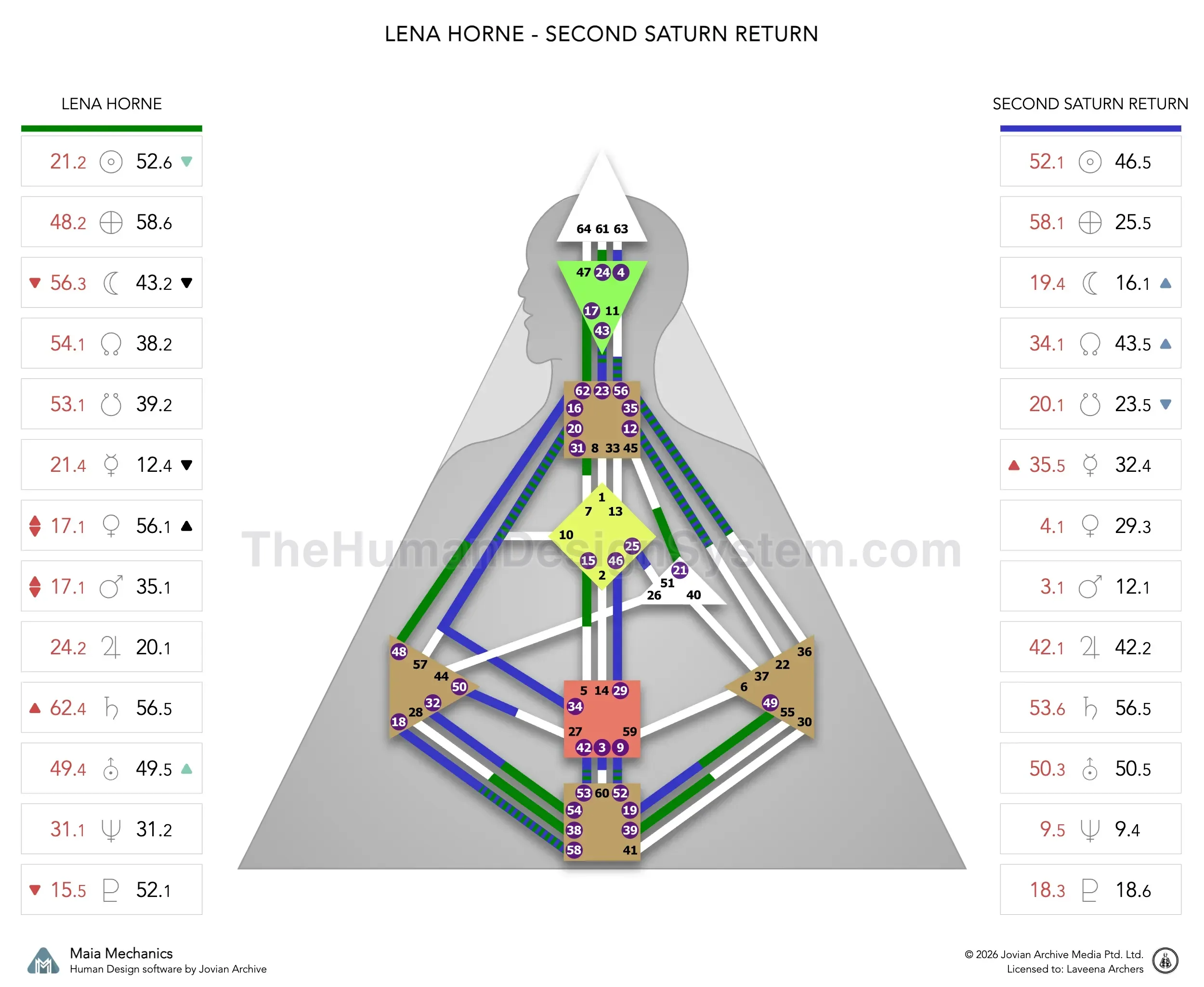
Natal chart against the September 1975 second Saturn Return transit, age 58: this cycle’s own cross is the Left Angle Cross of Healing.
Nothing is dated to 26 September 1975 itself. The window either side runs from March 1972 to March 1979, and what it holds is a rebuilt life. The three deaths below fall in the eighteen months just before it opens, which is worth stating exactly rather than folding them in. Her father died on 18 April 1970, her son Teddy of kidney failure on 12 September 1970 at thirty, and her husband Lennie Hayton of a heart attack on 24 April 1971. Three deaths in twelve months, and she stopped working for a year. She resumed on a limited basis in March 1972, played thirty-seven Broadway performances with Tony Bennett from 30 October to 24 November 1974, toured North America with him through March 1975, re-signed to RCA and recorded Lena & Michel with Michel Legrand, then Lena: A New Album the following year, and played Glinda in The Wiz in 1978, directed by her then son-in-law Sidney Lumet. A second Saturn Return audits what a life has actually built by that age. Hers found a woman who had buried three of the people closest to her and had gone back to work anyway, under a cross named for healing, five years before the Broadway show that made her a legend at sixty-three.
What the four returns show
Read together, the four cycles describe a design being asked the same question repeatedly. A Saturn Return that took away the role, the label and the studio in one year. A Uranus Opposition that broke the composure. A Chiron Return that arrived with nothing left to lose and took the sounding board too. A second Saturn Return that found her working again after the worst year of her life. The Cross of Demands makes its demands and is held to them in return; the Projector waits to be recognized and is embittered when it isn’t. Horne carried both, and the recognition, when it came, came last and came whole.
If you’re a Projector who has spent years being visible without being invited, or you’re living without an inner authority and have been told to trust your gut by people who have one, pull your free chart and see what your design actually runs on. And if you’re a 6/2 somewhere in the withdrawn middle stretch and want to know what you’re waiting for, a professional reading is built for that question.
Her last Solar Return, and the day she died
Horne died on May 9, 2010, at NewYork-Presbyterian Hospital in New York City, at ninety-two. The hospital confirmed her death and released no time, and the Associated Press report carried by the Deseret News records the date and the place. That is the whole public record, a firm date with no hour attached, and this series states the gap rather than estimating across it. A Solar Return needs none of what is missing, since it is computed from birth data alone.
Her last Solar Return, the chart for her final birthday on June 30, 2009, is where this chart makes its one computational demand. Across this series the return is computed at the birthday’s own clock time, and for most charts that lands the transiting Sun comfortably back inside the natal Sun’s gate. Horne’s personality Sun sits in the sixth and final line of Gate 52, close enough to the gate’s edge that the Sun’s year-to-year calendar drift can carry the birthday clock moment past the position a return revisits, and in 2009 it did exactly that: by 11:45 PM that night, the sky had already slipped across the border. Her true return has to be pinned to the exact minute the Sun comes back to her natal position, the same discipline three clock minutes forced onto Steve Jobs’s chart, and this series trusts that pinning to Maia Mechanics. Pinned there, her return falls on the morning of June 30, 2009, hours before the birthday clock time this chart would normally use, and it sets the Sun back on the Stillness of Gate 52 and the Earth on the Vitality of Gate 58, the conscious half of her Cross of Demands, restated for the last year of her life. For a design defined by a single channel, the return sky arrived crowded with company: four channels bridged into her chart at that minute, 43-23 Structuring, 35-36 Transitoriness, 20-10 Awakening and 20-57, the Brainwave, while the sky held the 10-57 Channel of Perfected Form whole on its own.
In memory of an ICONIC Human Design,
LaVeena B. Archers, PhD
Chart via myBodyGraph, rendered through Maia Mechanics, Human Design Professional Software licensed from Jovian Archive, birth data via Astro-Databank.