Channel 20-10: The Channel of Awakening
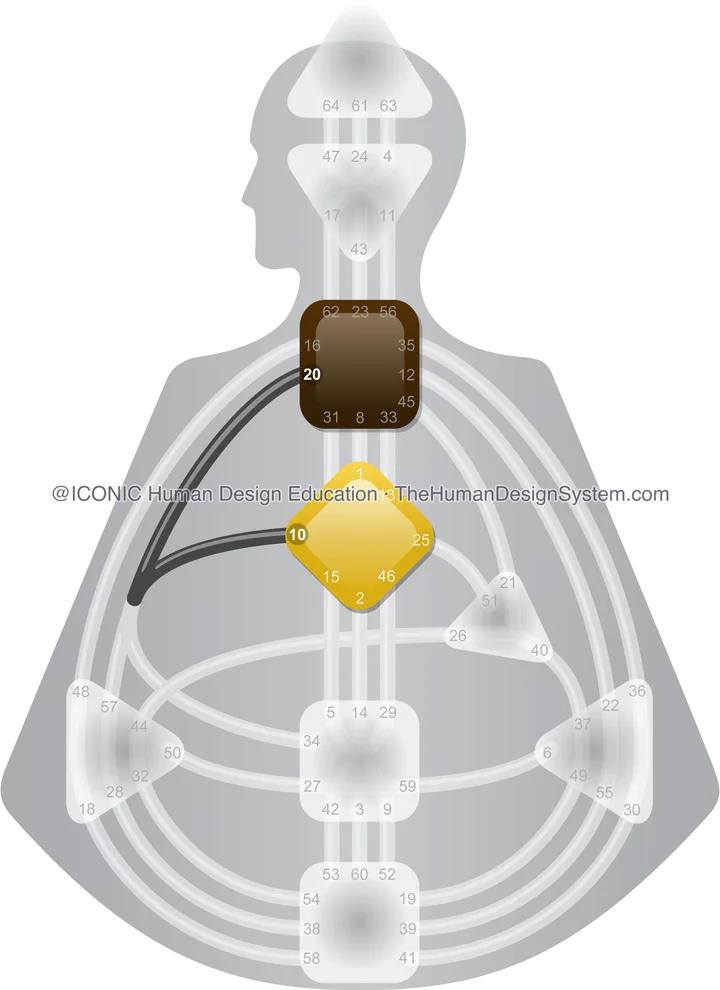
Part of the Integration superchannel →
There are people who talk about authenticity, and there are people who simply are themselves out loud, in real time, with no gap between who they are and what they say. The second kind wakes rooms up. That’s the Channel of Awakening.
The mechanics
The 20-10 connects Gate 20, The Now, in the Throat to Gate 10, Behavior of the Self, in the G Center. With both gates present, both centers are defined: an identity anchored in how one behaves as oneself, wired to a voice that can only speak in the present. This is one of the four channels that make up the Integration Superchannel, the oldest, most self-focused structure in the bodygraph, concerned not with tribe or collective but with the survival and empowerment of the individual self. Gates 10, 20, 34, and 57 interlink here; the 20-10 is the branch where selfhood finds its voice.
The now meets the behavior of the self
Gate 10 is the love of being oneself: a fixed code of authentic conduct, the six roles of behavior, and, at its highest, genuine self-acceptance. On its own, it lives that code, with no reliable way to express it. Gate 20 is pure presence at the Throat: the capacity to speak and act only in the now, with no yesterday and no plan. On its own, it’s spontaneity in search of something worth voicing.
The channel completes both. The behavior gets a microphone; the microphone gets character. What emerges is existential expression: “I am,” said and lived simultaneously. And because the Integration Superchannel carries no agenda for others, the awakening this channel triggers is a side effect, not a mission. You don’t set out to liberate anyone. You behave as yourself, audibly, and people near you remember they have a self too.
At work and in relationships
Professionally, the 20-10 is the culture-setter nobody appointed. Your unfiltered present-tense authenticity makes you a natural in leadership-by-example, coaching, performance, entrepreneurship, and any role where realness is the product. The friction shows up in environments that run on scripts and personas. You can’t sustain a mask, and trying costs you more than it costs others. Choose rooms where being exactly yourself is an asset, because it’s the only mode you have.
In relationships, this channel is refreshingly legible: what your partner sees and hears is genuinely what exists in that moment. The challenges are the flip side, commitments phrased in the now can shift by next week, and the channel’s self-referential center of gravity can leave a partner feeling orbital. The mature 20-10 learns to say “this is true for me right now” honestly, and to make deliberate space for the other person’s reality alongside their own.
One gate only: the hanging 20 or 10
With only Gate 10, your self-love and behavioral code are real but partly voiceless, and spontaneous expressers carrying Gate 20 feel like your missing loudspeaker. With only Gate 20, you’re the voice of the immediate, drawn toward people of substance (including 10, 34, and 57 carriers) who give the now something to say. The electromagnetic pull inside this four-gate cluster is famously strong, whichever circuit the resulting channel belongs to; these connections tend to feel existential rather than casual.
Human Design anatomy
Blood and thyroid, identity with a direct line to tempo. Gate 20 speaks as “I am now,” and gate 10 supplies the self that is being. Being yourself in the present tense is, in this anatomy, circulation reaching the throat with nothing in between to slow it down. That immediacy is both the gift and the trap, because there is no gland in this circuit whose job is to pause, and without a motor attached, the awakening this channel carries is a state rather than an act.
Living it
Living the 20-10 well means letting self-devotion be your discipline and trusting that the example is the teaching. Check whether this channel, or a hanging 20 or 10, is part of your design: get your free chart now. And to see how the Integration Superchannel shapes your type, strategy, and daily life, a professional reading will show you precisely how your awakening is built to work.
A framework for self-understanding, not a medical claim. See the full note on medical astrology and Human Design.
Frequently asked questions
What is the 20-10 channel in Human Design?
The 20-10 is the Channel of Awakening, connecting Gate 20 (The Now) in the Throat to Gate 10 (Behavior of the Self) in the G Center. It defines both centers and gives authentic self-behavior a spontaneous voice in the present moment. It is one of the four channels that make up the Integration Superchannel, the bodygraph's core survival-and-selfhood wiring.
Why is 20-10 called the Channel of Awakening?
Because its expression is awakeness itself: someone speaking and behaving as exactly who they are, in real time, without performance. That embodied authenticity has a contagious effect, witnessing it can wake others up to their own self-betrayals. The channel doesn't teach awakening; it demonstrates it, moment by moment.
Does the 20-10 channel make someone selfish?
It can look that way to the conditioned eye. The Integration Superchannel is genuinely self-referential: its keynote is self-empowerment, and the 20-10 voice says 'I am' more than 'we should.' That's mechanics, not moral failure. Correctly lived, its self-devotion becomes an example that empowers others; distorted, it collapses into vanity or ego performance.
What is a hanging Gate 20 or Gate 10 like here?
Only Gate 10: you carry a strong code of authentic behavior and self-love that lacks a consistent spontaneous voice, so present-moment speakers feel completing. Only Gate 20: you have the voice of the now, seeking substance worth expressing. Each is drawn to carriers of the harmonic gate. Gate 20 also completes Integration through Gate 34 (Charisma), and Gate 10 also completes it through Gate 57 (Perfected Form).
Source and lineage
This entry is written in original words from Ra Uru Hu's source material as held by Jovian Archive, and taught by an IHDS Certified Independent Teacher. The mechanics (which center a gate sits in, which gates make a channel, how the authority hierarchy is ordered) come from the site's reference data, the same data the free chart runs on. To check either, see who writes here and the Human Design tools this site publishes.
Spotted an error on this page? Tell us and a human will look into it.