Quincy Jones's Human Design Chart: A Projector Wired to Bridge Two Worlds
Quincy Jones ran on Split Definition, two separate pieces of chart with nothing natively joining them, which is close to a mechanical description of a career spent bridging jazz, pop, and classical into one body of work.

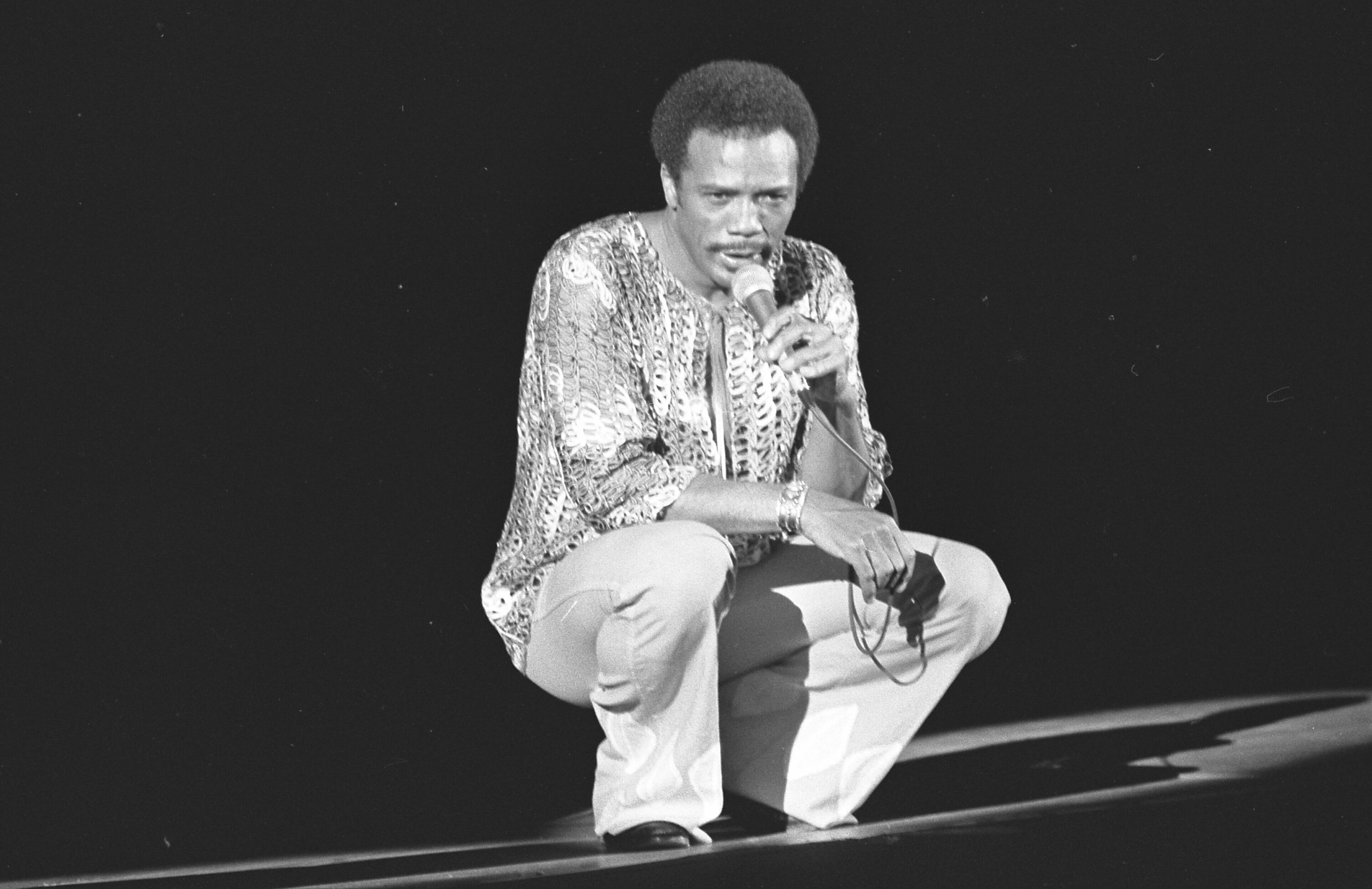
Quincy Jones’s birth record carries a Rodden AA rating on Astro-Databank, birth certificate in hand, collected by the Wilsons: 14 March 1933, Chicago, Illinois. There’s one genuine wrinkle. The certificate’s handwritten time reads as 8:40 PM, but Astro-Databank’s own notes flag that the digit could plausibly be a 3, giving 3:40 PM instead, and Jones himself said in more than one interview that he has “Leo rising,” which only fits the 3:40 reading. Both candidate times were calculated. Type, authority, definition, profile, incarnation cross, and every defined channel come back identical at either hour; only the finer-grained Motivation and Determination shift between the two. Whichever hour is correct, the mechanics below hold.
A Projector who spent a life waiting to be asked
Jones is a Projector, the type built to wait for recognition and invitation rather than to initiate. His authority is Emotional, run through a defined Solar Plexus: no truth in the now, clarity only after the wave has moved through. His profile is 2/4, Hermit/Opportunist, a conscious talent that consolidates in private and only moves once the surrounding network calls it forward.
The biography reads like a demonstration reel for Projector strategy, invitation followed by invitation, going back to childhood. He met a 16-year-old Ray Charles at 14 and the two started playing gigs around Seattle together. At 15, Lionel Hampton asked him to join his band, and Hampton’s wife promptly sent him back to school, an invitation extended and then withdrawn, which is exactly the kind of premature recognition a Projector has to learn to distinguish from the real thing. He finished his education, and the invitations that mattered kept arriving on their own schedule: a scholarship to Berklee, a place in Hampton’s band once he actually had something to offer it, work with Dizzy Gillespie, and eventually the position of first Black executive at Mercury Records. None of it reads as Jones pushing his way in. It reads as a life built almost entirely on being recognized and asked.
Two pieces, and a life spent bridging them
Jones’s chart carries Split Definition: his defined centers sit in two separate pieces, Head, Ajna, and Throat on one side, Heart and Solar Plexus on the other, with nothing in his own design natively bridging them. A split chart isn’t broken; it’s built to complete itself through other people, ideas, or a bridging planet, and the two halves stay genuinely distinct until something connects them.
It’s hard to find a more literal expression of that mechanic than Quincy Jones’s actual career. He moved between jazz, pop, soul, classical composition, and film scoring without ever settling into one lane, working with Frank Sinatra, Michael Jackson, Ella Fitzgerald, and Donna Summer inside the same professional life. The clearest single example is the 1985 “We Are the World” session, where he personally brought 46 of the era’s biggest recording artists into one room to cut one track. That’s not a metaphor for bridge-building. It’s the job description of a Split Definition chart, executed at a scale almost nobody else in the industry could have pulled off.
Emotional authority and the 31 days
Jones’s Solar Plexus definition comes through 40-37, the Channel of Community, which joins the Heart to the Solar Plexus and carries the tribal bargain of work exchanged for belonging, warmth, and loyalty. It’s a fitting mechanical anchor for a man whose working relationships routinely lasted decades, and whose own account of his career reads less like a series of transactions than like a family he kept building wherever he went.
Emotional authority means clarity only arrives after the wave completes, never in the moment, and Jones lived through at least one very literal version of that wait. After his marriage to Peggy Lipton ended in 1990, he described being on the verge of a breakdown and went on a 31-day spiritual retreat, building, in his own words, a spiritual base that carried him for the rest of his life. That’s not a quick decision made on a feeling. It’s a full month spent letting an emotional process complete before anything else could move.
The organizer’s voice
Three of his four defined channels sit in the mental territory that runs from the Head down through the Ajna to the Throat, and together they describe a specific kind of mind. Two of them start in the Head and stop at the Ajna, which is where the pressure to make sense of something gets processed rather than spoken. 63-4, the Channel of Logic, takes doubt about whether a pattern will hold and works it into a formula worth testing: the doubt is the fuel, and the answer it produces is always a hypothesis rather than a certainty, which is close to a description of how an arranger decides whether an idea will survive contact with an orchestra. 64-47, the Channel of Abstraction, works the other way, digesting past experience in images until it resolves into meaning on its own schedule, closer to the reflective instinct behind a 70-year career and an autobiography that, as his own biography notes, showed his loving zest through in every page. Only the third channel reaches a voice: 17-62, the Channel of Acceptance, turning a visual sense of how things should be organized into precise, detailed, sayable language, exactly the skill the job needs, since an abstract musical idea has to become a notated part specific enough for players to actually read it.
The Right Angle Cross of Eden
Jones’s Incarnation Cross is the Right Angle Cross of Eden, personality Sun and Earth in Gate 36 (Crisis) and Gate 6 (Friction), design Sun and Earth in Gate 11 (Ideas) and Gate 12 (Caution). The cross’s own page describes its theme: an idealized vision underneath, reached for through untried experience, met with real friction, and converted into emotional depth that couldn’t have been gathered any other way.
Two moments in the record fit that shape closely. In August 1974, Jones suffered a cerebral aneurysm and survived two dramatic surgeries that brought him close to death, about as literal a Gate 36 crisis as a chart could ask for. And the divorce and 31-day retreat described above is the same pattern again: friction, followed by a deliberate, extended process of converting the rupture into something durable rather than just surviving it. As a Right Angle cross, none of that turbulence is a debt owed to anyone else. It’s personal curriculum, and by his own account, he graduated it more than once.
None of this is a claim that mechanics alone built a 70-year career and 28 Grammy Awards. But it rhymes with one, and the fixed natal design reads more clearly against the four returns astrology marks out across a lifetime: Saturn, Uranus opposing itself, Chiron, and Saturn again.
Saturn Return, 1963
Jones’s first Saturn Return fell January 22, 1963, age 29, carrying its own temporary cross, the Left Angle Cross of Distraction (60/56 | 28/27). The three years running up to it were the hardest of his working life. He had taken his own big band to Europe as music director of Harold Arlen’s Free and Easy, the show folded in Paris in February 1960, and he kept eighteen musicians and their families on the road on concert money that could not carry them. The band dissolved and he came home roughly $145,000 in debt. A personal loan from Mercury’s Irving Green cleared it, and in 1961 he took a staff job as the label’s music director in New York. The vice-presidency, the one that made him the first Black executive at a major white-owned label, came in 1964, a year after this return. A Left Angle cross runs transpersonal rather than personal, fitting for a return that took apart the one venture he had built for himself and set him down inside somebody else’s structure.
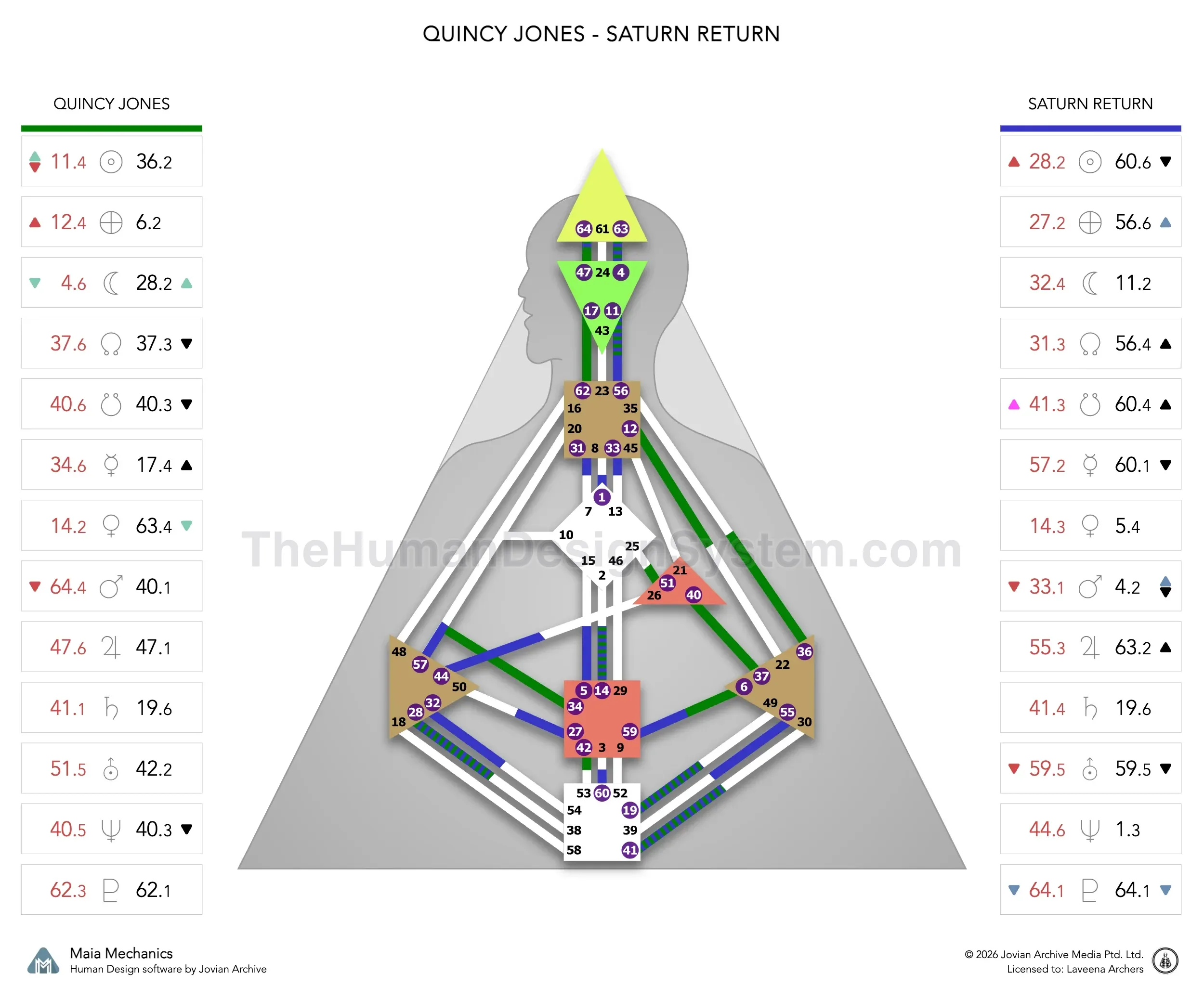
Natal chart against the January 1963 Saturn Return transit, age 29: the transiting Left Angle Cross of Distraction (60/56 | 28/27).
Uranus Opposition, 1972
His Uranus Opposition landed December 3, 1972, age 39, under the Left Angle Cross of Identification (9/16 | 64/63), a name that fits a man in the middle of building an identity well beyond bandleader or arranger. Less than two years later, in August 1974, he suffered a cerebral aneurysm and survived two dramatic surgeries that brought him close to death, the kind of disruption Uranus Oppositions are known for, arriving just past the exact date and well inside the window a transit this slow runs, which is roughly three and a half years either side of it.
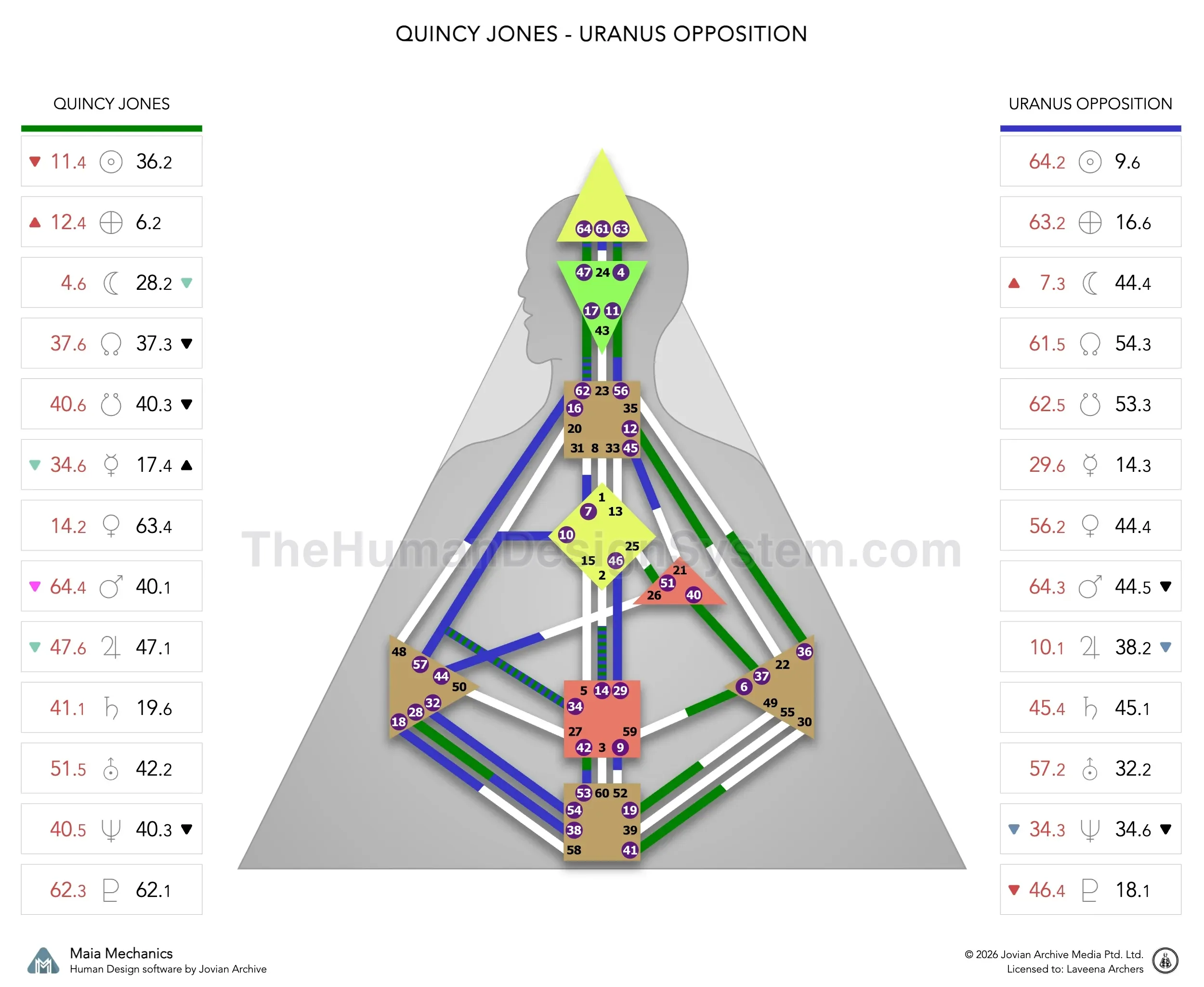
Natal chart against the December 1972 Uranus Opposition transit, age 39: the transiting Left Angle Cross of Identification (9/16 | 64/63).
Chiron Return, 1982
Jones’s Chiron Return fell June 9, 1982, age 49, under the Right Angle Cross of Rulership (45/26 | 22/47), the same cross name, as it happens, that showed up in Marlon Brando’s own Chiron Return a decade earlier. Less than six months after this exact date, on November 30, 1982, Michael Jackson’s Thriller was released, produced by Jones, and went on to become the best-selling album in recorded history. “Rulership” is a plain description of what that record did to the pop charts for the rest of the decade.
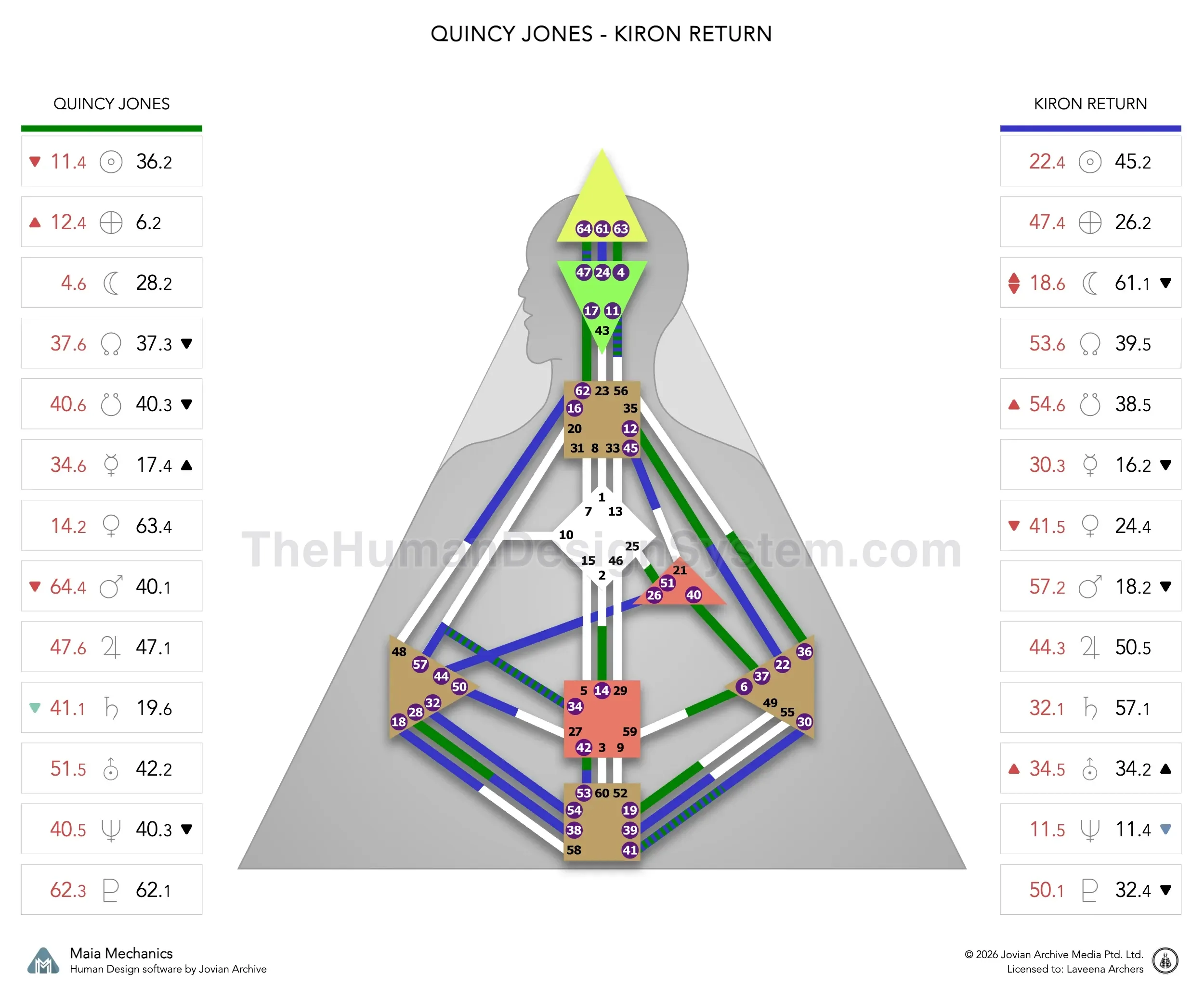
Natal chart against the June 1982 Chiron Return transit, age 49: the transiting Right Angle Cross of Rulership (45/26 | 22/47).
Second Saturn Return, 1992
His second Saturn Return landed February 25, 1992, age 58, under the Right Angle Cross of Planning (37/40 | 9/16). By his own account, 1992 was also the year he began a significant relationship with Nastassja Kinski, with whom he had a daughter the following February, a new chapter opening at almost exactly the moment this return marked out, right as his business interests were expanding well beyond music production into publishing and broadcasting.
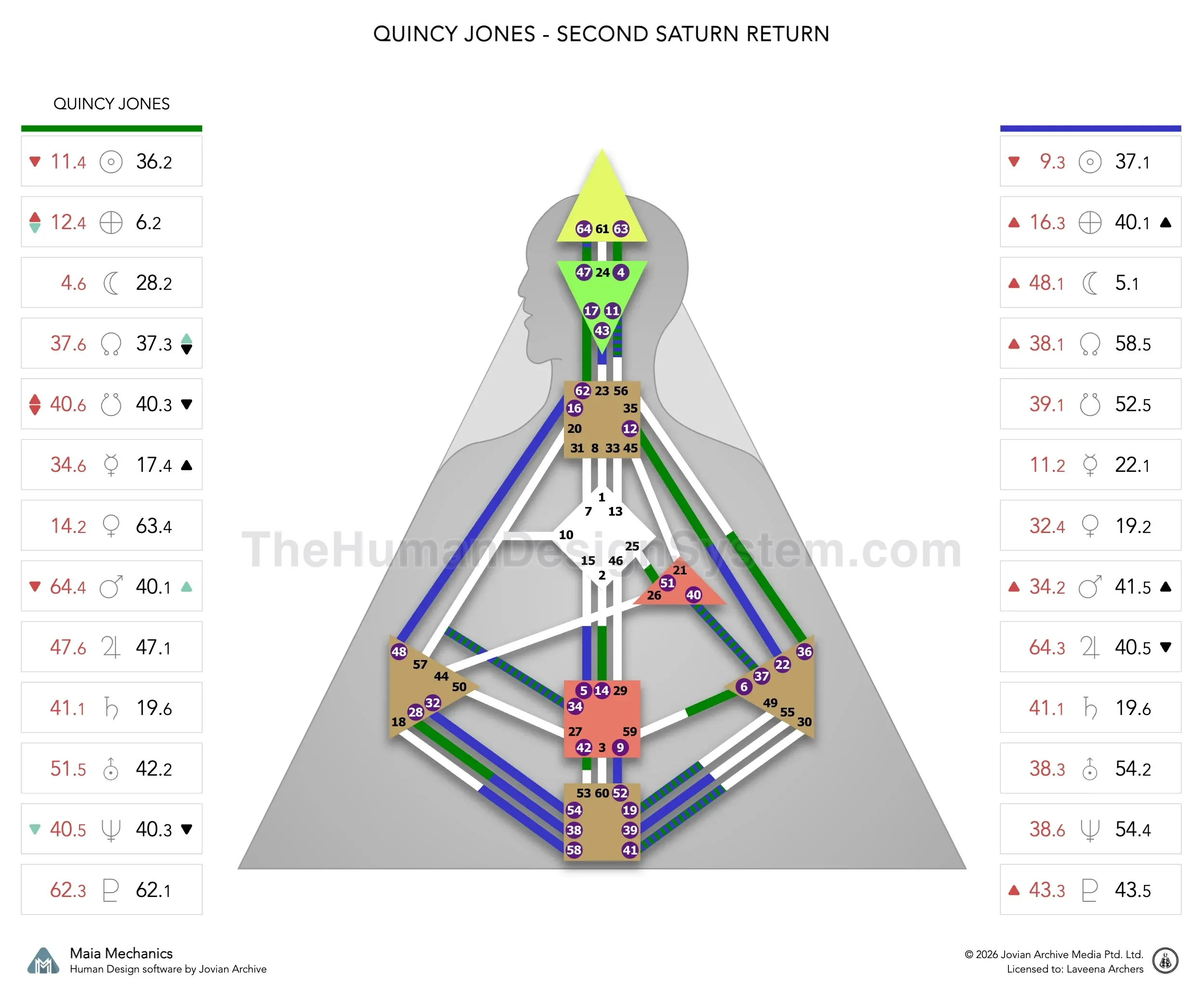
Natal chart against the February 1992 second Saturn Return transit, age 58: the transiting Right Angle Cross of Planning (37/40 | 9/16).
What the four returns show
Laid side by side, the returns trace one throughline: a Split Definition chart that needed the world to call it forward, doing exactly that at institutional scale, first inside a record label, then at the peak of a mutative Chiron Return that happened to land months before the best-selling album ever made. None of it required Jones to push. It required him to be positioned where the invitation could find him, which is the entire Projector strategy, lived at a scale most Projectors never get the chance to test.
If you want to see whether your own chart runs on Split or Single Definition, and what that actually asks of you, pull your free chart. And if a Projector’s strategy of waiting for the invitation is a mechanic you’re still learning to trust, a professional reading is where that gets concrete.
His last Solar Return, and the day he died
Jones died at 91 on the night of Sunday, November 3, 2024, at his home in Bel Air, Los Angeles, with his family around him; the death certificate later gave pancreatic cancer as the cause, as reported by Fox 11 Los Angeles. No clock time entered the public record. Every account says Sunday night and stops there, so there is no death-moment chart to cast, and this section makes no guess at one. His last Solar Return needs only the birth data, and that, certificate in hand, is the firmest part of his record.
His last Solar Return, the chart for his final birthday on March 14, 2024, landed his transiting Sun and Earth on the identical Gate 36 and Gate 6 they occupy natally, computed in Maia Mechanics against both candidate birth times, and like every other mechanic in this chart it comes back the same at either hour. Three channels connected that final year’s sky to his own design: the 2-14 Channel of the Beat and the 34-57 Channel of Power, both hanging off gates he carries in his open Sacral, the motor every Projector lives without, and the 49-19 Channel of Synthesis, sitting in the same Tribal Ego circuit as his natal 40-37 Channel of Community, one more channel of belonging in the sky over his final year.
In memory of an ICONIC Human Design,
LaVeena B. Archers, PhD
Chart via myBodyGraph, rendered through Maia Mechanics, Human Design Professional Software licensed from Jovian Archive, birth data via Astro-Databank.