Roberta Flack's Human Design Chart: The Right Angle Cross of Explanation
Roberta Flack was a 3/5 Manifestor with Emotional authority, built to turn raw feeling into a voice the world couldn't argue with. Her Uranus Opposition alone holds her divorce, both Record of the Year Grammys, and all three of her number-one singles.

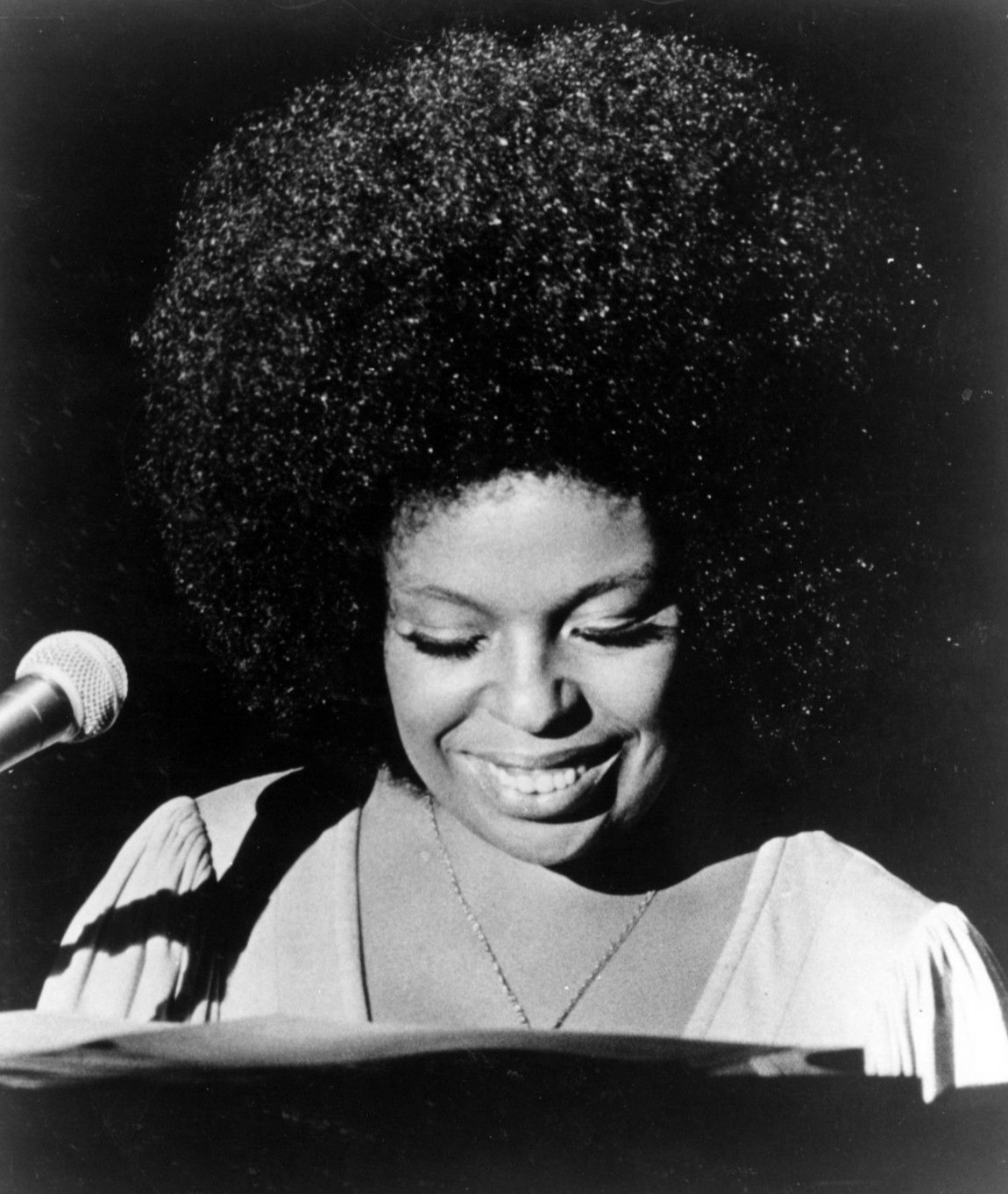
Roberta Flack’s birth record carries a Rodden AA rating on Astro-Databank, birth certificate in hand, collected by Ed Steinbrecher: 10 February 1937, 6:30 AM, Black Mountain, North Carolina. Standard Eastern time, no complication. The chart below is calculated from that record.
A Manifestor whose voice was the motor
Flack is a Manifestor with Emotional authority: the rarer path through the type, an aura built to initiate on its own urge, but with a Solar Plexus wired straight into the Throat, so the initiating always arrives on a wave rather than in the instant it’s felt. Her strategy is to inform before she acts, and the not-self theme, when that closed aura meets resistance, is anger. The signature on the other side is peace.
Five centers are defined and connected as a single structure: Root, Solar Plexus, Throat, Ajna, and Head. This is Single Definition, one continuous system, no bridge required, which is unusual for the type: a Manifestor’s whole mechanic depends on a motor reaching the Throat without anyone else’s help, and Flack’s chart supplies that connection twice over, through the Solar Plexus directly and through the Ajna above it.
The channel that makes the voice: 12-22, Openness
12-22, the Channel of Openness, runs from Solar Plexus to Throat, and it’s the specific wiring that put the motor behind Flack’s voice. The channel’s own page describes exactly what it produces: “expression that lands emotionally before it lands logically: the singer, the orator, the person whose ‘I need to tell you something’ changes the room’s chemistry.” It also names the cost: “the whole apparatus runs on the wave. In the mood: channels of pure influence. Not in the mood: better silent, and entitled to be.” Flack recorded her debut album, First Take, in ten hours, essentially live, and told interviewers she was rarely able to record on demand; the material had to arrive on its own schedule. That is 12-22, described from the inside by the person carrying it.
Two more channels: the constitution and the treaty
43-23, the Channel of Structuring, sits in her chart too, connecting Ajna to Throat: insight that lands whole and has to find its own timing to be heard, the same channel Jean-Paul Sartre carried in an earlier chart in this series. And 49-19, the Channel of Synthesis, links Root to Solar Plexus, described on its own page as “a treaty: needs on one side, terms on the other… the one who keeps it, and the one through whom it gets rewritten.” Flack was, by every account, a serious classical pianist before she was a soul singer, trained at Howard University from age fifteen, teaching in a segregated Farmville, North Carolina high school before Les McCann discovered her at a 1968 benefit concert. The principled, terms-setting energy of Gate 49 is there in a woman who spent a career refusing to be filed as any one genre.
3/5: the fixer, discovered
Flack’s profile is 3/5, Martyr/Heretic, the same experiential profile carried by Ted Kennedy elsewhere in this series: a conscious third line that learns only by trial, wrapped in a fifth line that projects competence onto her before she asks for it. The profile’s own page names the mechanic precisely: “by the time something reaches you, three careful people have already failed at it, and somehow everyone assumes you’ll figure it out.” She spent years as a working accompanist and teacher before “First Take” made her, at 32, an overnight discovery a decade in the making. The fifth line’s projection followed immediately: a woman who had spent a career learning her instrument in private was handed, almost at once, the role of interpreter for an entire genre of feeling.
The Right Angle Cross of Explanation
Flack’s Incarnation Cross is the Right Angle Cross of Explanation: personality Sun and Earth in Gate 49, Principles, and Gate 4, Formulization; design Sun and Earth in Gate 43, Insight, and Gate 23, Assimilation. The cross’s own page describes the theme as “turning raw knowing into shareable understanding,” and names the specific gift underneath it: “Gate 43 is individual insight: realizations that arrive whole, from nowhere… Gate 23 is the translator, the capacity to say the strange thing simply.” “The First Time Ever I Saw Your Face” is a 1957 folk song Flack heard once at a party, slowed to nearly half its original tempo, and rebuilt into a six-week number one. That’s Gate 43’s whole insight arriving intact, translated by Gate 23 into something an entire country could suddenly hear.
What the seven-year window means for the four cycles below
Saturn, Uranus and Chiron move slowly, and their influence on a chart builds across a window running about three and a half years either side of the precise return or opposition date an ephemeris calculates, roughly seven years in all. What follows tests each of Flack’s four major cycles against that full window, using both Astro-Databank’s own record and supplementary biography, and states directly which cycles show a real pattern.
Saturn Return, 1966
Flack’s first Saturn Return fell 21 March 1966, age 29, under the Right Angle Cross of the Vessel of Love (25/46 | 10/15).
The event lands close enough to need no window at all: she married the bassist Steve Novosel in 1966. A Saturn Return audits the structure a life is being built on, and marriage, arriving in the same calendar year as the return itself, is that audit in its most literal form.
What the first version of this post missed sits on the other side of the same window. Flack was still teaching school when this cycle opened. Les McCann heard her at a Washington benefit concert in 1968, she cut thirty-nine demo songs for Atlantic that November, and her debut album First Take followed in 1969, carrying the recording of “The First Time Ever I Saw Your Face” that would define her. The entire recording career this post is about begins inside the second half of her Saturn Return.
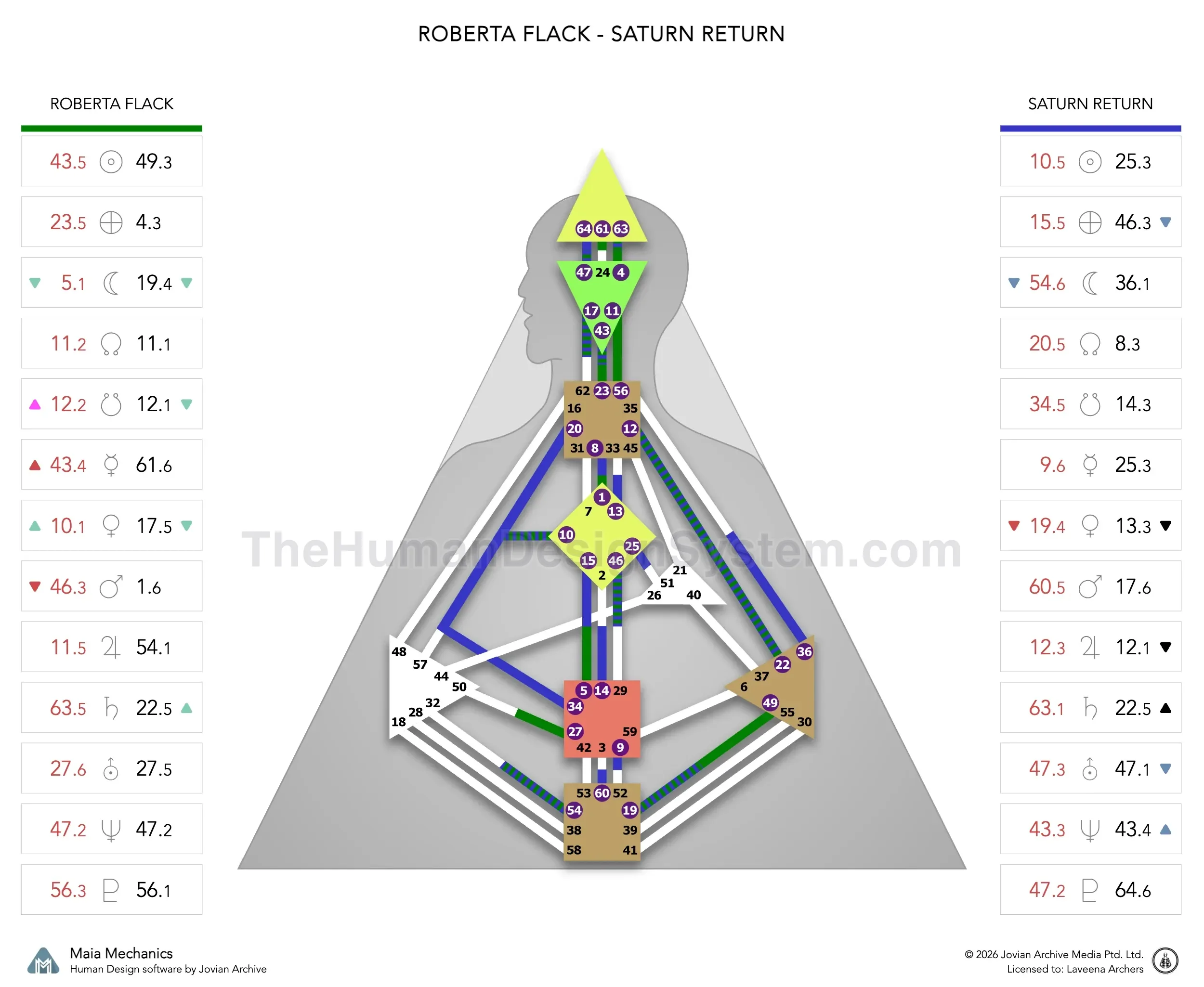
Natal chart against the March 1966 Saturn Return transit, age 29: the transiting Right Angle Cross of The Vessel of Love (25/46 | 10/15), the same cross family her own chart carries.
Uranus Opposition, 1975
Her Uranus Opposition landed 21 December 1975, age 38, under the Right Angle Cross of The Vessel of Love (10/15 | 46/25), the same cross family as her Saturn Return with the gates rotated.
This is the cycle every other chart in this series gets measured against. Before the exact date: her marriage to Novosel ended in divorce in 1972, the same year “The First Time Ever I Saw Your Face” became the biggest single of 1972 and held number one for six weeks. In 1973 it won Record of the Year and Song of the Year at the Grammys. In 1973 she released Killing Me Softly, and in 1974 its title track won her a second consecutive Record of the Year, an achievement no artist had managed before her. “Feel Like Makin’ Love,” her third number-one single, arrived the same year. After the exact date the window keeps running, and so does the pattern. “The Closer I Get to You,” with Donny Hathaway, became a million-selling gold single in 1978. On 13 January 1979 Hathaway died in a fall from his hotel room at the Essex House in New York, ruled a suicide. The structure her first Saturn Return had built, a marriage entered in earnest, came apart in this window; everything the culture now remembers her for arrived in the same handful of years; and then the musical partnership that defined her sound ended in the worst way available, three years past the exact opposition. A Uranus Opposition breaks the structure a life was built on so far. Here it broke a marriage, made a career, and took her closest collaborator, across one seven-year span.
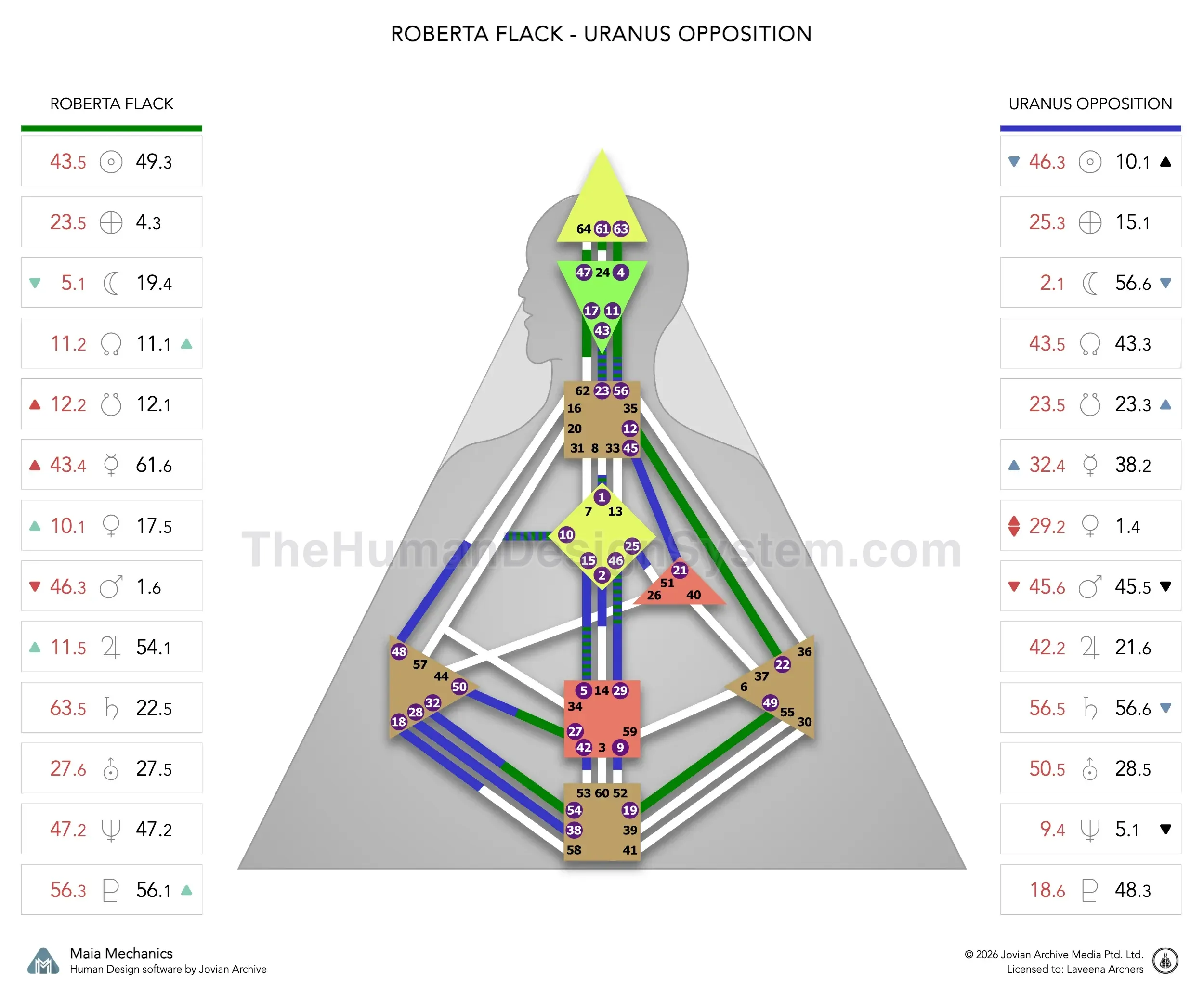
Natal chart against the December 1975 Uranus Opposition transit, age 38: the transiting Right Angle Cross of The Vessel of Love (10/15 | 46/25) mirrors her own natal cross, gates rotated, running through the exact window that closed her marriage and opened the peak of her career.
Chiron Return, 1986
Flack’s Chiron Return fell 9 July 1986, age 49, under the Right Angle Cross of Penetration (53/54 | 51/57).
Before the return, a real if less dramatic professional stretch: a hit single, “Making Love,” in 1982; the album Born to Love with Peabo Bryson in 1983, whose “Tonight, I Celebrate My Love” reached number two in the UK; a 1984 recording of a Yoko Ono song, made while Flack was documented as Ono and John Lennon’s next-door neighbor; and, arriving with the return itself, the theme song for NBC’s Valerie in 1986. Nothing here carries the singular force of the 1970s window, and the first version of this post concluded that the cycle held collaboration rather than solo reinvention. The rest of it sits on the side I had not searched: she voiced Michael Jackson’s mother in the Bad short film in 1987, released the Oasis album in 1988, and took a remix of “Uh-Uh Ooh-Ooh Look Out (Here It Comes)” to the top of the dance chart in 1989.
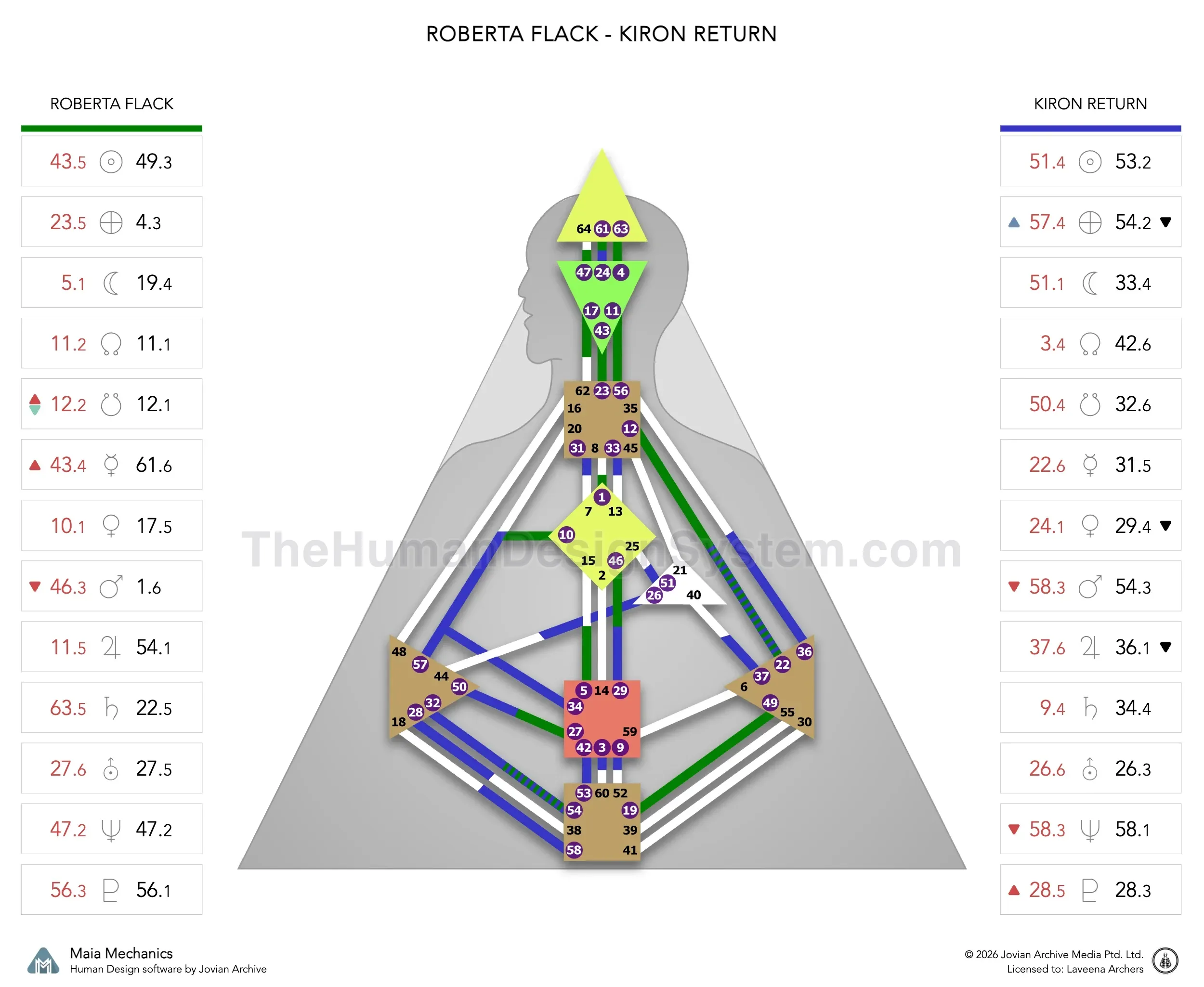
Natal chart against the July 1986 Chiron Return transit, age 49: the transiting Right Angle Cross of Penetration (53/54 | 51/57).
Second Saturn Return, 1995
Her second Saturn Return landed 29 April 1995, age 58, under the Right Angle Cross of The Four Ways (24/44 | 19/33).
I reported this as the one cycle in Flack’s record without a pattern, and how I got there is the most useful thing in this post. I named the answer myself and then threw it away. The original text noted that “Set the Night to Music,” her 1991 duet with Maxi Priest, sits at the edge of the window, and that nothing more specific falls between it and 1996, when The Fugees’ remake of “Killing Me Softly with His Song” returned her to the charts from outside her own work. The Fugees record is inside this window, in the half of it I was not searching. It put her signature song back on the charts without her involvement at all. For a woman whose recording career began in the years just after her first Saturn Return, having her own material handed back to her by someone else at her second is a fair account of what this cycle asked. The Christmas Album followed in 1997.
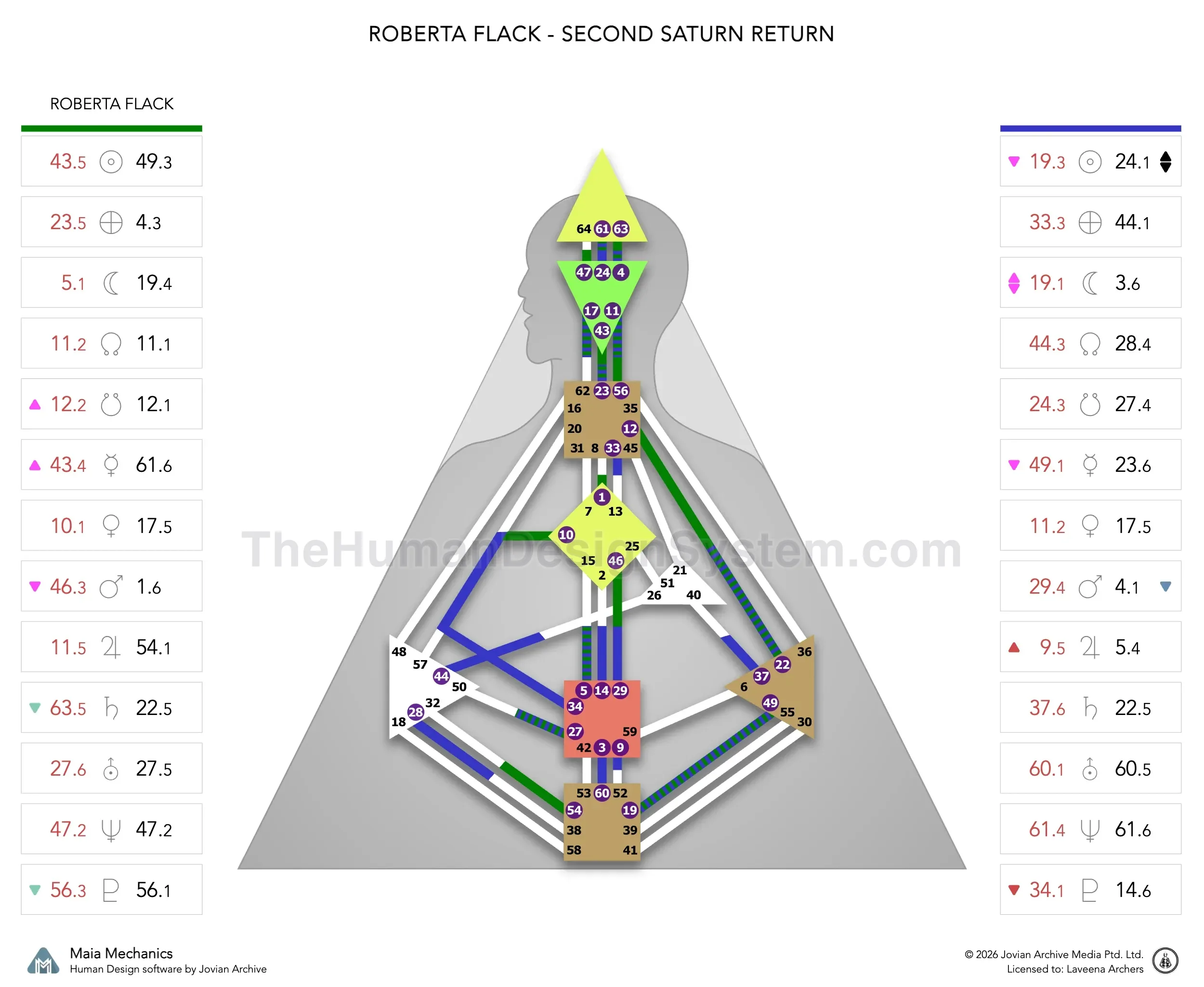
Natal chart against the April 1995 second Saturn Return transit, age 58: the transiting Right Angle Cross of The Four Ways (24/44 | 19/33).
What the four cycles show
Flack’s natal cross, the Right Angle Cross of Explanation, carried on a 3/5 profile, runs on turning raw, whole-arriving insight into something an entire room can suddenly hear, projected onto her by a network before she asked for it. Each return tested that same throughline against a real, dated turn in her life, under its own temporary cross:
- Saturn Return, 1966, the Right Angle Cross of The Vessel of Love (25/46 | 10/15). The structure got tested the same year it was built, her marriage to Steve Novosel, and the recording career began on the far side of the same window: Atlantic in 1968, First Take in 1969.
- Uranus Opposition, 1975, the Right Angle Cross of The Vessel of Love (10/15 | 46/25). Her richest correlation in the series: the marriage that began at her Saturn Return ended in this window, the entire commercial and critical peak of her career arrived in the same few years, and Donny Hathaway died three years past the exact date.
- Chiron Return, 1986, the Right Angle Cross of Penetration (53/54 | 51/57). A real if less dramatic stretch: the Peabo Bryson duets, the Lennon/Ono connection and the Valerie theme song before the date, then the Bad short film, Oasis and a number one dance remix after it.
- Second Saturn Return, 1995, the Right Angle Cross of The Four Ways (24/44 | 19/33). The Fugees’ remake of “Killing Me Softly with His Song” in 1996, which put her signature record back on the charts without her. I originally logged this cycle as a miss because I was searching only the years before the exact date.
A chart built on 43-23 and 12-22 does exactly what those channels do: insight arriving whole, translated into a voice with nothing holding it back once the wave was ready. Flack spent five decades proving it, from a debut album recorded essentially live in ten hours to a Grammy Record of the Year two years running, an achievement no artist had managed before her.
If your own chart carries emotional authority and you’ve spent years being told your mood isn’t a good enough reason, pull your free chart to see the wiring underneath. And if 12-22 or a Manifestor’s closed aura sound like your own life, a professional reading can show you what informing before you act buys you.
Her last Solar Return, and the day she died
Flack died on February 24, 2025, of cardiac arrest, at 88. Her manager and close friend, Suzanne Koga, announced the death; NPR and Variety carried it the same day, both noting she had lived with ALS since a 2022 diagnosis. No public account puts an hour on her death, and where none was recorded, this series says exactly that rather than inventing one.
Her last Solar Return, the chart for her eighty-eighth birthday on February 10, 2025, landed her transiting Sun and Earth back on the identical Gate 49 and Gate 4 they occupy natally, computed in Maia Mechanics against the stated 6:30 AM birth time. No border complicates this one: the same-clock sky returned cleanly. The field around it stayed quiet, too: nothing in that year’s transits completed a new channel with her own design. The five channels her whole chart already ran on, Synthesis, Logic, Curiosity, Openness, and Structuring, needed no help from the sky in her final year. The voice had been whole for a long time before it stopped.
In memory of an ICONIC Human Design,
LaVeena B. Archers, PhD
Chart via myBodyGraph, rendered through Maia Mechanics, Human Design Professional Software licensed from Jovian Archive, birth data via Astro-Databank.