In Memory of Robert Redford: The Yes That Spread
Robert Redford was a 2/4 Sacral Manifesting Generator on the Right Angle Cross of Contagion, birth certificate in hand. A design Sun whose own keynote is building the network that gives original work somewhere to land, and a man who spent forty years doing exactly that.

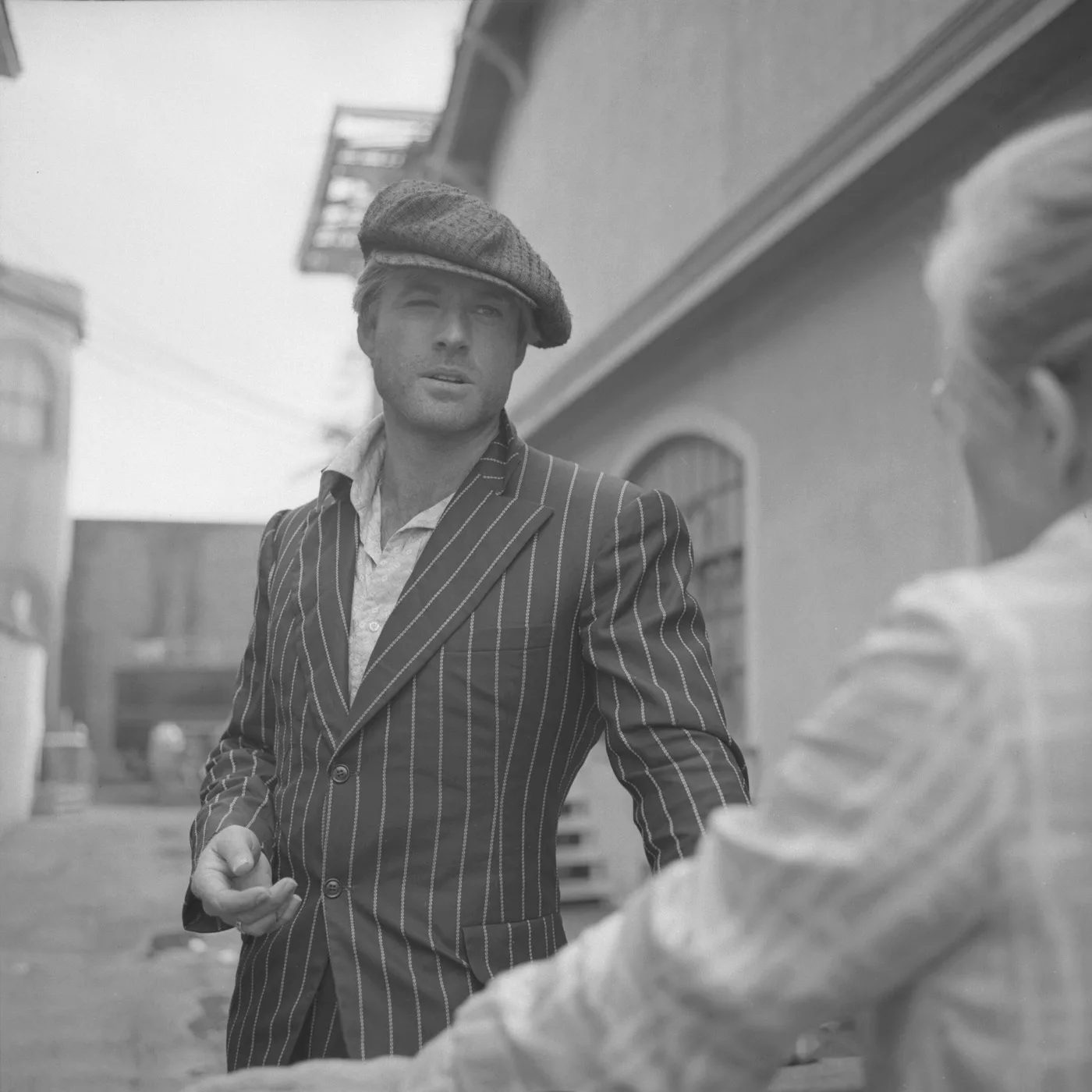
Robert Redford on the Santa Monica Pier, February 6, 1973, in costume for The Sting*, speaking against the pier’s demolition. Photo: Ken Dare, Los Angeles Times, via UCLA Library.*
Robert Redford died September 16, 2025, in his sleep, at his home at Sundance in the mountains of Utah. He was 89. His representative’s statement named the place before it named anything else: “the place he loved, surrounded by those he loved.”
I keep the photograph above at the top of this piece on purpose. He is in costume for The Sting, mid-shoot, in the city he was born in, and he is not there to be photographed as a movie star. He is there arguing that the Santa Monica Pier should not be torn down. That is February 1973, four years before most people had heard the word Sundance, and it is already the whole design.
His record is AA: August 18, 1936, 8:02 PM, Santa Monica, California, birth certificate in hand. I ran it on this site’s own engine and then rebuilt it from scratch in Maia Mechanics, and the two agree line for line.
| Type | Manifesting Generator |
| Strategy | Wait to respond |
| Authority | Sacral |
| Profile | 2/4 |
| Definition | Split Definition |
| Cross | Right Angle Cross of Contagion 3 (29/30 | 8/14) |
| Signature / Not-Self | Satisfaction / Frustration |
| Data | AA record, 8:02 PM PST, Santa Monica, CA |
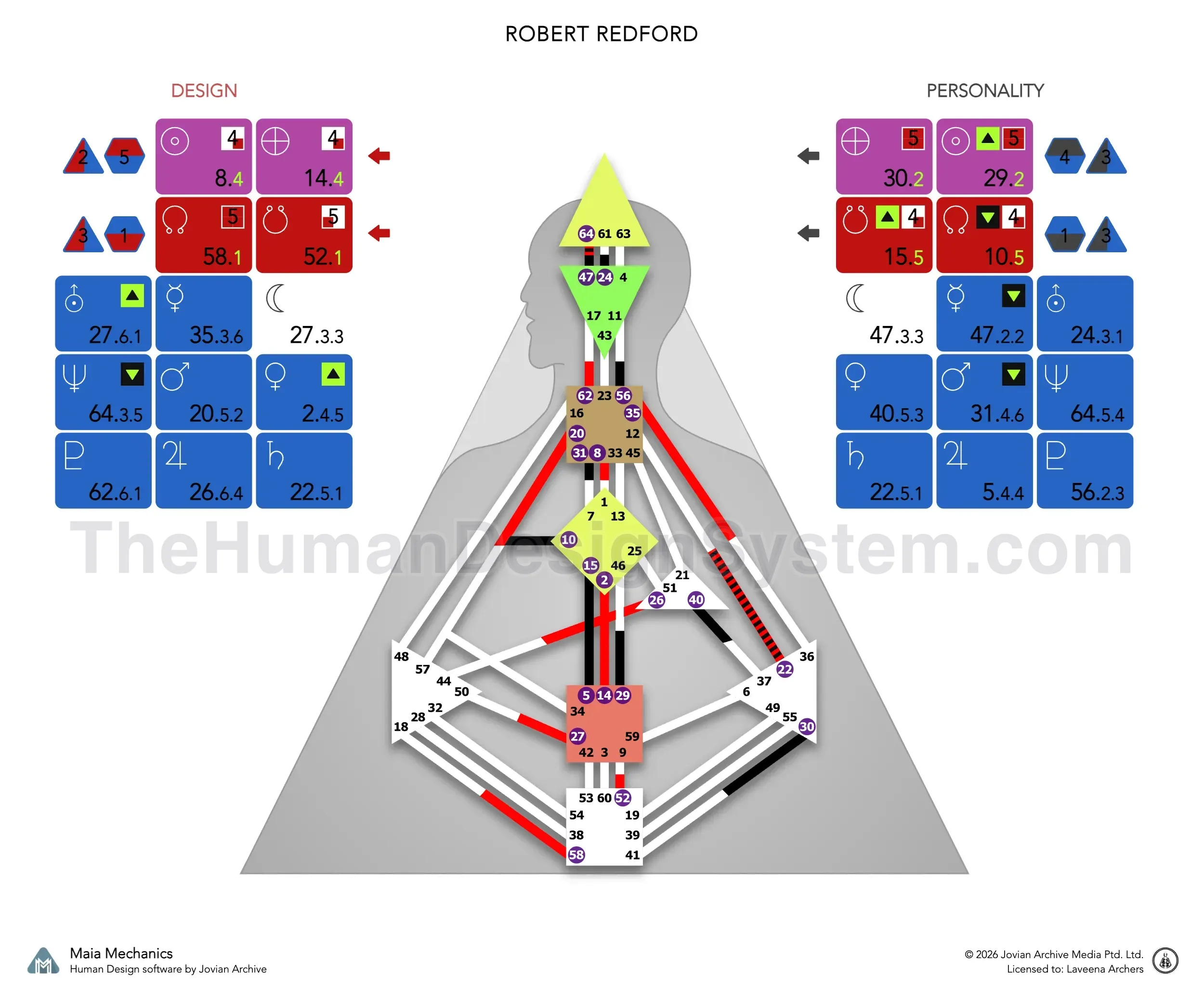
Robert Redford’s natal bodygraph, 2/4 Sacral Manifesting Generator: Design and Personality, activated at birth.
The gate that describes Sundance in one line
His design Sun sits in Gate 8, Contribution, in the Throat, on the fourth line. Our own page for that gate gives line 4 as building the network and goodwill that give original work somewhere to land.
I did not write that line about him. It has been on this site for a long time, describing a hexagram line in the abstract. It also happens to be the most compact description of the Sundance Institute anyone has produced.
He founded it in 1981, after buying a Utah ski area called Timp Haven and renaming it after the character that made him famous. The Institute existed to give filmmakers with no route to a studio a place to develop work and, from 1985, a festival at which it could be seen. What came through that door over the following forty years is most of what people mean when they say American independent film. He did not direct those films or star in them. He built the somewhere for them to land, which is line 4’s actual job description, and he did it from just offstage.
His design Earth sits in Gate 14, Power Skills, also on the fourth line: building security steadily, so the direction can be traveled without panic. He paid for the early Institute out of his own star salary. The commercial career and the thing it funded were two halves of one mechanic, and he said as much often, that the acting bought the land and the land bought the freedom.
The gate that says no
His conscious Sun sits in Gate 29, Perseverance, the Sacral’s gate of saying yes, on the second line: refuses commitments that don’t fit, however attractive they look to others.
That is a strange keynote for the gate of yes, and it is exactly right for him. A Sacral Generator’s power is the yes, and a second line’s discipline is declining almost everything so the yes means something when it arrives. His conscious Earth is Gate 30 line 2, which the page gives as knowing which yearnings deserve pursuit and declining the rest. Both conscious lights on the second line, both on the refusal.
The public record of his career is a long list of things he would not do. He turned down more than he took, walked away from the industry entirely in 1966, spent decades declining to become the kind of star the studios kept offering to make him, and stayed in Utah rather than in Los Angeles for the whole second half of his life. A 2/4 profile is a hermit and a networker in the same body: the second line needs to be left alone and has to be called out of the house, and the fourth line’s network is the only thing that can call it. That is a fair account of a man who built one of the most connected institutions in film and then lived up a canyon.
Contagion
The Right Angle Cross of Contagion runs through Gates 29, 30, 8 and 14, and our page for it describes a personal destiny whose yes to experience infects everyone nearby. Gate 29 is the Sacral’s commitment. Gate 30 is the Solar Plexus’s desire, the wanting that pulls a life forward. Gate 8 is the Throat’s contribution. Gate 14 is the Sacral’s fuel.
Put those four together and the theme is a person whose own appetite for an experience becomes other people’s appetite for it. He is the third chart in this series on that cross. Ted Turner carried the same four gates in a different arrangement, 14/8 | 29/30, and built CNN. My own chart carries them in a third arrangement. I mention that not as a credential but because it is the honest reason I recognize the pattern: the Contagion crosses do not persuade anyone of anything. They say yes to a thing in public with enough conviction that other people catch it.
Sundance is that mechanism at industrial scale. He did not lobby the studios to fund independent film. He said yes to it, on his own land, with his own money, and within fifteen years the entire category existed because people had caught it from him.
A Split, and the bridge he kept looking for
He had Split Definition: two separate areas of his chart that never touch. Head and Ajna are joined by Abstraction, the mental pressure to make sense of confusion. Separately, Throat, G Center and Sacral are joined by Awakening, Rhythm and The Beat. Nothing connects the two halves. Maia names the bridging gates as 17 and 11.
A Split looks for its bridge in the world, and tends to be drawn to whoever or whatever supplies it. His thinking apparatus and his doing apparatus were structurally separate, which is a mechanical way of saying that what he understood and what he could act on did not automatically connect, and that he needed other people in the room to close the gap. He worked in long, loyal partnerships his whole life: Sydney Pollack across seven films, Paul Newman, Alan Pakula, the same producers and crews for decades. Those relationships were not sentimentality. A Split chart runs better with them.
The Beat is the one I would point a student at. It joins direction to fuel: Gate 2’s sense of where the self is going, wired straight into Gate 14’s resources. It is the channel of having both the compass and the money for the journey, and it is rare to see it used as literally as he used it. He converted a movie-star income into a canyon, and the canyon into an institution.
Saturn Return, March 19, 1966
The Saturn Return arrives around twenty-nine and audits the structure you have built against the design underneath it. It asks whether the life you assembled is yours. His fell on March 19, 1966, at 29.58, under the Left Angle Cross of The Plane (36/6 | 10/15).
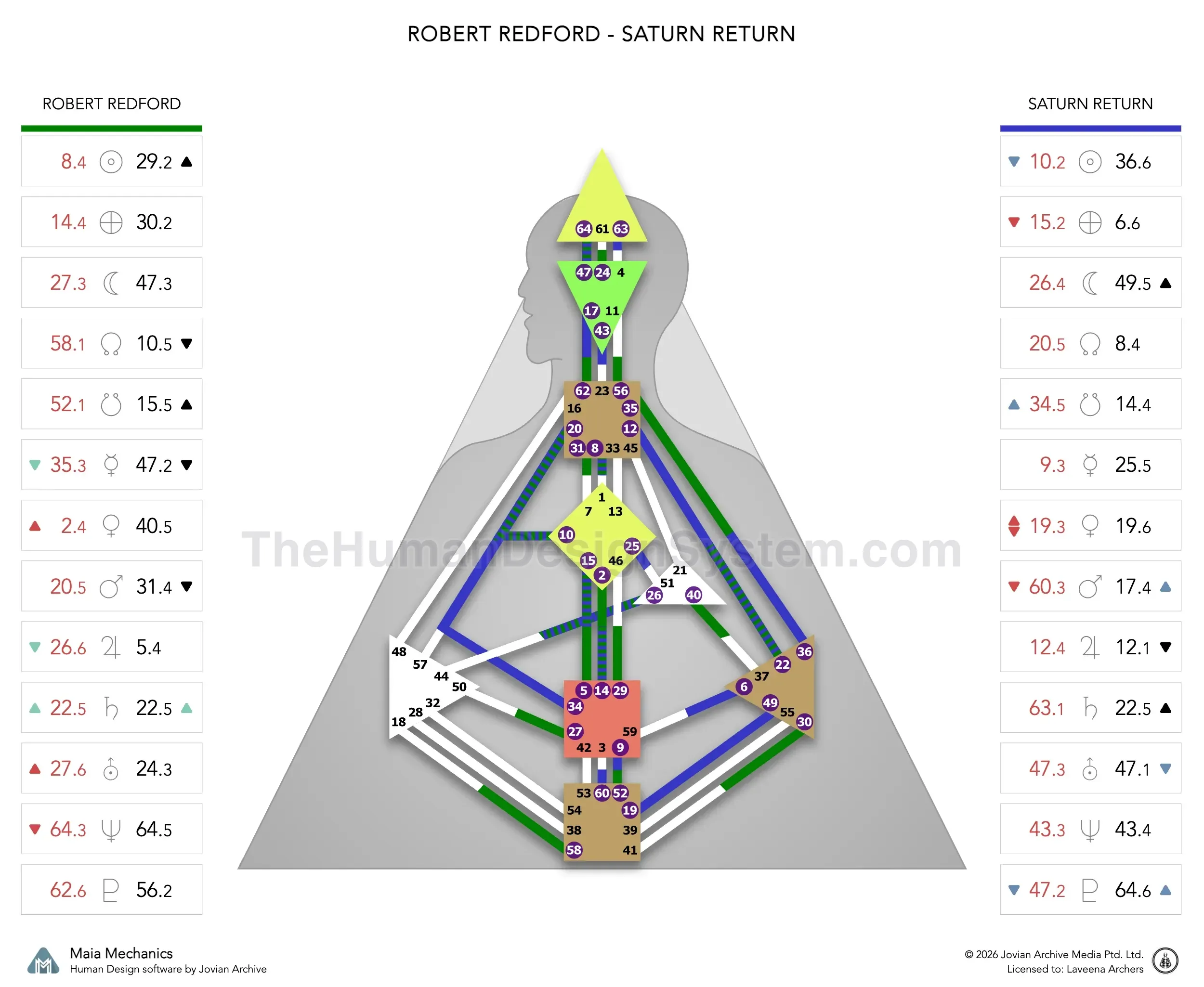
Natal chart against the March 19, 1966 Saturn Return transit, age 29: the year he left for Spain.
This is the cleanest of his four. In 1966 he had two films land and disappoint, The Chase in February and This Property Is Condemned in August, and instead of pushing harder he took his family to Europe. He spent close to seven months in Mijas, in Málaga, on a rented farm with no electricity and no running water, waiting for a part worth taking rather than accepting one that was not.
That is Gate 29 line 2 with nothing in the way: refusing commitments that don’t fit, however attractive they look to others. It is also as pure a Saturn Return as this series has documented. A twenty-nine-year-old actor with momentum and offers, auditing the structure, deciding it was not his, and walking off it to a hillside. Butch Cassidy and the Sundance Kid was three years away, and the name he took off that character is the name on the canyon, the institute, the festival and the mountain he died on.
Uranus Opposition, December 4, 1976
The Uranus Opposition falls around forty, when transiting Uranus reaches the point opposite its birth position. It breaks open whatever has set too hard. His fell on December 4, 1976, at 40.29, under the Right Angle Cross of Consciousness (5/35 | 64/63).
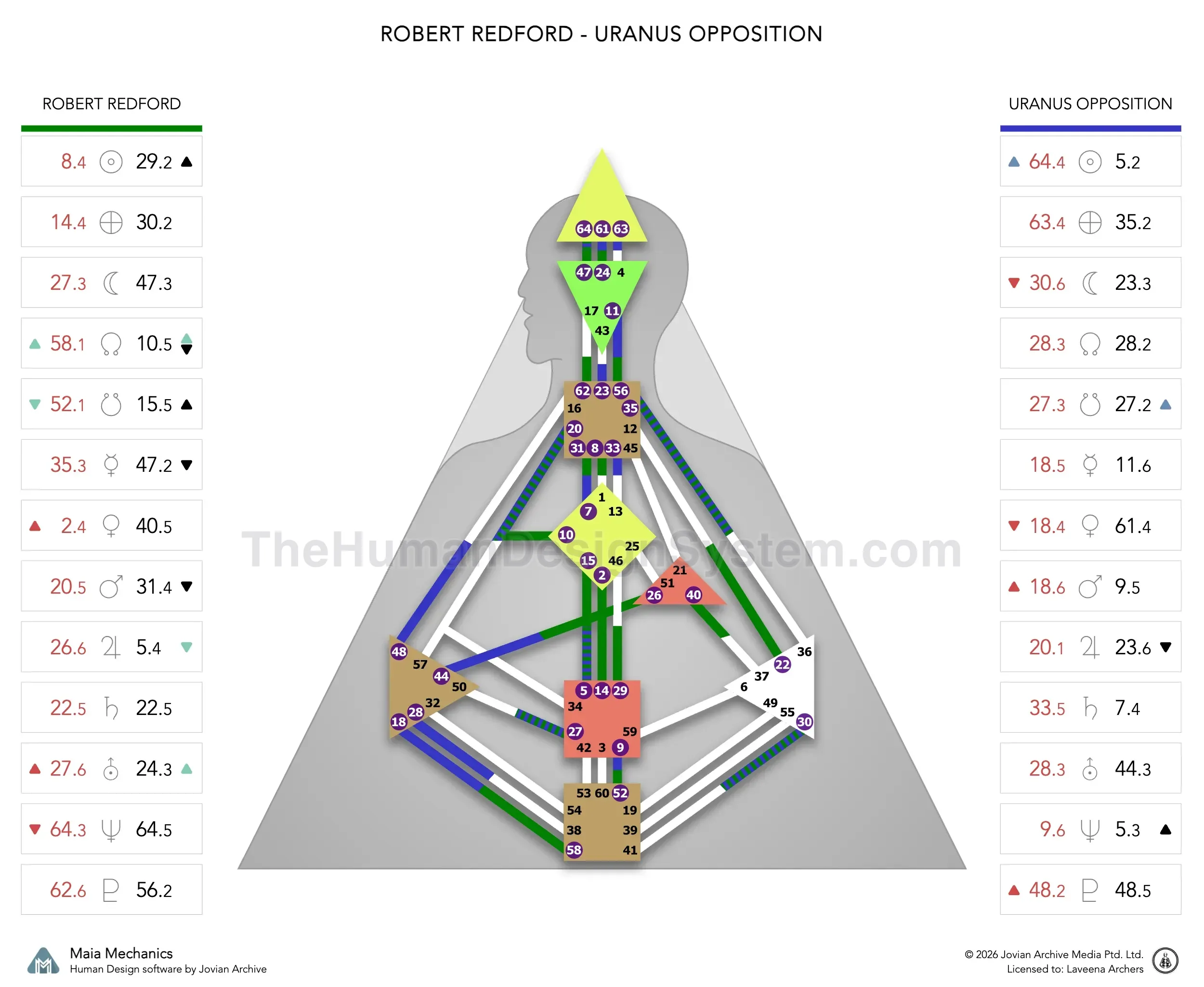
Natal chart against the December 4, 1976 Uranus Opposition transit, age 40: the year All the President’s Men reached the screen.
There is no single dated event on December 4, 1976, and I am not going to invent one. The window runs three and a half years either side of that date, and All the President’s Men is inside it, released on April 4, 1976, eight months before the return, with its four Academy Awards following the March after. What 1976 holds is the year the thing that had set hard came apart, which is the same statement made about a year instead of a day.
By 1976 he was one of the most bankable actors alive, and the structure around that had calcified into a single role: be the face. All the President’s Men was released in April 1976 and it is the film where he stopped accepting that. He had optioned Woodward and Bernstein’s story himself, before their book existed, pushed the project through as a producer, and cast himself in it rather than being cast. It went on to eight Academy Award nominations and four wins.
The break the transit describes is the one between Redford the leading man and Redford the person who decides what gets made. Everything after it follows from that side of the split: his directing debut with Ordinary People in 1980, which won him the Best Director Oscar, the Institute in 1981, the festival from 1985. A cross of Consciousness sitting over the year he changed which end of the camera he was answerable to is a fit I am comfortable naming, and a day-level claim is not one I can make.
Chiron Return, June 14, 1987
The Chiron Return comes around fifty, when Chiron completes its orbit. In this series it has kept landing on the point where somebody stops auditioning for a role and simply occupies it. His fell on June 14, 1987, at 50.82, with Chiron in Gate 45, under the Right Angle Cross of Eden (12/11 | 36/6).
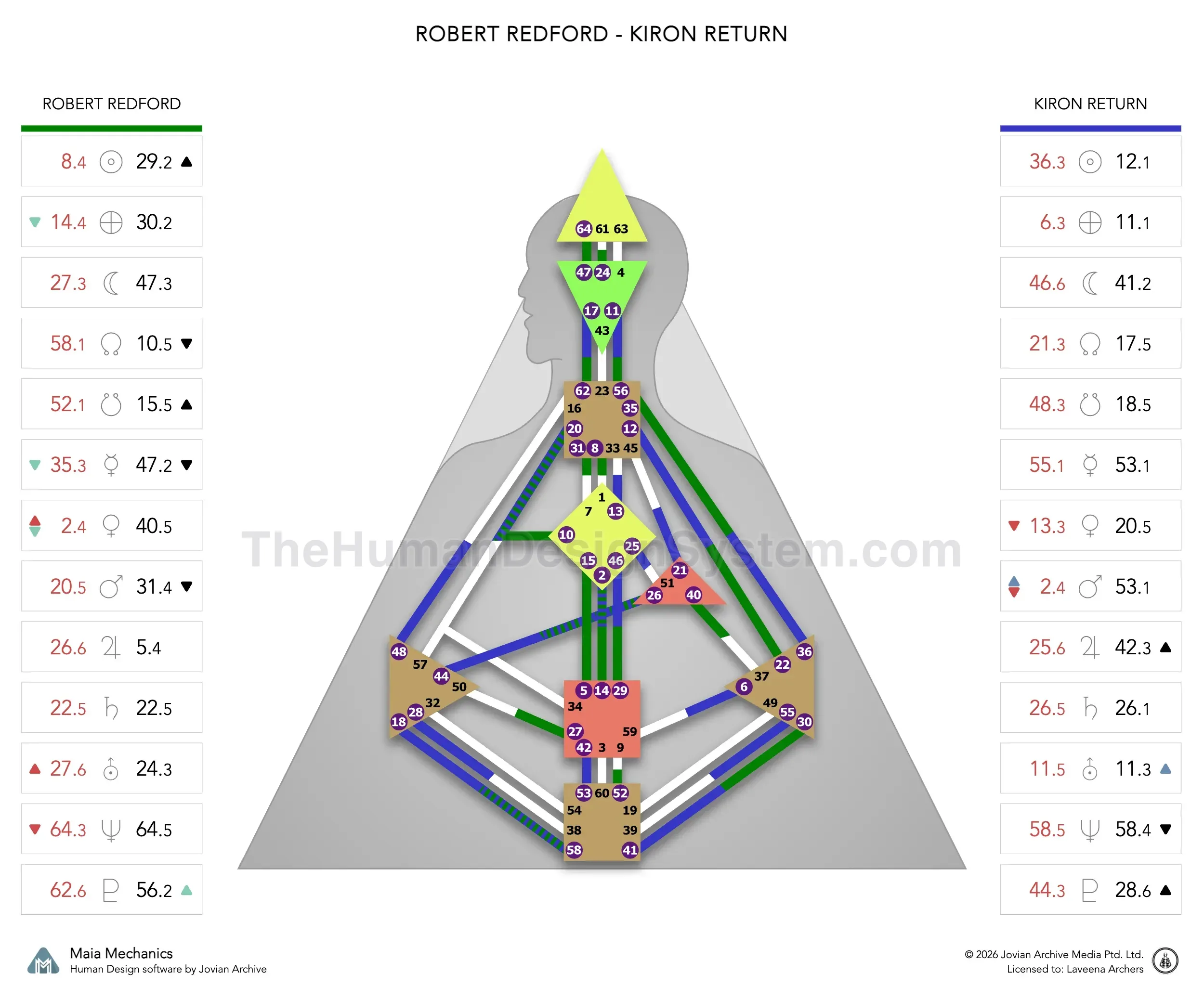
Natal chart against the June 14, 1987 Chiron Return transit, age 50: between a troubled film and the institution that outlasted it.
Nothing is dated to June 14, 1987 itself. Everything below sits inside the window either side of it, which runs from the end of 1983 to the end of 1990.
Here is the state of him instead. The Milagro Beanfield War, which he directed, had wrapped its shoot in Truchas, New Mexico in November 1986 after a difficult production, missed its planned November 1987 opening, went back for reshoots that October and did not reach cinemas until March 1988. His marriage of twenty-seven years to Lola Van Wagenen had ended in 1985. The Institute was six years old and the festival had been under its wing for two. So the picture around his fiftieth is a man whose film was stuck, whose marriage was over, and whose institution was becoming, without any announcement, the most durable thing he ever built.
Chiron in Gate 45, the gate of the one who gathers and holds resources for a group, is a suggestive placement for a man whose fiftieth year sat him squarely between his own work stalling and his work for other people compounding. I offer the gate reading as a reading. The events around it are dated, and they are inside the window rather than on the day, which is the ordinary shape of a cycle this slow.
Second Saturn Return, April 26, 1995
The second Saturn Return arrives around fifty-eight to sixty. Where the first audits the structure you built, the second asks what you intend to leave standing. His fell on April 26, 1995, at 58.68, under the Right Angle Cross of The Unexpected (27/28 | 41/31).
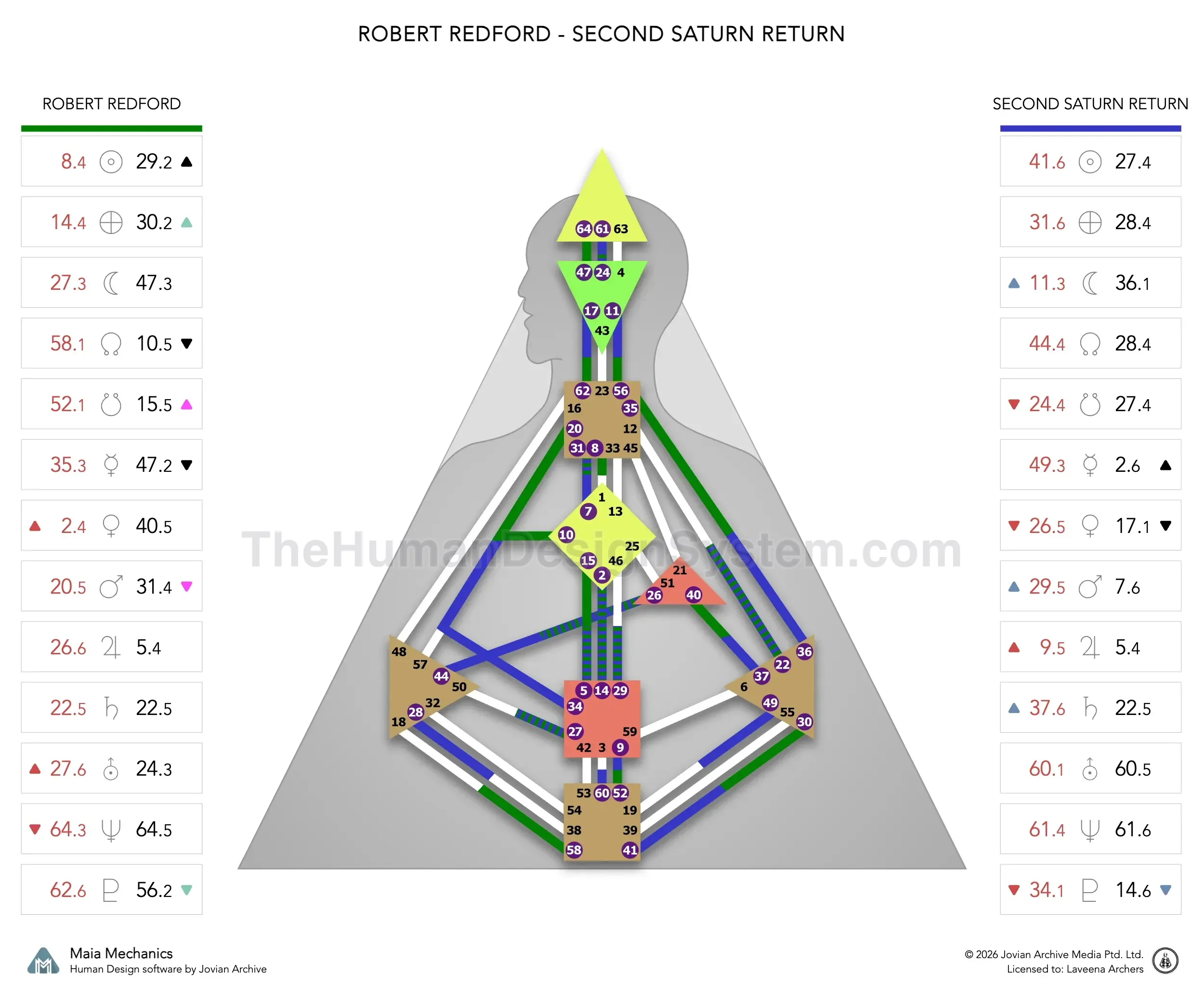
Natal chart against the April 26, 1995 second Saturn Return transit, age 58: the year Sundance stopped being a place you had to travel to.
The window fits even where the day does not. A month before the return, on March 27, 1995, Quiz Show, which he directed, went to the Academy Awards with four nominations including Best Picture and Best Director and won none. In the same year he signed the deal with Showtime that created the Sundance Channel, which launched on February 29, 1996 and turned a ten-day festival in a Utah ski town into something running every day of the year in people’s houses. I do not have a date in April for the signing, so I am placing it in the year rather than on the transit.
That pairing is the second Saturn Return’s question answered out loud. The awards for his own work came to nothing. The distribution channel for everyone else’s work went permanent. He was fifty-eight and he chose the one that would outlast him, which is what the second return is for.
What his design leaves behind
The thing about a Contagion cross is that you can measure it after the person is gone by counting who caught it.
He was a 2/4 who needed to be left alone and needed to be called on, a Split who needed other people to close a gap in his own wiring, and a Sacral Generator whose Sun sat on the line that declines almost everything. None of that reads, on paper, like a man who would found an institution. It reads like a recluse with good taste.
What made the difference is where his design Sun sat. Gate 8 line 4 does not ask you to be the original voice. It asks you to build the network and the goodwill that give original work somewhere to land, and it does that work from just offstage. He spent his fame as currency rather than as an identity, and bought a place for other people’s films to exist. Every director who got a first feature made because a festival in a ski town would show it is downstream of a twenty-nine-year-old who went to Spain rather than take a part he did not want, and who kept saying no until he found the yes that was his.
He died at Sundance. Not in Santa Monica where he was born, and not in Los Angeles where the career was. On the mountain he named after a character, that he turned into a place, that he turned into a door for other people. A 2/4 gets to go home at the end, and his home was the thing he built.
His last Solar Return, and the day he died
He died on September 16, 2025, twenty-nine days after his eighty-ninth birthday, in his sleep, at his home at Sundance in the mountains of Utah, as NPR reported. No time of death was made public. His representative’s statement gave the place and the sleep and left the clock out, which is how a death at home in the night tends to reach the record, and I am not going to guess at a minute. A Solar Return is computed from birth data alone, and his is a birth certificate, so that last chart is exact where a death chart cannot be.
His last Solar Return, the chart for his final birthday on August 18, 2025, landed his transiting Sun and Earth on the identical Gate 29 and Gate 30 they occupy natally, computed in Maia Mechanics against the birth-certificate 8:02 PM time: the yes and the wanting, the personality half of his Cross of Contagion, presiding over one more year. Two channels connected that year’s sky to his own design: the 18-58 Channel of Judgment, the sky reaching the Gate 58 love of life he carried in his design, and the 30-41 Channel of Recognition, the sky reaching his conscious Earth in Gate 30. That birthday sky held a Gate 30 of its own as well, so Recognition also hung whole among the transits themselves, the Abstract circuit’s fuel of desire, the hunger for an experience not yet lived, standing over the final year of a man who built a life out of knowing which yearnings deserved pursuit.
In memory of an ICONIC Human Design,
LaVeena B. Archers, PhD
Chart via myBodyGraph, computed independently on this site’s own engine and cross-checked against Maia Mechanics, Human Design Professional Software licensed from Jovian Archive, birth data via Astro-Databank. Cycle dates via Maia Mechanics. Biographical dates cross-checked against Wikipedia, Variety, Deadline and NPR. His death, its date and place, and his representative’s statement via CNN, NPR and the Washington Post. His 1966 stay in Mijas via the Majorca Daily Bulletin and the Olive Press. The Milagro Beanfield War‘s production and release dates via the AFI Catalog. The Sundance Channel’s launch date and ownership via UPI and Showtime Networks’ own corporate history.
If you want to know which of your own noes are mechanics rather than fear, your chart is free. It will not tell you what to build. It will show you where your yes lives, and how much you are allowed to decline before you find it.