
Self-Projected Authority (G Center) in Human Design
Self-Projected Authority belongs to Projectors with a defined G Center connected to the Throat, while the Solar Plexus, Sacral, Spleen, and Heart are undefined. LaVeena teaches this process through hearing your own spontaneous voice in relation to identity, direction, and what brings personal satisfaction.
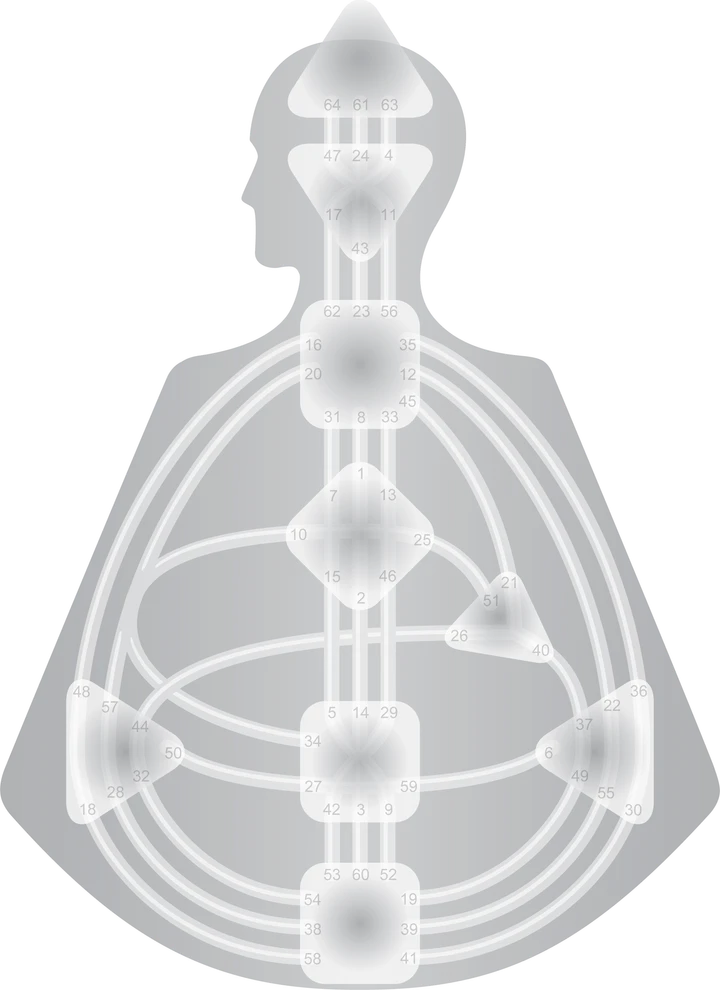


Self-Projected Authority brings identity, direction, and the voice into the same teaching. The starting point is a specific chart structure: a defined G Center connected to the Throat, with no defined Solar Plexus, Sacral, Spleen, or Heart taking precedence.
Keep your free Human Design chart beside you. The Authority overview compares the seven categories; this page explores the Self-Projected process and how it belongs alongside the Projector’s Strategy.
In my Authority classes, I ask Self-Projected Projectors to listen to what they themselves say spontaneously. The questions concern their own direction and what brings personal satisfaction. That is something to investigate in experience, rather than a performance of certainty or a test of how confidently you speak.
The mechanics: identity wired to the voice
Self-Projected Authority occurs in Projectors. The G Center, associated in Human Design with identity, love, and direction, connects to the Throat through at least one of four complete channels:
Those connections are part of the classification, but they are not the whole check. The Solar Plexus, Sacral, Spleen, and Heart must all be undefined. Any of those centers being defined gives another Authority precedence, even when a G-to-Throat channel is present.
For example, G-to-Throat definition with a defined Solar Plexus gives Emotional Authority. Without emotional definition, the engine checks Sacral, Splenic, and Ego Authority before reaching Self-Projected.
Complete channels, rather than individual gates
The engine combines the Personality and Design gate activations, finds complete channels, and derives center definition. Black and red activations both contribute. One highlighted G gate does not define the center, and an undefined center can contain activated gates.
A G-to-Throat channel can be completed on either side or through a combination of the two. You do not need to recognize a trait consciously for its activation to contribute to the calculation.
The chart-reading guide explains these layers. The calculation guide describes the engine’s steps and verification limits. The classification identifies structure; the calculator does not hear your voice or measure personal satisfaction.
Decisions through the voice
In my teaching, the Self-Projected process involves hearing your own spontaneous expression in relation to identity and direction. I bring attention to questions about happiness, personal satisfaction, and whether a direction expresses the self.
The emphasis is on listening to what you yourself say, rather than preparing the answer that will get a particular response from someone else. You may have an idea about what you intend to say and then hear something different as you speak. The difference gives you something to notice; surprise alone is not a guarantee that a statement is correct.
Keep recognition and invitation in view
Self-Projected Authority belongs alongside the Projector Strategy of recognition and invitation. In class, I discuss the larger engagements of life, including work, relationships, and where to live. These involve other people and the context in which your contribution is recognized.
Talking about an opportunity does not create an invitation or establish that the other person recognizes you. Equally, receiving an invitation does not make this page able to determine your answer. Strategy and Authority are taught together.
Questions about identity and direction need not become an instruction to ignore practical circumstances. Money, responsibilities, other people’s agreements, and the details of an opportunity remain real. The teaching gives you a process to explore within that situation.
A listener helps you hear yourself
A trusted listener can offer room for you to speak without pushing you toward the answer they prefer. In my classes, I distinguish inquiry and listening from telling another person what to do.
A listener’s agreement does not become your Authority. Their role also does not require them to certify whether every phrase came from the self or the mind. You can ask for space to talk without asking them to take responsibility for your choice.
A practical protocol
Treat these as starting points for observation, rather than mandatory steps that prove you are doing Authority correctly:
- Confirm the chart structure. Check the named Authority result, the complete G-to-Throat channel, and the absence of definition in the four higher-ranking centers.
- Notice the context. Keep recognition and invitation in view for the major engagements where Projector Strategy applies.
- Give yourself room to speak. When you talk about a direction or invitation, listen to what you yourself say. Notice where a rehearsed argument differs from spontaneous expression.
- Ask for listening when useful. Choose someone who can hear you without making the choice for you. Explain that you are exploring your own process.
- Leave room for what is unclear. You do not need to manufacture excitement, a surprising sentence, or an immediate answer to demonstrate trust in yourself.
You can reflect on what you heard afterward. A short note is an optional learning aid, rather than a score for whether you have accessed Authority.
Speaking alone and the Mental Projector distinction
In my Living Your Design teaching, I acknowledge that some Self-Projected Projectors say they do not need to speak to another person. Hearing your spontaneous voice is the central point. Being alone does not mean that your Authority has disappeared.
This also helps distinguish Self-Projected Authority from the Mental/environmental process. Both discussions involve listening, but I teach the Mental Projector process through discussion and environment, with a different relationship to processing over engagements. The fact that you like talking things through does not identify which chart classification you have.
When the mind overrides the voice
In my Authority classes, I distinguish spontaneous expression from the mind trying to work out what it should say to produce an outcome. You might notice yourself building a persuasive case, repeating what seems acceptable, or searching for someone else to approve a direction.
Those are observations to explore, rather than a basis for declaring every thought false. The mind can learn, describe, remember, and share perspective. A defined Head or Ajna does not move the mind above the G Center in the Authority hierarchy.
There is also no universal vocal test here. A flat tone does not automatically establish no; excitement does not automatically establish yes. You do not need to reject your words in favor of an arbitrary sound rule or treat every unplanned sentence as binding.
The deconditioning overview connects Authority with recognizing conditioned patterns. The deconditioning article explores the individual pace of that process. Finding recognition difficult does not change the natal classification or prove that you have failed.
Living it
Start with the free chart, your Projector Type page, and the Authority overview. Return to the complete chart when a single channel description seems to contradict the Authority result.
If the birth time is estimated, the birth-time guide explains how to investigate a plausible window. Agreement at sampled times does not recover an exact time or exclude every intervening change. The chart-change article separates corrected inputs, calculation differences, and temporary comparison layers.
A Foundational Analysis can provide a setting for understanding the chart and asking questions. A practitioner can explain the teaching without becoming the person who chooses your direction.
The ongoing experiment is hearing your own expression in the context of identity, direction, and Projector Strategy. It does not require a particular personality, constant access to a listener, or a promise that every spontaneous statement will be infallible.
A framework for self-understanding, not a medical claim. See the full note on medical astrology and Human Design.
Frequently asked questions
What is Self-Projected Authority in Human Design?
Self-Projected Authority is a Projector classification with G-to-Throat definition and no defined Solar Plexus, Sacral, Spleen, or Heart. LaVeena teaches attention to your own spontaneous voice in relation to identity, direction, happiness, and personal satisfaction. Enjoying conversation alone does not establish this Authority.
Which channels can give Self-Projected Authority?
The four G-to-Throat channels are 8-1, 31-7, 20-10, and 33-13. At least one must be complete, and the Solar Plexus, Sacral, Spleen, and Heart must all be undefined. The complete chart matters: a G-to-Throat channel can also appear in a chart with another Authority.
Does a defined G Center always mean Self-Projected Authority?
No. The Solar Plexus, Sacral, Spleen, and Heart each take precedence over the G Center in the engine’s Authority hierarchy. One activated G gate also does not define the center. Check the complete natal chart rather than selecting the process you prefer.
Do Self-Projected Projectors always need a sounding board?
LaVeena describes hearing your own spontaneous voice and acknowledges that some Self-Projected Projectors speak to themselves. A trusted listener can help you hear yourself without directing you. She distinguishes this from the Mental Projector process, which involves discussion and environment. Being alone does not erase Self-Projected Authority.
Should I trust my tone more than my words?
LaVeena emphasizes listening to what you yourself say spontaneously. This page does not prescribe a tone test in which enthusiasm proves yes or a flat voice proves no. A single sound, surprise, or rehearsed phrase cannot be used here to certify that a particular choice is correct.
Does Self-Projected Authority replace waiting for an invitation?
No. Keep the Projector Strategy of recognition and invitation alongside Authority, particularly in the major relationships and engagements LaVeena discusses. Speaking about something does not itself create recognition or an invitation.
Do red activations count toward Self-Projected Authority?
Yes. The engine combines Personality and Design activations before finding complete channels and defined centers. A G-to-Throat channel can be completed through black activations, red activations, or both sides. Identifying consciously with a trait is not required for its activation to contribute.
Can deconditioning or a transit change Self-Projected Authority?
The same birth instant and calculation produce the same natal Authority. Deconditioning concerns recognition and experience of the process. Transits and connection charts are comparison layers; corrected birth details or a calculation correction can produce a revised natal result.
Source and lineage
This entry is written in original words from Ra Uru Hu's source material as held by Jovian Archive, and taught by an IHDS Independent Teacher. The mechanics (which center a gate sits in, which gates make a channel, how the authority hierarchy is ordered) come from the site's reference data, the same data the free chart runs on. To check either, see who writes here and the Human Design tools this site publishes.
Spotted an error on this page? Tell us and a human will look into it.