In Memory of Ted Turner: A Life Built Like a Cave
Ted Turner was a 3/5 Manifesting Generator with a Heart center fully activated and never once defined. A look at the father he lost at 24, the sister before that, and the enclosures he kept building around an open center that never stopped needing to prove itself.

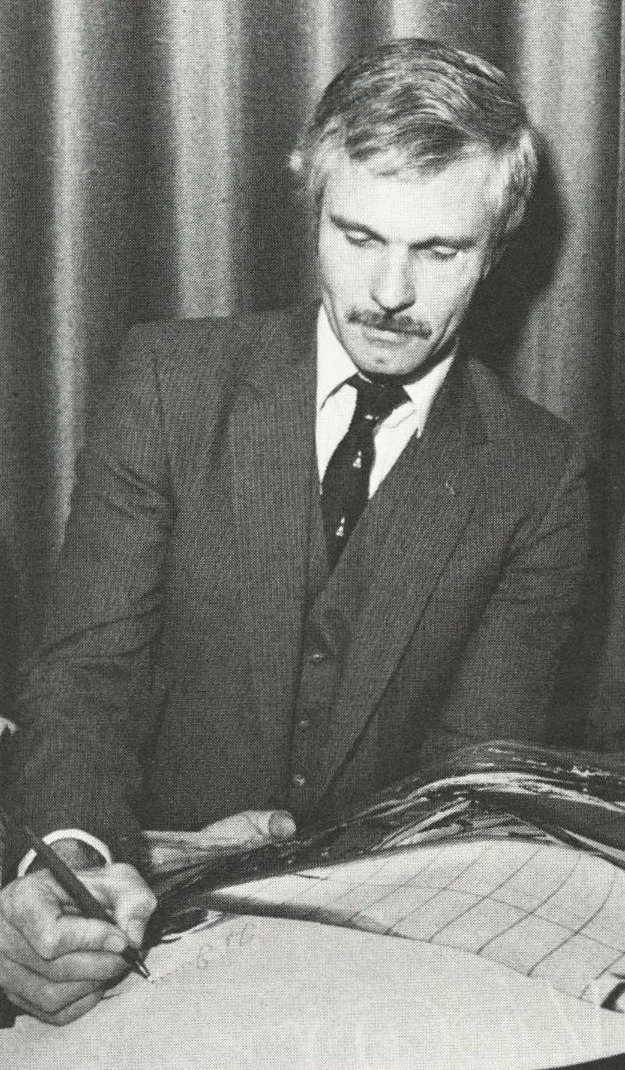
Ted Turner, 1981, a year after CNN went on air. Photo: Rochester Institute of Technology, public domain.
Ted Turner died May 6, 2026, at his home in Florida. He was 87, eight years past the afternoon he sat down with Ted Koppel on CBS Sunday Morning and told the country he had a brain disease most people had never heard of. I didn’t feel this one the way I felt Dolly Parton a few months back, that ache in the chest that doesn’t wait for you to think first. This is a quieter grief, more like closing a file I’ve had open for a while. So I’m going to do the thing I know how to do with it: read a life through the chart underneath it.
I’ve written a separate piece, Ted Turner, Human Design, and the Deals He Answered Instead of Starting, on my HumanDesignBusiness.com site for anyone who wants the deals: the takeover at 24, the superstation, the 1978 CNN commitment, the Time Warner merger that cost him control of the company he built. That piece owns the balance sheet, and I’m not going to repeat it here. This one is what the balance sheet leaves out.
Turner’s chart runs on an AA-rated record: November 19, 1938, 8:50 AM, Cincinnati, Ohio, birth certificate and birth record both in hand, collected by the astrologer Clifford and carried on Astro-Databank at the top rating the database gives. I swept every hour of that birth day before writing a word of this. Type, Authority and Definition hold at all 24 hours. The 3/5 profile holds from 5:00 AM onward, so the recorded time sits well inside the band rather than anywhere near an edge. Nothing here needs a hedge, and I’d rather say that than manufacture a caveat the data doesn’t ask for.
Run the chart and here’s what comes back:
| Type | Manifesting Generator |
| Strategy | Wait to respond |
| Authority | Sacral |
| Profile | 3/5 |
| Definition | Single |
| Cross | Right Angle Cross of Contagion (14/8 | 29/30) |
| Defined centers | Ajna, G, Sacral, Throat |
| Data | AA record, 8:50 AM EST, Cincinnati, OH |
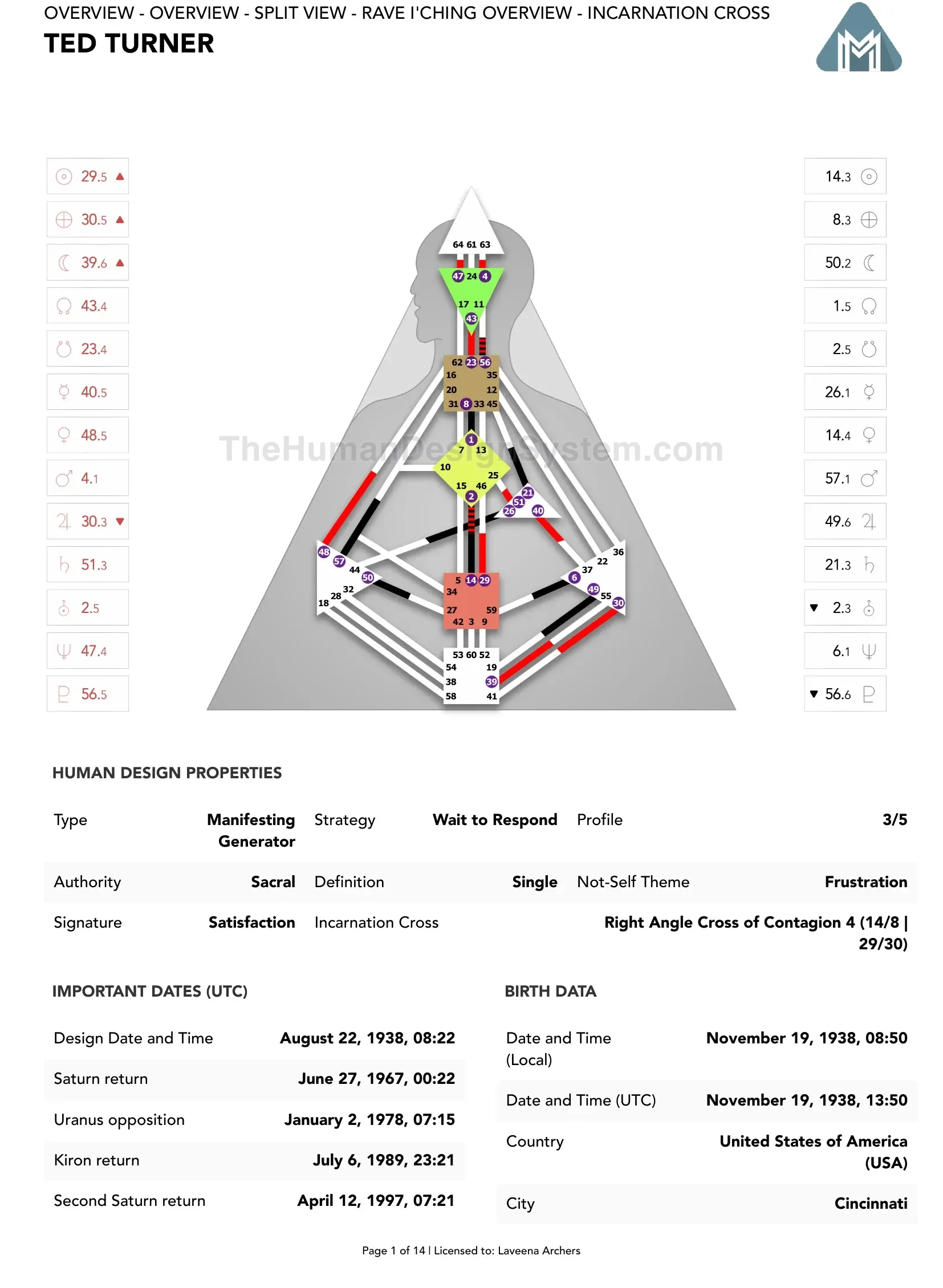
Ted Turner’s natal bodygraph, 3/5 Manifesting Generator: Design and Personality, activated at birth.
The center that was loaded and never closed
Two things about this chart stopped me before I’d read a word of biography against it.
The Heart center carries all four of its gates activated at once: 21, 26, 40 and 51. Not one of their partner gates, 45, 44, 37 or 25, showed up in the same chart. That’s a center completely loaded and completely open at the same time, four separate pulls toward willpower and self-worth with no fixed channel connecting any of them to steady definition. Gate 21, The Hunter, is the gate that insists on controlling its own domain and its own resources. Partnered with Gate 45 it becomes what this system calls the Channel of Money. His never was. He built one of the largest media and land fortunes in American history on a gate whose one job is guarding resources, and the channel that would have made that guarding a fixed, stable trait in his design never closed.
The other finding sits at the opposite end of the chart. The Head center carries zero activated gates, not 61, not 63, not 64. Whatever pressure most people feel to have an answer, a theory, a private certainty before they’ll speak, Turner’s chart simply didn’t generate it from that source. What he did generate came from a fully defined Ajna reaching a fully defined G Center, with no mental pressure behind it and no outside input required to trust it.
The wound at twenty-four
His father, Robert “Ed” Turner, shot himself on the morning of March 5, 1963, at 53, at the family’s home outside Savannah. He had been drinking and using pills, wrestling depression, and frightened he’d overreached on a $4 million deal that had just made Turner Advertising the largest billboard company in the South. Ted was 24. He inherited a company on the edge of collapse and, according to his own account in his 2008 memoir Call Me Ted, a suicide note that said simply that his father was sorry, that he’d felt in over his head when he wasn’t. Academy of Achievement has him describing his father’s illness in his own words decades later: “classic case… clinical depression primarily… up and down mood swings.” He never diagnosed it further than his father had let him see, and neither will I.
A 3/5 profile spends its first three decades finding out what works by getting burned on what doesn’t, in public, in relationships, in business, then carries that hard-won practicality forward as something other people can lean on. Turner’s version of that arrived at the worst possible moment to learn anything: a company on the brink, a father’s failure as the only material to learn from, no time to fail slowly. He didn’t fold the company, he expanded it, buying more radio and television properties through the rest of the 1960s while the debt his father had died over was still being paid down. That’s not a business strategy I’m reading here. It’s what a Sacral response looks like when it has no other choice but to trust itself immediately, at 24, with no time left for trial and error to run its normal, slower course.
The sister he lost first
Before his father, there was his sister. Mary Jean Turner developed encephalitis and then a severe form of lupus at 12, and the illness left her in pain and increasingly unable to communicate for years before she died at 17. Ted was about 20. He’s said since that her death did more to shake his faith than his father’s suicide did later: “She was sick for five years before she passed away, and it just seemed so unfair, because she hadn’t done anything wrong. Christianity couldn’t give me any answers to that. So my faith got shaken somewhat,” he told an interviewer, a line widely reported alongside his own account in Call Me Ted. In 2001, the Turner Foundation gave a million dollars to lupus research, thirty-plus years and an entire media empire away from the sister it was for.
His own account of how he carried both losses is the same sentence twice: “If I had spent my time just sitting down and thinking about it, it would have absolutely crushed me,” and, of the general pattern, “whenever I had tragedy occur in my life, I’d just go to work harder.” That’s not a chart reading. That’s a Sacral authority’s actual coping mechanism, described by the man who had one: don’t sit with the feeling, respond to the next thing in front of you instead.
Saturn Return, 1967-68
Saturn returns to its own natal position roughly every twenty-nine years, and the return itself functions less like a mood than an audit: whatever structure was never built to last gets tested right about now. Turner’s exact return spanned three passes, June 27 and August 22, 1967, then March 7, 1968, the transiting planet settling each time on Gate 21 line 3, the first pass carrying its own temporary cross, the Right Angle Cross of Service (52/58 | 17/18). That’s not a coincidence of timing. A return means Saturn is back at the degree it occupied at birth, and his natal Saturn sits at that same gate: Gate 21, the Hunter, the one gate in this whole chart built to guard its own resources and answer to no one else about them.
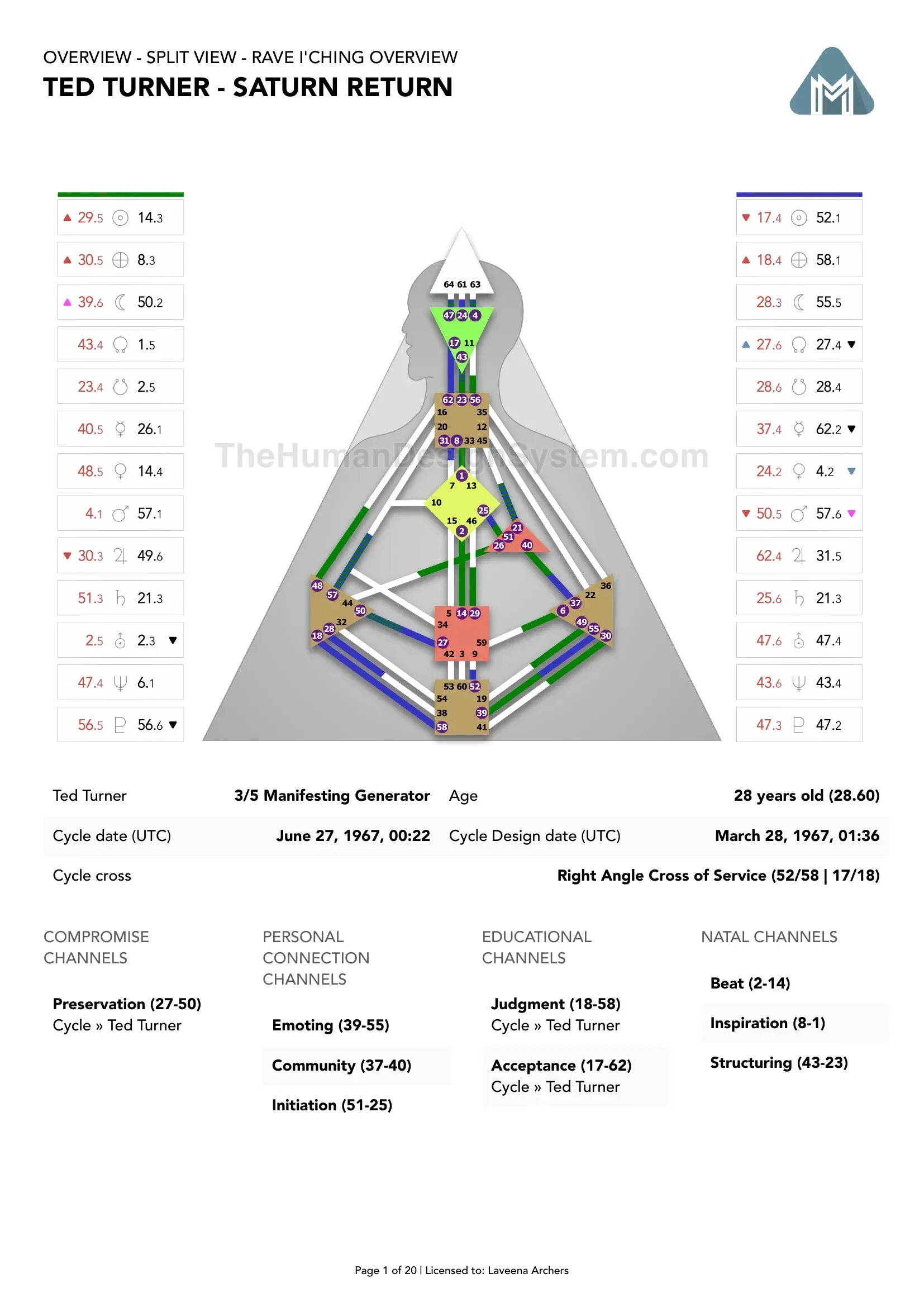
Natal chart against the June 1967-March 1968 Saturn Return transit, age 28 turning 29.
The audit did more than sit still. Two channels reached straight into gates already fixed in him: Gate 25 arrived to complete 25-51, The Initiation, with his natal Gate 51 in the Heart, and Gate 37 arrived to complete 37-40, Community, with his natal Gate 40 beside it, the first time either isolated gate had found a partner in this record. Two more channels formed entirely inside the transiting sky itself, 27-50, Preservation, and 55-39, Emoting, touching nothing already his. At 29, three years into a debt he was still paying off from his father’s estate, Saturn’s answer to “was the foundation ever going to hold” was to point straight back at the gate that had never once needed anyone else’s permission to hold it, while two of the four gates around it got their first partners of his life.
Three marriages, one complete chart
Single Definition means the chart is whole on its own, no outside person required to complete it. It doesn’t predict how many marriages a person has. Turner had three: Julia Nye from 1960 to 1964, Jane Smith from 1965 to 1988, twenty-three years and three of his five children, and Jane Fonda from December 21, 1991 to May 22, 2001. None of them, mechanically, was ever going to be the piece that made him whole. What a Single Definition chart with a wide-open Heart center needs from a partnership is somewhere to keep proving a worth that never gets to rest in a fixed trait, and that is a much harder thing to give a person than completion is. Fonda has spoken since his death about the “love and support” that outlasted their divorce; whatever it demanded of both of them while it lasted, it wasn’t the demand a textbook reading of Single Definition would predict.
Environment: Caves
Of the four readings in his Rave Psychology, Environment is the one that looks wrong on paper for the man everyone remembers buying land by the million-acre unit. Caves is a setting a body needs in order to feel safe enough to function, and a cave is defined by enclosure, not scenery. It has nothing to do with being outdoors. It has to do with a fixed boundary a person controls completely.
Turner spent the first twenty years of CNN’s life practicing exactly that indoors. By his own account, in a 2007 interview: “for 20 years, I lived at my office… I lived on a couch in my office for ten years, and then luckily, I got wealthy enough to build a little penthouse on the roof, 700 square feet, and I moved up there.” Colleagues who worked the overnight desk remembered him wandering the newsroom barefoot in a bathrobe at three in the morning to get his own coffee, a boss who never actually left the building he owned. That’s Gate 40, Aloneness, sitting in the same open Heart as Gate 21: the willingness to carry the whole weight alone, on the condition that “alone” also means “enclosed, on my own terms.”
He built the same structure outdoors once he could afford to, just at a different scale. By his death he held roughly two million acres across thirteen ranches in five states, Kansas, Montana, Nebraska, New Mexico and South Dakota, gated, privately managed, and stocked with more than 45,000 bison, by his own company’s account the largest private bison herd in the world. He was the largest private landowner in the United States for roughly fifteen years, a title John Malone finally took from him in 2011. Two million acres is not a small space by any ordinary measure. But every acre of it sat behind a fence he controlled, on land nobody else could enter without his permission, which is a cave built at the scale of a small country rather than a room above a newsroom. Same mechanic, same need, just with more zeros attached.
The sea, briefly
The one enclosure he never built was the one he raced across. Turner skippered Courageous to a four-race sweep of the Australian challenger in the 1977 America’s Cup, and across his sailing career he was named US Sailing’s Yachtsman of the Year four separate times, a record nobody else holds. Open water is the one setting in this piece with no fence at all, notable only because everything else he built ran the opposite direction: walls first, then whatever got done inside them. The water was where the rule didn’t apply, and it produced the one trophy case in his life that had nothing to do with the businesses.
Uranus Opposition, 1978
Uranus takes eighty-four years to complete a full circuit, so its first opposition to itself falls in early midlife, usually the loudest, most disruptive transit a chart sees before sixty. Turner’s fell across three passes in 1978, January 2, April 11 and October 18, the year after the water had given him the one trophy with no fence around it, the first pass under the Right Angle Cross of Tension (38/39 | 48/21). The exact transiting gate each time was 1.3, and Gate 1, Self-Expression, is already his: half of Channel 8-1, the Channel of Inspiration, already running through his own defined Throat.
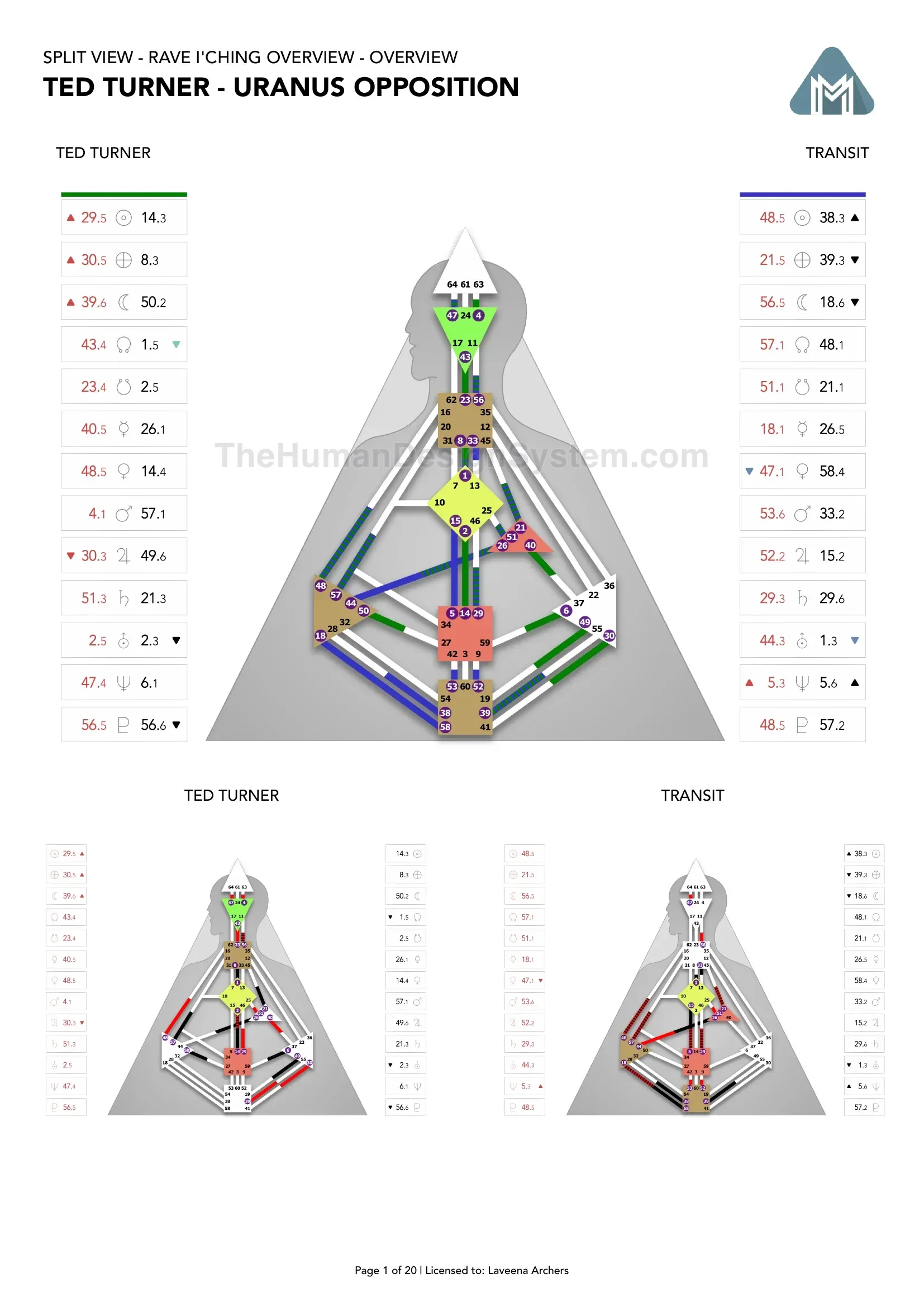
Natal chart against the January-October 1978 Uranus Opposition transit, age 39.
What’s notable about this one is how little else it touched. At the January pass two new channels formed, 15-5 and 18-58, and both sat entirely outside his own gates, transiting planets pairing off with each other in a sky that wasn’t reaching for anything already fixed in him. October reached for nothing at all. Only April made contact, and briefly: the transiting Moon crossed gate 20 and met his own Mars in gate 57, closing 20-57, The Brainwave, for the half day the Moon spends in a gate. Intuition given a voice, for eleven hours, five months before he said yes to the thing. Uranus is disruption without negotiation, and what it mostly found worth disrupting that year was the gate that already spoke for him, at the exact age a chart like his tends to be loudest and most sure of what it has to say.
Chiron comes home, 1989
Chiron’s return, close to fifty, tends to ask a person to make something useful out of whatever wound they’ve spent a life managing rather than hiding. Turner’s Chiron Return fell July 6, 1989, under the Left Angle Cross of Individualism (39/38 | 51/57), transiting Gate 52, Root, opposite the open center that carries the pressure he’d spent his whole adult life turning into motion instead of stillness.
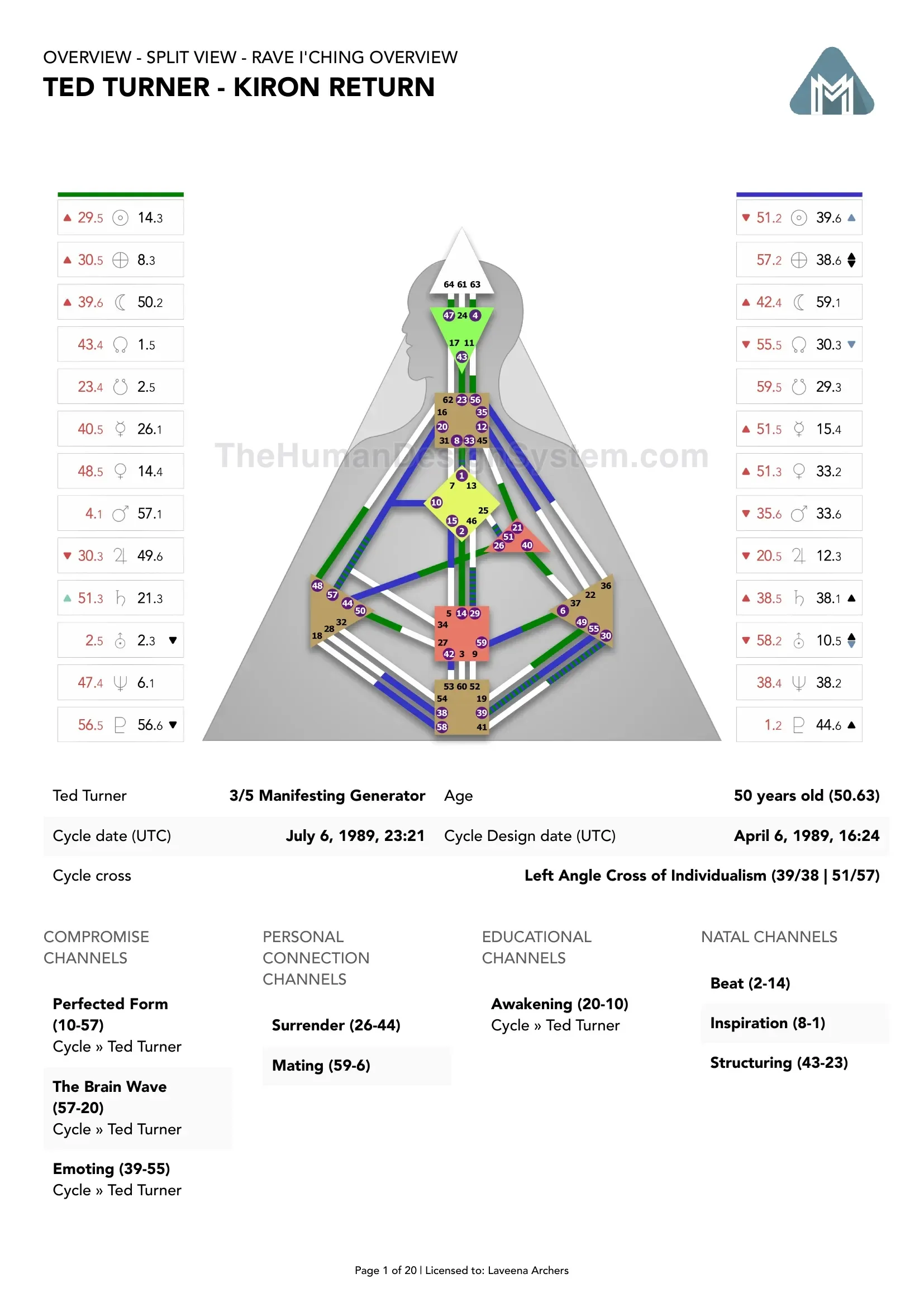
Natal chart against the July 1989 Chiron Return transit, age 50.
Something specific happened in that chart. Two of his four isolated Heart gates, 40 and 51, had already found a partner once, back at the Saturn Return. The other two, 21 and 26, hadn’t. At the Chiron Return, the transiting chart carried Gate 44, and 44 completes Gate 26, the Egoist, into Channel 26-44, the Channel of Surrender, the first partner that gate had ever gotten. The other new channels that same year, 10-57 and 59-6, sit outside his natal gates entirely, formed transit-to-transit rather than reaching into anything already his. The 26-44 pairing is the one that touches him directly, and Surrender is exactly what a wounded-healer transit would ask an open, overloaded Heart center to finally practice: not more control, but a season of letting go of some of it.
What outlived the deals
His Second Saturn Return landed April 12, 1997, under the Right Angle Cross of Maya (42/32 | 61/62), transiting Gate 21 line 3 for the second time in his life, the same natal placement 1967-68 had already visited once. It carried its own echo of that first Saturn Return rather than a new event: Gate 51, Shock, found Gate 25 in the transit chart again and completed Channel 25-51, the Channel of Initiation, for the second time in his life, thirty years after the first pass had already opened it.
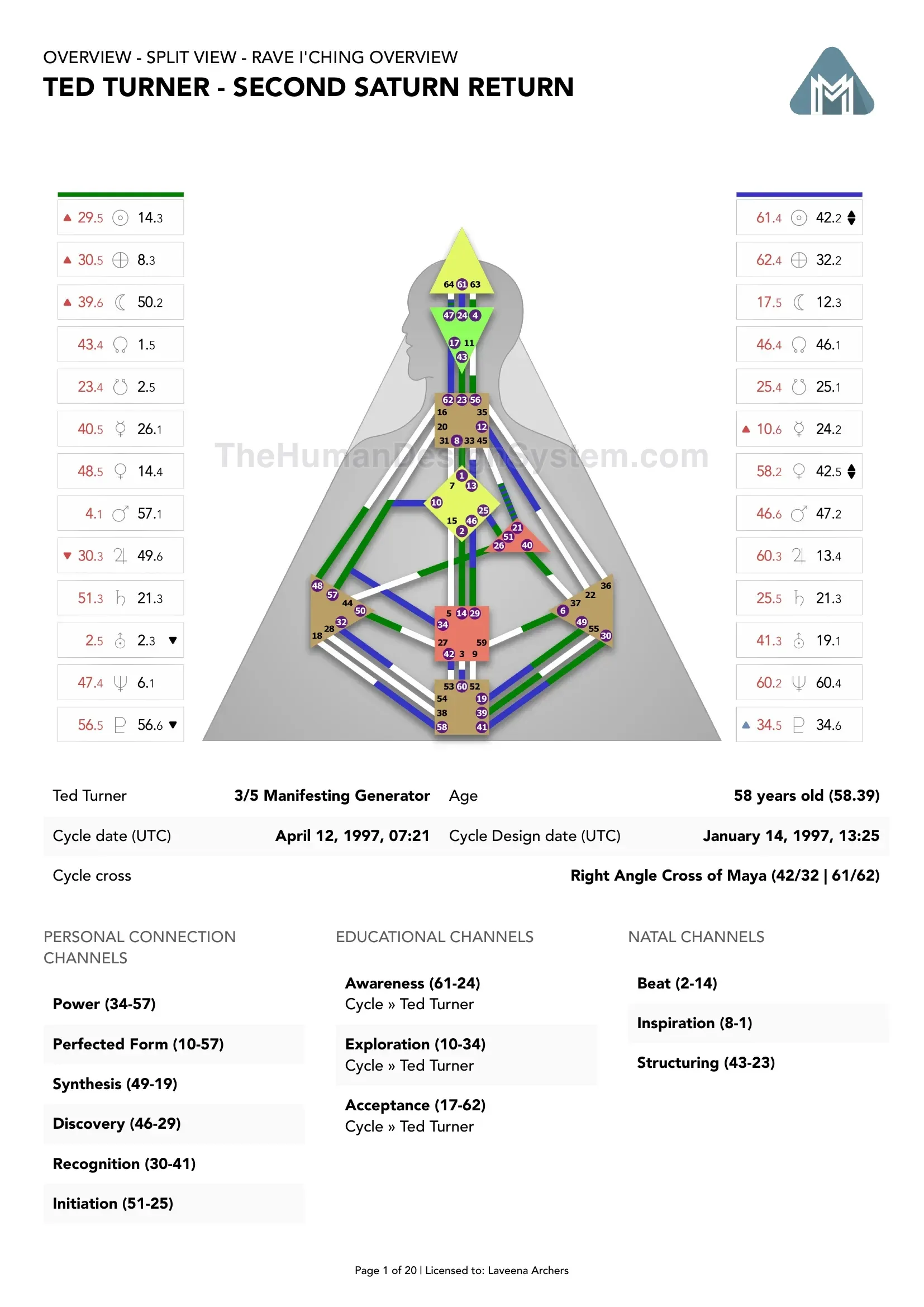
Natal chart against the April 1997 second Saturn Return transit, age 58.
Across the four returns this piece tracks, the accounting comes out uneven. Gate 51 found its partner twice, both times Saturn came home. Gate 40 found its partner once, at that same first Saturn Return. Gate 26 found its partner once, at the Chiron Return. Gate 21 itself, the Hunter, the Money gate, never found one at all, not even on the two occasions its own ruling planet returned to stand exactly on top of it. I’m not going to tell you what that means for a man’s inner life. I’ll tell you what the chart shows: the one gate literally named for controlling resources is the one gate that stayed alone through every return computed here.
His Motivation, the Rave Psychology reading of what sustains effort over time, was Hope: fuel that works on what’s possible rather than what’s already proven. It’s the throughline under the parts of his record hardest to file as either wound or deal. The Goodwill Games, founded in 1986 to ease Cold War tensions through sport when nobody was paying him to try. The Nuclear Threat Initiative, co-founded with Senator Sam Nunn in 2001, built around the same year as his Fonda divorce to reduce the odds of a catastrophe he’d have no financial stake in preventing. The bison and the grasslands, kept not as inventory but, by his own ranches’ account, managed for ecological sustainability alongside the economics. None of it paid out the way CNN did. Hope, mechanically, is the fuel that keeps spending when the return is still years out or never arrives at all, and he kept spending it past the point most people would have called the account closed.
His health
He told the truth about his diagnosis the same way he told most things: directly, on camera, in September 2018, describing it to Ted Koppel as “a mild case of what people have as Alzheimer’s… similar to that, but not nearly as bad.” Lewy body dementia is a real, progressive, diagnosable illness, and I’m not going to pretend a bodygraph explains it, predicts it, or had anything to do with causing it. It doesn’t, and it didn’t. What I can say is that the directness of that disclosure sits exactly where his defined Throat gates, 1 and 8, Self-Expression and Contribution, running Channel 8-1, would say it should: an individual voice built to model its own experience for other people, used here to name an illness in public before most Americans had ever heard its name. That is a statement about his voice. It is not, and should never be read as, a statement about what caused what followed it.
What the chart leaves behind
Laid side by side, none of this reads as separate stories. A Sacral response trusted at 24 because there was no time left to trust anything else. A sister lost before the father, and a faith that didn’t survive either. A Heart center loaded with everything and defined by nothing, spending eighty-seven years building enclosures, an office couch, a penthouse, two million fenced acres, that could hold what the chart itself never fixed in place. Three marriages that were never going to complete a chart that was already whole, and never stopped needing somewhere to prove it anyway. Three returns across sixty years handed that same open center its only partners: two gates got theirs once each, one gate got the same partner twice. And underneath all of it, a Money gate that stayed alone through every single one of them.
His chart’s signature and its shadow are the same instrument built at MG scale: satisfaction when the response gets trusted and let run at his own energy, frustration and anger when it’s checked, slowed, or made to wait for someone else’s schedule, which is most of what the merger and the years after cost him and precisely the register that piece belongs to, not this one. Read here, on the personal side of the same chart, the throughline is simpler and harder: an open center is not a wound to be fixed. It’s a room with no walls of its own, and Ted Turner spent a lifetime building the walls himself, one acre, one couch, one ranch at a time, because the chart was never going to build them for him.
His last Solar Return, and the day he died
Turner died on May 6, 2026, at his home in Florida. The announcement came from his own company’s site, tedturner.com, and it carries the date, the place, and no time of death. None has been made public since, and I’m not going to invent one. A Solar Return needs only birth data, and his is the AA record this entire piece runs on.
His last Solar Return, the chart for his final birthday on November 19, 2025, landed his transiting Sun and Earth on the identical Gate 14 and Gate 8 they occupy natally, computed in Maia Mechanics against the stated 8:50 AM birth time. Three channels connected that final year’s sky to his design, and two of them reached straight into the center this piece opened with. The sky supplied Gate 63 and Gate 64, two of the three Head gates missing from his own chart, and bridged each one to a gate already activated in his design, 63 down to his Gate 4 and 64 down to his Gate 47, completing the 63-4 Channel of Logic and the 64-47 Channel of Abstraction at once. Both are Collective channels, the two ways a mind gets pressured to make sense of what happened, the formula and the story. In his final year, the one center that never generated its own pressure to have answers had both questions wired in from above.
The third bridge is the one the rest of this piece was already tracking. Transiting Neptune sat in Gate 25, the partner that completes his Gate 51, Shock, into the 25-51 Channel of Initiation. Across every cycle computed above, Gate 51 found that same partner three times: at the first Saturn Return in 1967, at the second in 1997, and now here, in the last year of his life. I said earlier I wouldn’t tell you what an unpartnered gate means for a man’s inner life, and that holds for Gate 21, the one that never once got an answer. Gate 51 got the same one three separate times, sixty years apart at the ends and thirty in the middle. The mechanics alone are enough: a Heart center open for eighty-seven years, and the same single channel reopening across it at both edges of his adult life and the last year of it.
In memory of an ICONIC Human Design,
LaVeena B. Archers, PhD
Chart rendered through Maia Mechanics, Human Design Professional Software licensed from Jovian Archive. Birth data via Astro-Databank, Rodden AA, birth certificate and birth record in hand. Death and biographical dates cross-checked against CNN, NPR, Al Jazeera, Wikipedia, the Academy of Achievement, his own memoir Call Me Ted as reported by The List, americascup.com, the Sailing Museum & National Sailing Hall of Fame, Forbes, DTN Progressive Farmer, Turner Enterprises’ own tedturner.com, and Today.com on the 2018 Lewy body dementia disclosure. If you want the business-mechanics half of this same chart, that’s the companion piece: Ted Turner, Human Design, and the Deals He Answered Instead of Starting on HumanDesignBusiness.com.
If you want to see what your own design would ask you to trust the way his trusted a gut response at 24 with no time left to learn any other way, your chart is free.