Sigmund Freud's Human Design Chart: The Listener Who Couldn't Let Go
Freud carried the same three open centers as Carl Jung. A look at his actual chart: the Sphinx cross, a mood-gated voice, and the custodial channel that turned every disciple who outgrew him into an ex-disciple.

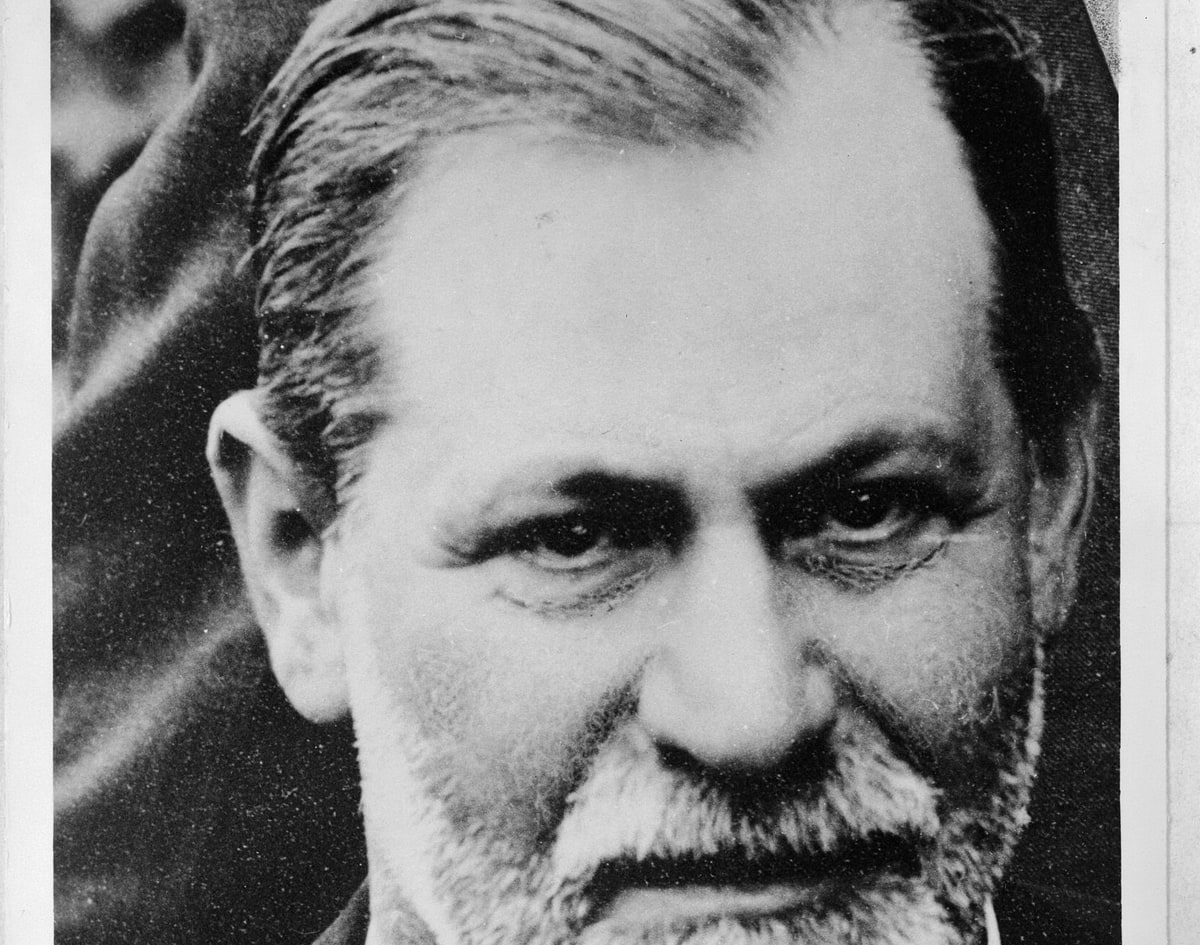
I already use Carl Jung’s chart to teach open centers: an open Head, Ajna, and Ego built an entire field of psychology out of the mind’s own uncertainty. Freud is the other half of that story. His chart carries the exact same three centers open. Same vulnerability, a different way of building a life around it, and eventually a break neither man recovered from.
A note on the data first, since this is a chart from 1856. Astro-Databank carries Freud’s birth at a Rodden AA rating, collected by Lois Rodden herself from a quoted birth record: 6 May 1856, 18:30 local standard time, in Freiberg/Mähren, then Austria-Hungary, now Příbor in the Czech Republic. That’s about as solid as birth data gets for a chart this old, and the chart below is calculated from that record.
What he shared with Jung
Freud’s Head, Ajna, and Ego are open, the identical trio I described in Jung’s piece. Both men took in the pressure to have answers, the pressure to be certain, the pressure to prove their own worth, and both built careers out of exactly that territory: the mind, certainty, self-worth. His Root is open too, so he was also pressured toward urgency, always the sense that something needed resolving now, a not-self stress that fits a man famous for working obsessively once a theory had him.
The engine underneath is nearly identical as well. Freud’s Sacral is defined, and his throat connects to a motor, which makes his type a Manifesting Generator rather than a plain Generator: energy that gets things built, plus the capacity to inform people of the direction before it’s finished. His authority is emotional, run through the Solar Plexus, so nothing he decided was trustworthy in the moment he decided it. He needed the wave to move through before the theory, the letter, the break with a friend, was actually his. And like Jung, his definition is split: his defined centers sit in two separate pieces rather than one connected whole, the same bridging work I described in Jung’s chart, just built from different bridges.
His Motivation, the color underneath his personality Sun, is Hope: the frequency of knowing what to wait for and refusing to interfere with it before its time. Paired with an open Ajna that never gets to feel certain, Hope is what kept a theory this contested from being abandoned the moment it was attacked. The uncertainty was real. The refusal to let go of the direction anyway was the Motivation talking rather than stubbornness for its own sake.
Two men, the same three centers wide open, the same generator engine underneath, the same split holding their identity in two pieces. What’s different is what each of them did with it.
The Sphinx
Freud carries the Right Angle Cross of the Sphinx, 2/1 personality, 13/7 design. Every gate in this cross sits in the G Center, identity and direction. Consciously he ran on Gate 2, the Direction of the Self, the receptive compass people call the driver, grounded by Gate 1, Self-Expression: a need to know which way is forward, then to make the answer into something concrete rather than leave it abstract. Unconsciously his design Sun sat in Gate 13, the Listener, the keeper of other people’s stories, anchored by Gate 7, the instinct for how leadership gets organized.
Read that design side again next to the biography. The man who built his method by listening to patients talk, who called it the talking cure before he called it anything else, carried the Listener as his unconscious drive. The man who organized psychoanalysis into societies, training standards, and a defended body of doctrine carried Gate 7’s instinct for structuring leadership. Neither of those was a choice he reasoned his way into. It’s what his design was already doing before he had language for it.
A voice that ran on mood, not discipline
Freud’s Throat carries two channels, and both explain something real about how he actually worked. The 8-1 Channel of Inspiration ties his G Center identity straight to his voice: a creative role model whose contribution is himself, who cannot do the work by copying anyone else’s method. That’s exactly the shape of a man who broke from established psychiatry rather than practice within it. Inspiration doesn’t work on command, either. It shows an original creation and lets people come to it, which is closer to how his early theory actually spread, through people who read it and were changed, rather than through anything he pushed on them.
The 12-22 Channel of Openness ties his voice to his emotional authority directly: eloquence that is real and considerable when the mood is there, and genuinely unavailable when it isn’t. Anyone who has read Freud’s own prose against his more strained, defensive letters from the years of conflict with his circle has already met both sides of this channel. It isn’t inconsistency. It’s a channel that was never built to perform on schedule.
The custodian, and the cost of it
The gate that explains the most about what actually happened to his friendships is 27-50, the Channel of Preservation, running from a defined Sacral to a defined Spleen. This channel makes someone the custodian of a group’s values: consistent caretaking energy, joined to an instinctive sense of the rules that keep the tribe intact. Its gift is real leadership. Its shadow, when it runs without limits, is over-responsibility: it takes custody of everyone in range and cannot let them carry what’s theirs to carry.
Freud didn’t just found a field. He spent the rest of his life defending its rules, and every major relationship he lost was with someone who tried to revise those rules from inside the circle he’d built. Jung, Adler, Rank: each of them grew a theory of their own, and each time, Freud experienced the deviation as a threat to what he was preserving rather than a colleague’s honest development. A hanging need to protect the tribe’s values doesn’t distinguish easily between an actual threat and a disciple who simply grew past the founder. That, more than any single theoretical disagreement, is the mechanical story behind why psychoanalysis’s history is a string of expulsions rather than a school of equals.
Built through a network, and held that way too
Freud’s profile is 4/6, the Opportunist/Role Model, and it’s the piece that explains the shape of his career better than any single theory did. The conscious fourth line builds through people already known, friends, colleagues, referrals, never cold strangers, and the unconscious sixth line runs its own three-decade arc underneath: trial and error until around 30, withdrawal into a narrower, more curated circle from 30 to 50, then the descent into embodied authority after 50. Freud’s Vienna practice and the Wednesday Psychological Society that grew into the Vienna Psychoanalytic Society were exactly this: a small, deliberately curated network rather than an open field, held together by personal relationship as much as by theory. His public authority as the founder didn’t arrive until after 50, right on schedule for the arc, once decades of that curated circle had done their work.
The same fourth-line rule that makes a 4/6’s life run through relationship also makes the losses personal. When a 4/6 loses someone from a foundational relationship, it isn’t a professional disagreement. It’s a hole in the actual network the entire life runs through, which is a large part of why the ruptures with Jung and Adler read, in Freud’s own letters, less like intellectual disputes and more like grief.
What the shared openness actually explains
None of this is a diagnosis of a man who has been gone for a century, and it isn’t a verdict on psychoanalysis either. It’s what the mechanics were already doing before either Freud or Jung had a name for it: two open Heads and Ajnas built two different theories of the same territory, two open Egos built two different relationships to authority and dispute, and where Jung’s chart resolved its vulnerability through waiting for his own sacral response, Freud’s ran the same waiting through a channel that also needed to protect what it had built. The three centers being open never decided the outcome. What each man did with the pressure did.
If you want to see how your own chart handles the same kind of openness, pull your free chart and look at your Head, Ajna, and Ego, or read Jung’s piece next to this one for the fuller comparison.
His last Solar Return, and the day he died
Freud died in exile. He had left Vienna in June 1938, after the Anschluss, and spent his last year at 20 Maresfield Gardens in Hampstead, London, the house that is now the Freud Museum, still writing while the jaw cancer he had carried since 1923 closed in. Three weeks into the Second World War he reminded his physician, Max Schur, of an old promise between them, and Schur eased the end with morphine. He died there in the night of September 23 to 24, 1939. The museum’s own account of his death bed is the source this series leans on for that night, and the hour is the one detail the accounts disagree on: around midnight in some, 3:00 AM in others. I’m not going to pick one, and that open hour is why this piece stays with his Solar Return, which needs only the birth record.
His last Solar Return, the chart for his eighty-third birthday on May 6, 1939, landed his transiting Sun and Earth on the identical Gate 2 and Gate 1 they occupy natally, computed in Maia Mechanics, Human Design Professional Software licensed from Jovian Archive, against the same 6:30pm record the chart above is calculated from. One channel connected that final sky to his own design: transiting Gate 51, the gate of shock, reached the Gate 25 his personality Jupiter activates and completed the 25-51 Channel of Initiation, which runs from the G Center into the Ego, one of the three centers he lived with open. Sixteen years of surgeries and prostheses had already been their own initiation; his last year wired the theme straight into the center where his worth had never been his own to prove. And that same sky carried the 61-24 Channel of Awareness whole, both gates supplied by the transits themselves, the Individual pressure to know arched over the open Head and Ajna this entire piece began with.
What his cycles show
Freud’s natal cross, the Right Angle Cross of the Sphinx (2/1 | 13/7), carried on a 4/6 profile, runs on trusting a private sense of direction long enough to make it into a public method, built and later defended through the same network of colleagues that first carried it.
- Saturn Return, 1885, age 29. Under the Right Angle Cross of Eden (12/11 | 36/6), he arrived in Paris that October on a travel grant to study under Jean-Martin Charcot at the Salpêtrière, the four months that turned him from a neurologist toward the study of hysteria.
- Uranus Opposition, 1895, age 39. Under the Right Angle Cross of Contagion (14/8 | 29/30), he and Josef Breuer published Studies on Hysteria, the book most historians mark as psychoanalysis’s actual starting point.
- Chiron Return, 1905, age 48. Under the Right Angle Cross of Tension (21/48 | 38/39), his Three Essays on the Theory of Sexuality appeared that same year, the work that did more than any other to make his theory of infantile sexuality a public target.
- Second Saturn Return, 1914, age 58. Under the Left Angle Cross of the Alpha (31/41 | 24/44), the break with Jung was already final, the two having ended their personal correspondence the year before over exactly the kind of doctrinal departure the Preservation channel above already explains.
In memory of an ICONIC Human Design,
LaVeena B. Archers, PhD