
Does your birth time matter in Human Design?
Your birth time matters, and its effect is specific to your chart. A small difference can cross a boundary, while a larger window may leave some values unchanged. Check what changes across the time you actually know, and keep the uncertainty visible as you study.
In my teaching on estimating birth time, I ask people to investigate the time they have been given and compare the changes that occur through the day. A rounded time or a recollection such as “around noon” needs that context before it becomes the basis for a reading.
This guide helps you work with the record and compare possibilities. For the calculation itself, including UTC conversion and the 88-degree Design search, see how a Human Design chart is calculated.
Start with the source of the time
Write down the birth date, birthplace, local time and where each piece of information came from. Distinguish a time printed in a record from a family recollection, a rounded estimate or a time proposed through rectification.
- Look for an available record. A birth record or hospital document may contain a time. Keep the original wording and any uncertainty about how it was recorded.
- Record recollections as recollections. Ask whether the person remembers a clock time or a general part of the day, and how confident they are.
- Keep estimates labeled. Do not turn “between 8 and 10” into a documented 9:00 simply because a calculator needs a time.
- Check the date and place too. A precise-looking clock time cannot correct a wrong date or time zone.
A time printed to the minute is useful evidence, but its formatting alone does not tell you how accurately it was recorded. Equally, an exact noon on a record is not proof that the time was guessed. Ask about the source before drawing either conclusion.
Check stability for your own chart
A slower-moving position usually changes less over a short interval than a faster one. That does not tell you how close either position is to its next gate or line boundary. A position already beside a boundary can change with a small time adjustment.
That is why the Sun and Earth gates, including the four gates used for the Incarnation Cross, should be checked across the actual window. They are not automatically protected by the Sun's slower motion.
Type and Authority depend on the chart's completed channels and center configuration. Profile comes separately from the Personality and Design Sun lines. A stable Type therefore does not establish a stable Profile, Definition or set of activations.
For example, the same Type and Authority can appear at several candidate times while Profile or Definition changes. Check the Sun and Earth gates too, rather than assuming the Incarnation Cross is stable.
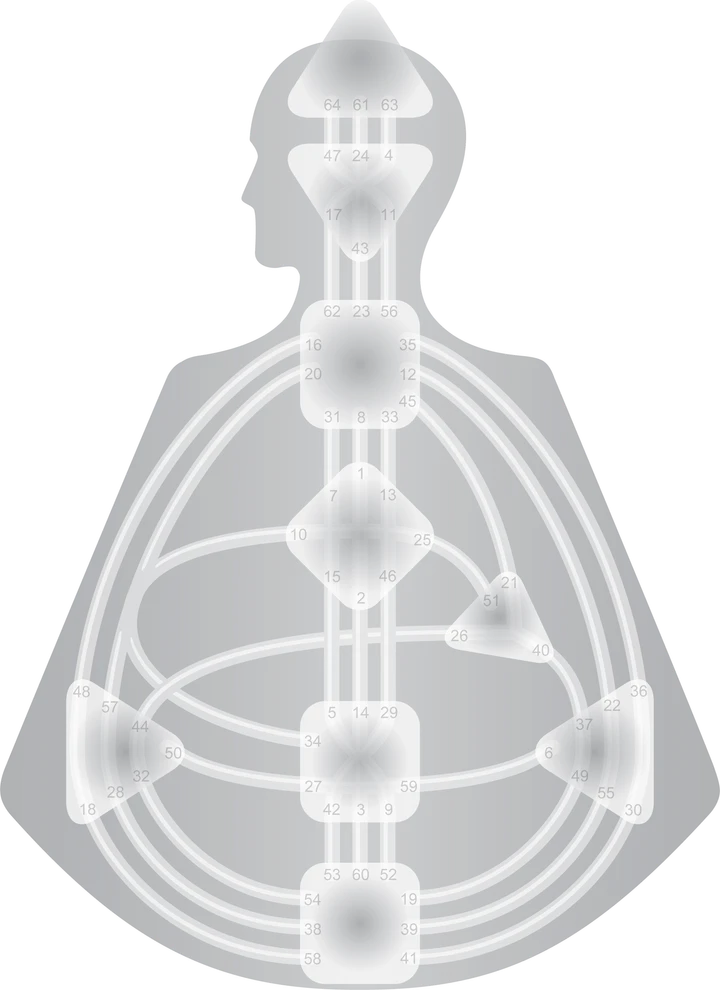


Single Definition


Split Definition
Compare the parts separately
| Part of the chart | What to compare |
|---|---|
| Type and Authority | Whether either value changes, and which channel or center configuration changed with it. |
| Definition | The connected groups of defined centers, as well as individual channels and centers. |
| Profile | Both numbers: the Personality Sun line and the Design Sun line. |
| Incarnation Cross gates | The Sun and Earth gates in both calculations. |
| Individual activations | The Personality and Design gate and line for each position. |
| Color, Tone and Base | Keep finer claims provisional when the time is uncertain. The window tool described below does not compare these layers. |
In the Kepler class, I discuss twins and triplets in relation to Color, Tone and Base beneath the line. Those finer subdivisions are another reason to retain the uncertainty of the record, even when the surface chart appears unchanged.
Use the time window you actually know
- Enter the birth date and place. Check that the selected place and time zone match the record.
- Choose the unknown-time option on the free chart. Enter the earliest and latest plausible local times for that date. Use a whole day only when that is the range you know.
- Compare the reported values. Note what agrees across the samples and what changes. Keep the window and time zone with your notes.
- Study within those limits. Do not pick a candidate time solely because you prefer its Type, Profile or reading.
If your uncertainty includes more than one birth date, compare those dates separately. The current window tool works within a single selected local date; it cannot settle which date a record intended.
What the unknown-time tool can and cannot establish
The tool compares Type, Authority, Profile, Definition, defined centers and channels, and every Personality and Design gate/line activation. It can sample each minute or use a coarser fifteen-minute pass, depending on the device, with additional checks around detected changes.
Agreement at sampled times is evidence about those samples. It does not rule out every change between them. In particular, a brief change that returns to the same value before the next coarse sample can be missed. A displayed change minute is not a verified birth minute.
The tool does not compare Color, Tone or Base. The primary engine returns Color and Tone for a timed chart, but not Base. Do not use the window summary as confirmation of your Variable or other fine substructure.
Check clock changes and time-zone ambiguity
A local clock time needs a time zone to become a UTC instant. On a spring clock-change date, some local times never occurred. The current form rejects those skipped times, and the window tool excludes them from its samples.
When clocks move back, the same local clock time can occur twice, referring to two different UTC instants. The current conversion and window tool do not enumerate both occurrences. Confirm the relevant offset from the record before relying on a result within that repeated hour.
The form's time-zone readout is date-based. It does not by itself establish the offset at an ambiguous recorded birth time. The calculation checks and their limits explain what this site's tests cover.
Rectification remains an estimate
Rectification works backwards from other information and interpretation to propose a birth time. In my recorded teaching, I discuss my own experience of working with proposed times and acknowledge that I still did not have certainty.
Keep the recorded time, any estimated window and a rectified time as separate pieces of information. A proposed time written with seconds is not automatically a record accurate to the second. Personal recognition can be part of your exploration; it does not independently prove a clock time.
If you seek help with an uncertain time, bring the source of the data and the range you know. Ask which parts of the reading depend on a particular candidate time.
Related birth-data studies
These archive studies explore birth-data sources, candidate times and changes within a day. Read each study alongside its cited birth-data source.
Two other questions have their own articles: whether a C-section changes the calculation and whether your chart can change. For the broader introduction, read Human Design vs Astrology.
The teaching behind this guide
This guide draws on my recorded teaching Estimating Your Birth Time and Can't Find Clients' Birth Time? Look at These Changes, including the instruction to investigate the source and compare the changes through a day. The implementation notes describe this site's current chart engine and window tool.
Frequently asked questions
Does birth time matter in Human Design?
Yes. A small time change can move an activation across a boundary. Its effect depends on the rest of that chart. There is no universal safe number of minutes for Type, Authority, Profile or the Incarnation Cross.
Can I explore Human Design without knowing my birth time?
You can compare candidate times or sample a known window. Treat each result according to the information behind it. Some values may agree across the samples, while others change. A chart at an invented time does not establish your actual birth chart.
Can I use noon when my birth time is unknown?
Noon can be an explicitly labeled candidate for comparison. It should not be presented as your recorded birth time. Use the unknown-time option to explore the range you actually know.
Are Sun and Earth gates always safe when the time is uncertain?
No. They can be close to a gate boundary. Profile comes from the Sun lines in two calculations, while the Incarnation Cross uses their Sun and Earth gates. Check those values across the relevant window rather than assuming they hold.
Does a stable Type mean the whole chart is stable?
No. Profile, Definition, individual activations or finer layers can change while Type stays the same. Compare each item separately.
Does rectification prove my birth time?
No. Rectification estimates a time using other information and interpretation. Keep the original record, the proposed time and the method separate. An estimate remains an estimate even when it includes seconds.
What does the unknown-time tool check?
It samples the selected local-time window and compares Type, Authority, Profile, Definition, defined centers and channels, and Personality and Design gate/line activations. It does not compare Color, Tone or Base, prove an exact birth time, or rule out every change between samples.