Hale Appleman's Human Design: The Chart With Nothing to Go On
No Astro-Databank record, no candidate time, not even a disputed one, a first for this series. What holds across all twenty-four hours of January 17, 1986 anyway, and exactly where a Generator's design comes apart between one hour and the next.


Hale Appleman is an actor best known for playing Eliot Waugh across five seasons of The Magicians, born January 17, 1986, in New York City. That much is public record. What isn’t public is a birth time, and I mean that more completely than it usually sounds. Not a disputed one. Not an invented one. Not even a bad one. Astro-Databank has no page for him at all. He isn’t in my own Maia library. myBodyGraph has nothing under his name either. Every public biography stops at the date.
Every other chart in this series has had at least something to argue about. Esther Hicks’s time was invented by a blogger who said so outright. Bob Marley’s comes from a biography, attached to a date he disputed himself. Hillary Clinton’s is rated dirty data, five competing accounts spread across twenty hours. Donald Trump has an actual birth certificate. Astro-Databank’s own rating system has a category for what’s left after all of that: X, no time known. Nothing in this series has been an X case yet. Appleman is the first.
That makes him the cleanest test this series has run of its own question: with the least possible information, what can a reading still honestly claim?
What holds at every hour of the day
I ran his chart across the full twenty-four hours of January 17, 1986, New York City, computed through MaiaMechanics, the licensed Jovian Archive software, checking every candidate time against the last. Four things never move, not once, not by a minute:
- Type: Generator
- Strategy: Wait to respond
- Authority: Emotional, Solar Plexus
- Incarnation Cross: Right Angle Cross of Laws 4, Gate 60 (Limitation) and Gate 56 (Stimulation) conscious, Gate 50 (Values) and Gate 3 (Ordering) unconscious
The cross holds for a mechanical reason: the Sun takes roughly six days to cross a single gate, so a single calendar day is nowhere near enough time to move it out of Gate 60 and Gate 56, no matter which hour he was actually born. Type and authority hold for a different reason, and it’s the more interesting one.
Five channels are active at every hour I tested, and together they account for both:
- 60-3, Mutation (Root to Sacral)
- 18-58, Judgment (Spleen to Root)
- 26-44, Surrender (Heart to Spleen)
- 49-19, Synthesis (Solar Plexus to Root)
- 27-50, Preservation (Spleen to Sacral)
Wired together, those five channels connect his Root, Sacral, Spleen, Heart, and Solar Plexus into one running engine, with the Solar Plexus sitting inside it. That’s why his authority doesn’t move: the emotional wave is load-bearing, held in place by a channel that’s active at every hour I checked. Nothing about not knowing his birth time threatens the two most decision-relevant facts about him.
Where it breaks: two boundaries in twenty-four hours
The rest of the chart isn’t as forgiving.
Definition is Split from midnight until sometime between 3:20 and 3:45 in the morning, then Single for the remaining twenty hours of the day. The reason is a sixth channel, 61-24, the Channel of Awareness, joining the Head and Ajna, that’s only active in that narrow pre-dawn window. For those few hours, Head and Ajna form their own small, separate group, cut off from the five-channel cluster running everything else, and the chart reads as two pieces rather than one. Once that channel goes quiet, sometime before 4 a.m., Head and Ajna go undefined, and the whole chart resolves into a single connected piece for the rest of the day.
Twenty out of twenty-four hours, in other words, give Single Definition. But the honest answer to “what’s his Definition” is still that it depends on a birth window nobody has ever recorded, and a chart run at 3:30 in the morning would be wrong in a way a chart run at any other hour wouldn’t.
There is no single chart to show here, so here are two, one from each side of that boundary. Neither is his chart. Each is one hour out of twenty-four.
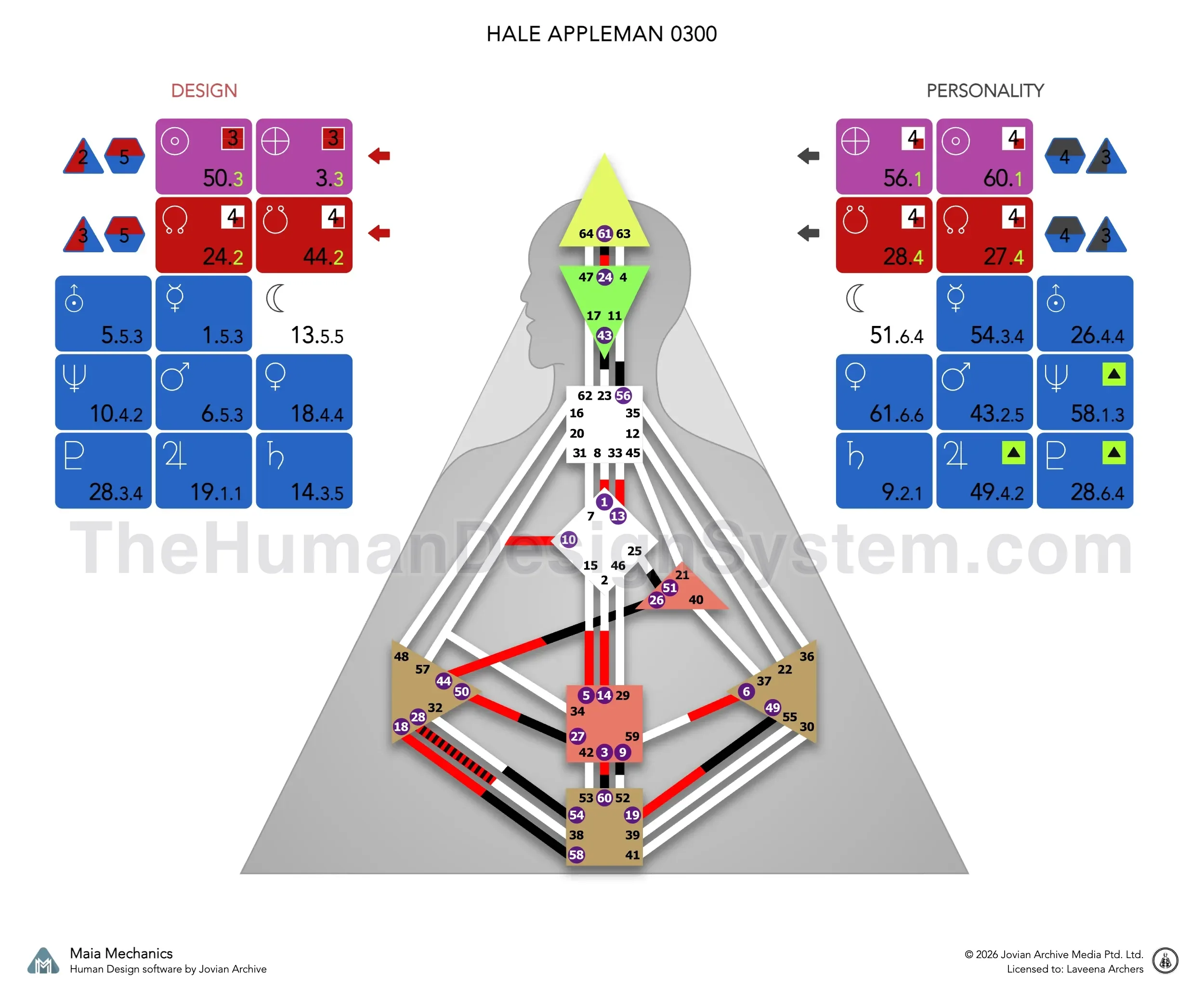 3:00am, inside the pre-dawn window: Split Definition, profile 1/3.
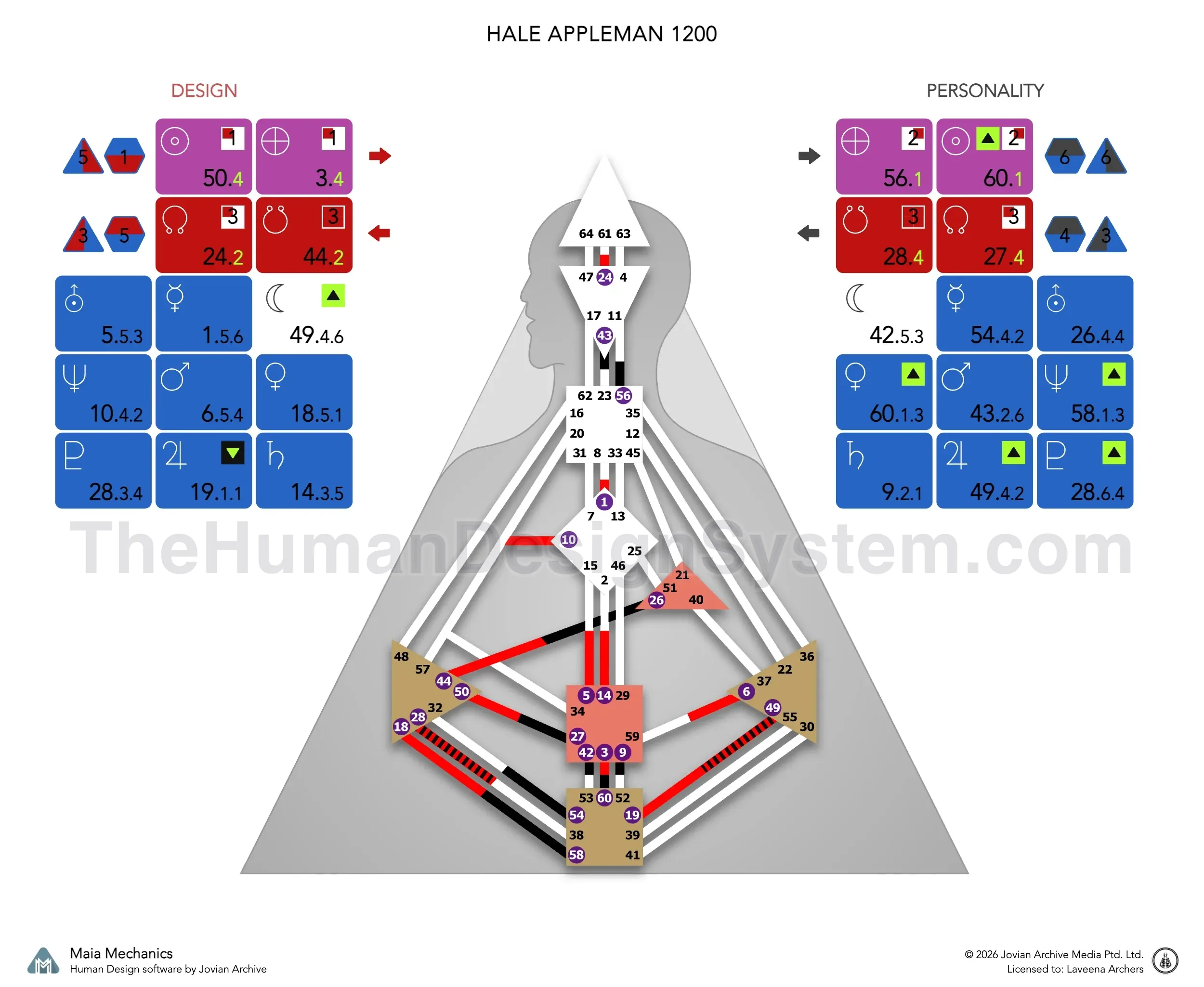 Noon, in the twenty hours that follow: Single Definition, profile 1/4. Type, authority and the Right Angle Cross of Laws 4 are identical in both. Definition and profile are what the missing birth time costs.
Three profiles, and no way to choose between them
This is the sharper problem, because it isn’t confined to a three-hour window before dawn. It runs the whole day.
- Midnight to somewhere between 9 and 10:30 a.m.: 1/3, the Investigator/Martyr
- From there until a six-minute window between 12:20 and 12:26 p.m.: 1/4, the Investigator/Opportunist
- From that window onward, through the rest of the night: 2/4, the Hermit/Opportunist
Three genuinely different profiles, each with its own strategy for how a person is built to learn and to be recognized, and there is no hour, no document, no family account anywhere that says which stretch of the day he actually arrived in. Trump’s certificate settled an equivalent three-way split in his chart down to a single minute. Appleman has no certificate to settle his. Both boundaries sit inside the Personality and Design Sun and Earth lines, which is exactly the layer the Incarnation Cross gates are too coarse to protect: the gates survive because the Sun needs six days to leave one, but the line underneath any one of those gates turns over roughly every twenty-three hours, well inside a single birthday.
The tool that actually finds the boundary
Everything above came from one feature in MaiaMechanics called Birth Time Reliability. The same technique is available to anyone, not just on licensed software.
Enter a birth date, time, and place, and the software scans the hours immediately before and after the entered time, checking whether anything about the chart, a channel, a definition, a profile line, changes nearby. If nothing changes for a wide stretch on either side, the score reads High. If a boundary sits close by, it reads Low, with a note that the chart changes significantly within a short window. In between, it reads Medium.
Run against Appleman’s chart, the score does exactly what the mechanics above predict. At an arbitrary midnight guess, High. Approaching 3:20 a.m., Low. At 4:30 a.m., Medium, climbing back to High by 6 a.m. Then it drops to Low again approaching 9 a.m., recovers only as far as Medium, drops Low a second time around the midday line change, and holds High from four o’clock on, once the chart is safely inside the 2/4 window.
A High score at midnight isn’t evidence that midnight is correct. Nobody entered his real time, and the tool has no way to know what it is. High only means the specific minute you typed happens to sit in a quiet stretch, three or more hours from the nearest thing that changes. It’s a local reading, not a verdict on your data. And because it’s local, two High readings taken hours apart can straddle a real boundary you’d never see unless you actually checked the hours in between, which is exactly what happened here between midnight and 6 a.m.: both ends read High, and a real Definition boundary sat in the middle of that stretch the entire time, invisible to either reading.
If you don’t know your own exact birth time, here’s the version of this you can run yourself without a Maia account. Pull up your free chart, enter your best guess, and note the Type, Authority, Profile, and Definition it returns. Then run it again an hour earlier, and again an hour later. If nothing changes across those three runs, that layer is probably safe to trust even off a soft time. If something does change, you’ve found a boundary sitting inside your own margin of error, and that specific layer, not the whole chart, is what a more precise time would actually be for.
What this leaves you with
A Generator, built to wait and respond rather than initiate. Emotional authority, so no decision made in the moment is one to trust. A five-channel engine running Root, Sacral, Spleen, Heart, and Solar Plexus in one connected piece, with no fixed channel to the Throat, meaning the follow-through has to be built rather than assumed. The Right Angle Cross of Laws 4, a life spent noticing what actually holds a group together and what corrodes it. All of that is safe to say about Hale Appleman with a date and a city and nothing else.
What isn’t safe to say is his Profile, or whether the first few hours of his life carried a second area of definition that resolved before dawn. Those questions don’t have bad answers. They have no answer, because the one piece of information that would settle them was never written down anywhere I can find.
If you want to see how your own chart handles a shift in time, pull your free chart and try the hour-before, hour-after check above. And if what you’re really after is your own Saturn Return, your own Profile read against real dated events, a professional reading is where that gets mapped to a birth time you can actually verify.
The series continues with Ra Uru Hu’s own chart, the founder’s self-reported time against the system he built to insist that birth time matters.
Postscript: testing one guess against the record
Everything above is what the chart alone will support. After this went up, I picked one of the three unresolvable profiles and tried to break it, the same way the rest of this series tries to break every convenient answer before printing it.
The guess was 2/4, on Fear.
Color 1’s own True Profile page predicts something specific and checkable for that pairing: a hidden discipline underneath what reads as natural talent, “preparedness wearing the costume of natural talent,” in the page’s own words. Two magazine profiles of Appleman hand you exactly that tension without either one trying to: one calls him instinctive, the other has him crediting daily, deliberate practice at LaGuardia High School. Under most Colors that’s two sources disagreeing. Under Color 1 it’s the mechanic working correctly, alertness that studied in the dark and got called gifted for it. The same Color’s transpersonal role, Teacher, has a real match too: guest Q&A sessions for acting students, no coach title, no syllabus, the exact shape the role’s own description predicts.
That ruled one thing out along the way. Color 2, Hope, the other live candidate near that boundary, carries the transpersonal role of Guru, an explicitly spiritual frequency. Nothing in Appleman’s public record reads as spiritual or guru-adjacent: no stated faith, no meditation or yoga teaching, no wellness persona. Absence isn’t proof, but it’s a real absence across a real search, and it points away from Hope rather than toward it.
That left Fear’s own window, and it opens exactly where the 2/4 does, mechanically so: the moment his Personality Sun crosses into Line 2 and the profile turns 2/4, the Color count starts over at 1. Fear begins inside that six-minute window between 12:20 and 12:26 p.m. and ends between 4:00 and 4:15, close to the three and three-quarter hours one Color should actually take. I’m holding 4:00 p.m. as the working rectified time for what follows, the same way I held my own nineteen-minute correction in My Own Chart: a hypothesis I’m using out loud, not a document.
At that exact minute, the Tone underneath Fear is 6, Acceptance, on the Right Arrow: Receptive, which for Fear means the Separatist side of its pair rather than the Communalist. A Tone spans about thirty-seven minutes of birth time, and Tone 6 is Color 1’s last, so 4:00 p.m. sits in the final stretch of the Fear window with the Color boundary only minutes away. The tones inside the window even check themselves: at 1:30 the chart reads Tone 2, precisely where thirty-seven-minute steps from a 12:23 start would put it. And Maia’s reliability score still reads High at 4:00, which is its own lesson: the score reads the surface chart, and the Variable turns over beneath it without registering at all.
Strategic and Receptive are themselves a checkable claim, not just a label: Strategic offers the insight before anyone asks for it, Receptive only delivers it once someone does. So I went looking for the one clear case that would break it, in either direction.
I didn’t find a Strategic one. Across the record, Appleman answers what he’s asked and stops there. When The Magicians’ fourth-season finale killed off the lead in a way a vocal part of the queer fanbase read as the “bury your gays” trope again, and the pressure on him to say something was real, every quote on record traces back to a direct question, and even then the answer stayed on the craft rather than the controversy, framed around what the death let him explore in his own character. Asked outright by Out magazine whether he shipped his own character with the one who died, the entire answer was five words: “Oh always. Yeah. No brainer.” Nothing volunteered past it. The one case that comes close to a counterexample, an unprompted-sounding line about his own sexuality in a 2018 Advocate profile, turns out to be introduced as him “adding” a further comment to a conversation the journalist had already opened about his character. Walking through an open door isn’t the same as opening one.
None of this proves the rectified time. It shows what the record produced when I went hunting for the version of Appleman that would have disproven the guess, which is the only way a check like this is worth running. If a real birth time ever surfaces for him, every claim in this postscript becomes verifiable in a minute instead of an afternoon, and I’ll print whatever it says.
Chart computed through MaiaMechanics, the licensed Jovian Archive software, run across all twenty-four hours of January 17, 1986. Astro-Databank has no record for Hale Appleman, he is not in my own Maia library, and myBodyGraph has nothing under his name either; no birth time is in public circulation anywhere I could find. The 4 p.m. rectification in the postscript is a working hypothesis built from that same data-free starting point, not a correction to it.
See this in your own chart
Generate your free bodygraph and start your own experiment.
Get My Free HD Chart